



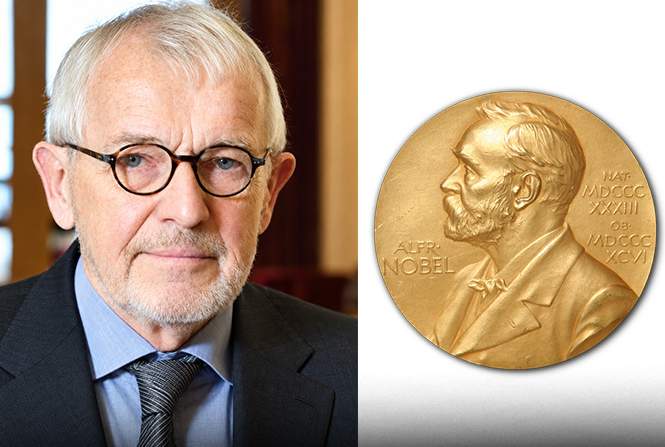
Francis Halzen Wins Nobel

Francis Halzen has won the 2026 Nobel Prize in Physics for his decisive contributions to the IceCube Neutrino Observatory and the discovery of high-energy neutrinos of astrophysical origin. The Royal Swedish Academy of Sciences announced the award on October 6, 2026. Halzen is a Belgian-born particle physicist and professor at the University of Wisconsin-Madison, where he has played a leading role in developing IceCube into a major international scientific facility.
Thank you for reading this post, don't forget to subscribe!Francis Halzen and the IceCube Discovery
Francis Halzen has spent decades working on one of the most difficult problems in modern particle astrophysics: detecting neutrinos arriving from distant parts of the universe.
Neutrinos are extremely light, electrically neutral particles that interact only weakly with matter. Because they rarely interact with other particles, they can travel enormous distances through space without being significantly affected by matter or magnetic fields.
This makes them valuable for studying some of the most powerful objects and events in the universe. The IceCube Neutrino Observatory was designed to detect these rare particles using the enormous volume of clear Antarctic ice at the South Pole.
What Is the IceCube Neutrino Observatory?
IceCube is a giant neutrino detector built deep inside the Antarctic ice. It instruments about one cubic kilometre of ice with thousands of light sensors.
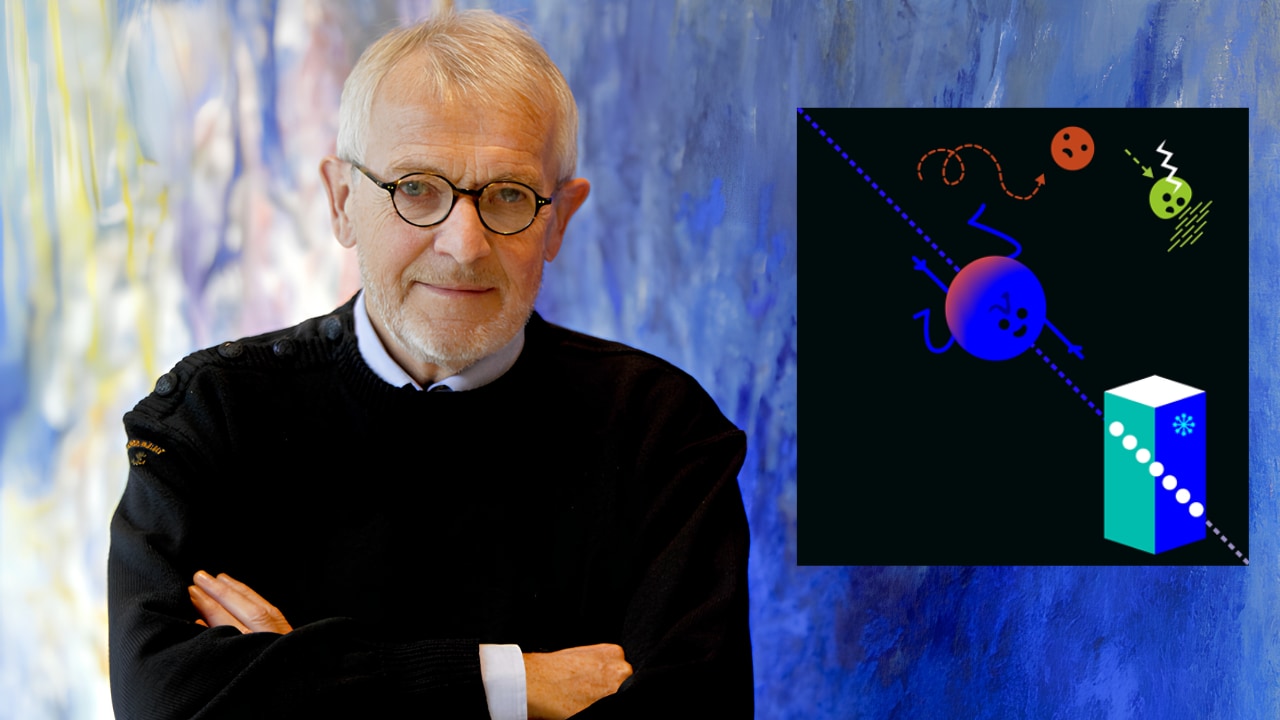
When a high-energy neutrino interacts with matter in or near the detector, it can produce charged particles. These particles create faint flashes of blue light known as Cherenkov light. IceCube’s sensors detect these flashes and use them to reconstruct information about the incoming neutrino.
The observatory is operated by an international collaboration led by scientists at the University of Wisconsin–Madison. The collaboration includes about 450 scientists from 58 institutions in 14 countries.
High-Energy Neutrinos Open a New Window
The work recognised by the Nobel Prize helped establish neutrinos as a new way of studying the universe.
Astronomers have traditionally relied heavily on electromagnetic radiation such as visible light, radio waves, X-rays and gamma rays. Neutrinos provide another type of information because they can travel from powerful cosmic environments with little interference.
The discovery of high-energy astrophysical neutrinos by IceCube in 2013 marked an important step in this field. At that time, scientists detected neutrinos with energies far greater than those normally produced in Earth’s atmosphere. The discovery showed that the universe contains natural particle accelerators capable of producing extremely energetic particles.
Tracing the Sources of Cosmic Particles
One major challenge in cosmic-ray research is identifying where the highest-energy particles come from. Cosmic rays are charged, so magnetic fields can bend their paths as they travel through space.
Neutrinos are different because they have no electric charge. They can travel almost directly from their production sites to Earth.
This makes neutrinos particularly useful for investigating extreme environments around objects such as supermassive black holes and active galaxies.
IceCube has since reported evidence connecting high-energy neutrinos with sources including the active galaxy TXS 0506+056 and the galaxy NGC 1068. In 2023, the observatory also reported evidence of high-energy neutrino emission from the Milky Way.
Halzen’s Role in IceCube
Francis Halzen was a driving force behind the idea of using Antarctic ice as a detector for high-energy neutrinos. His work helped turn an ambitious scientific proposal into a large international observatory.
The South Pole was particularly useful because the deep glacial ice is highly transparent, allowing sensitive optical instruments to detect tiny flashes of light produced by particle interactions.
Halzen also helped build the international collaboration needed to design, construct and operate IceCube. The project brought together physicists, engineers, computing experts and researchers from many countries.
IceCube’s Latest Developments
The Nobel recognition comes as IceCube enters another important stage of its research programme.
The IceCube Upgrade was installed during 2025–2026. The upgrade is designed to improve the detector’s sensitivity and calibration, while lowering its energy threshold and improving the ability to determine the direction from which neutrinos arrive.
According to the IceCube collaboration, the first scientific data from the upgraded detector is expected later in 2026. Researchers are also looking ahead to the proposed IceCube-Gen2 project, which would significantly expand the detector’s capabilities.
Neutrino Astronomy Is Growing
The recognition of Francis Halzen comes at a time when neutrino astronomy is becoming an increasingly important part of modern astrophysics.
Scientists now combine information from different types of observatories. Light, gravitational waves, cosmic rays and neutrinos can provide different clues about the same cosmic event.
This approach is known as multi-messenger astronomy. It allows researchers to study distant and energetic objects from several perspectives instead of relying on a single type of signal.
The continued development of IceCube and future detectors could help scientists identify more cosmic neutrino sources and understand how nature accelerates particles to extreme energies.
A Nobel Prize for a Long Scientific Effort
The 2026 Nobel Prize in Physics recognises a scientific effort that developed over several decades. Francis Halzen’s work helped establish the IceCube observatory and advance the study of high-energy neutrinos from beyond the Solar System.
For the University of Wisconsin–Madison, the award also adds to its long history of Nobel recognition. Halzen becomes the sixth physicist connected with the university to receive a Nobel Prize in Physics.
The award also highlights the importance of large international scientific collaborations. IceCube’s discoveries have depended not only on the detector itself but also on advanced computing, data analysis and cooperation between researchers across many countries.
As the upgraded IceCube detector begins collecting new data, scientists will continue searching the Antarctic ice for more of these elusive particles and for clues about the most energetic processes in the universe.