Quadruple Star System Discovery Sheds Light on Brown Dwarfs and Stellar Formation

Quadruple Star System discoveries are extremely rare, and the recent identification of UPM J1040−3551 AabBab has created a buzz in the astronomical community. Located within our galaxy, this remarkable system consists of two young red dwarf stars accompanied by a pair of cold brown dwarfs. What makes this finding exceptional is the hierarchical arrangement of these objects—a configuration that has never been observed before. The discovery opens new doors to understanding how stars and substellar objects like brown dwarfs form and evolve.
Thank you for reading this post, don't forget to subscribe!What Is the Quadruple Star System?
The newly discovered system contains four celestial bodies arranged in two pairs. One pair consists of young red dwarf stars, which are common and relatively bright. The other pair consists of cold brown dwarfs, faint objects comparable in size to Jupiter but with much greater mass. These brown dwarfs orbit the red dwarf pair in a gravitationally linked structure, forming a unique quadruple star system.
This arrangement is particularly significant because brown dwarfs are rarely found in multiple-star systems, let alone paired together within a four-body configuration. Astronomers suggest that this rare setup could provide key insights into the diversity of stellar and substellar systems within our galaxy.
Characteristics of Brown Dwarfs
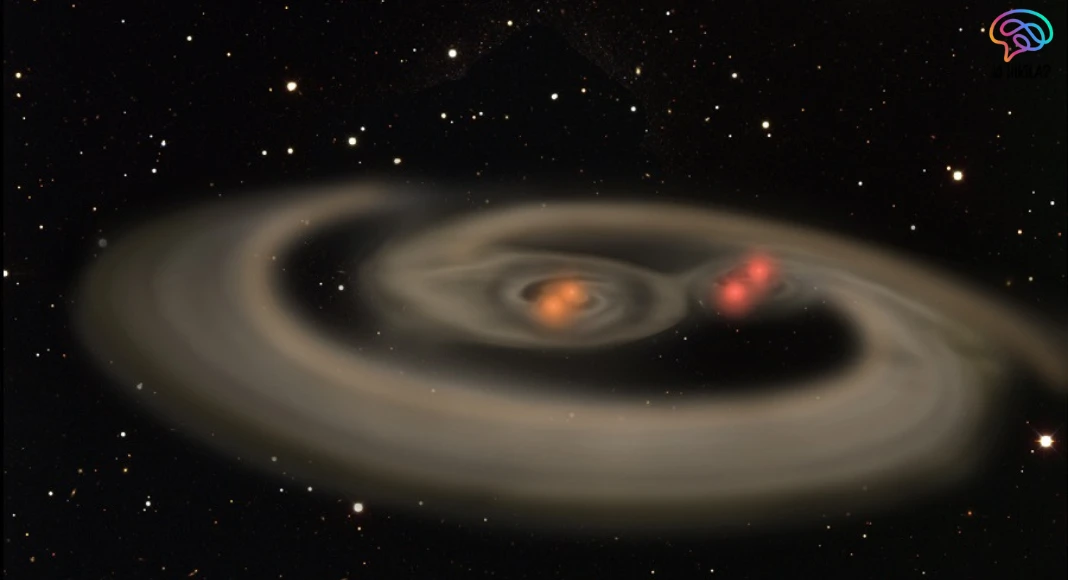
At the heart of this discovery lies the mystery of brown dwarfs. Unlike stars, brown dwarfs lack the necessary mass to sustain hydrogen fusion in their cores. Because of this, they are often referred to as “failed stars.” Despite their inability to ignite like stars, they still share many traits with gas giant planets, including thick atmospheres rich in water molecules and cloud-like structures.
Brown dwarfs typically range up to 70 times the mass of Jupiter. However, their relatively low temperatures and weak visible light emission make them extremely difficult to detect. Astronomers rely on infrared observations and the presence of companion stars to spot them. The fact that two T-type brown dwarfs were found orbiting together in this system makes the discovery highly significant.
Challenges in Detecting Brown Dwarfs
Detecting brown dwarfs has always been a major challenge for astronomers. Since they emit little visible light, they often blend into the cosmic background. Their cold nature further complicates detection.
Scientists frequently discover brown dwarfs by observing their brighter stellar companions. In the case of the quadruple star system, the presence of young red dwarfs allowed researchers to make more accurate inferences about the brown dwarfs’ age, temperature, and chemical composition. Such indirect observations are vital in advancing our knowledge of these elusive cosmic objects.
Scientific Importance of the Discovery
The discovery of UPM J1040−3551 AabBab is more than just a rare astronomical event—it is a breakthrough for stellar science. Since all four objects likely formed from the same molecular gas cloud, they provide a natural laboratory to study the processes of star and brown dwarf formation side by side.
By comparing the properties of the red dwarfs and brown dwarfs, scientists can better understand why some gas clouds collapse into stars while others form into substellar bodies. Moreover, having two brown dwarfs in the same system increases the reliability of the data, offering a more complete picture of their nature and evolution.
Implications for Astronomy
The implications of this quadruple system stretch far beyond its own uniqueness. Studying brown dwarfs can enhance our understanding of both star and planet formation, filling the knowledge gap between these two categories of celestial objects.
Additionally, brown dwarfs play a role in mapping the universe’s mass distribution. Much of the universe is composed of dark matter, which cannot be directly observed. By studying low-mass objects like brown dwarfs, astronomers can better estimate the visible and invisible mass of galaxies. This contributes to solving fundamental cosmic puzzles about the structure and evolution of the universe.
Rare Breakthrough in Stellar Research
Multiple-star systems are not new to science, but the discovery of a quadruple star system with paired brown dwarfs is unprecedented. The uniqueness of this structure makes it one of the rarest known configurations in stellar astronomy.
The findings highlight the complexity of star formation and suggest that nature creates celestial systems in more varied forms than previously imagined. As technology improves and telescopes become more advanced, astronomers expect to discover more unusual systems that will challenge existing theories.
Conclusion
The discovery of UPM J1040−3551 AabBab marks an extraordinary milestone in modern astronomy. By uncovering a quadruple star system featuring two red dwarfs and two brown dwarfs, scientists have not only revealed a cosmic rarity but also opened new pathways for exploring the origins of stars and planets.
This system acts as a cosmic laboratory, allowing astronomers to compare different types of celestial bodies formed from the same environment. Beyond enriching our understanding of brown dwarfs, it also sheds light on the broader questions of cosmic evolution, star formation, and the universe’s hidden mass.
As research continues, this groundbreaking discovery may prove to be one of the most valuable astronomical findings of the decade.