



Rubidium BEC Sets Cold Record

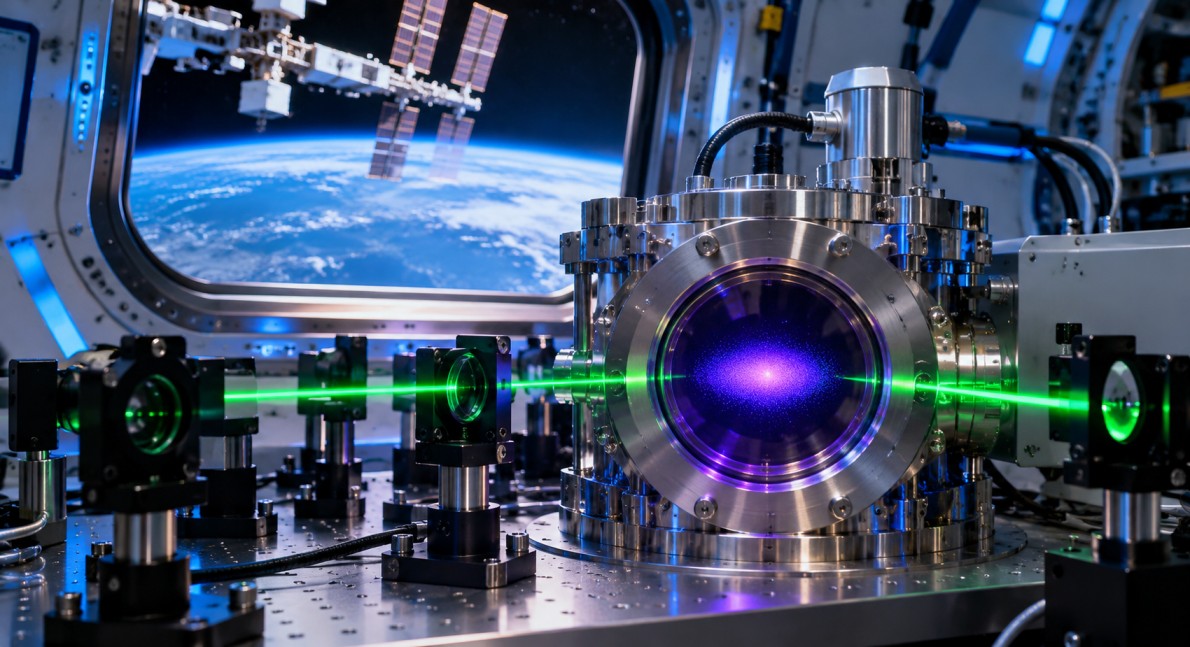
Rubidium BEC research has reached a remarkable milestone after a Chinese research team cooled rubidium atoms to a record-low temperature of 9.7 picokelvins aboard the Tiangong space station. The achievement, reported on November 7, 2026, brought the atoms to just 9.7 trillionths of a kelvin above absolute zero, the lowest possible temperature.
The experiment was carried out by researchers from Peking University and the Chinese Academy of Sciences. It surpassed earlier temperature records reported by research teams in the United States and Germany. The achievement also highlights the growing role of space-based laboratories in studying unusual states of matter and exploring the laws of quantum physics.

What Is a Bose-Einstein Condensate?
A Bose-Einstein condensate, commonly called a BEC, is a special state of matter that forms when certain particles are cooled to temperatures extremely close to absolute zero.
At ordinary temperatures, atoms move around with different amounts of energy. When suitable atoms are cooled enough, many of them can occupy the same lowest-energy quantum state. They begin to behave together as a single quantum system rather than as separate particles.
This makes a BEC useful for studying quantum effects on a much larger scale than is normally possible. Scientists can observe properties such as wave-like behaviour and interference that are usually associated with the microscopic world.

How Chinese Researchers Created the Record-Cold BEC
The research teams used the Cold Atom Physics Rack aboard China’s Tiangong space station. The work was led by physicists Xiaoji Zhou, Xuzong Chen and Weibiao Chen.
They used thousands of rubidium atoms to create the ultracold cloud. The atoms were confined using optical dipole traps, which use laser light to control the movement and position of neutral atoms.
This approach is different from methods that depend on magnetic fields to trap atoms. By using a laser-based trapping system, the researchers were able to prepare the atoms for the formation of a Bose-Einstein condensate.
Around 20,000 atoms formed the final ultracold cloud. According to the report, the cloud remained visible for about seven seconds after it was released.
The measured temperature reached 9.7 picokelvins. One picokelvin is one trillionth of a kelvin. This means the experiment brought the atoms extremely close to absolute zero.
Why Conduct the Experiment in Space?
The Tiangong space station provides a microgravity environment for scientific experiments. On Earth, gravity can affect the shape and movement of ultracold atomic clouds. It can also cause atoms to fall during measurements.
In microgravity, these effects are greatly reduced. Scientists can observe the atoms for longer periods and study their behaviour under conditions that are difficult to achieve in ground-based laboratories.
This makes space an important place for research involving ultracold atoms. Longer observation times can help researchers measure atomic interactions and other delicate quantum properties more precisely.
The experiment also demonstrates how an orbiting laboratory can support complex research that requires highly controlled conditions.
Why Rubidium Atoms Are Used
Rubidium is an alkali metal that is widely used in atomic physics experiments. Its isotope rubidium-87 is especially useful because it is a bosonic atom and can form a Bose-Einstein condensate under suitable conditions.
Scientists can cool rubidium atoms using laser-based techniques. One important feature is its optical transition near a wavelength of 780 nanometres, which supports efficient laser cooling and trapping.
Rubidium atoms are also useful for studying atomic interactions, quantum behaviour and precision measurement. For these reasons, they have become a common choice in experiments involving ultracold gases.
How Optical Dipole Traps Work
Optical dipole traps use focused laser light to hold neutral atoms in controlled regions. The light changes the energy of the atoms through an effect known as the AC Stark shift.
Depending on the laser’s frequency, atoms can be attracted towards areas of higher light intensity or pushed towards areas of lower intensity. This allows researchers to control where the atoms are held without relying entirely on magnetic trapping.
In the Tiangong experiment, the researchers used an optical trapping setup to prepare the rubidium atoms and form the ultracold cloud.
Possible Uses of the New Research
Creating a BEC at an extremely low temperature is not only about setting a record. It can also help scientists develop new tools and improve existing research methods.
One possible application is quantum simulation. Scientists can use ultracold atoms to create controlled models of complex quantum systems. These models may help researchers understand materials and physical processes that are difficult to study directly.
Another area is precision measurement. Extremely cold atoms can be used in sensitive instruments that measure movement, acceleration and other physical quantities.
The research may also support the development of highly accurate space sensors. Such instruments could help improve navigation and measurements in space.
Scientists are also interested in using ultracold atoms to test fundamental physics, including aspects of Einstein’s theory of gravity. Experiments in microgravity can provide a different setting for examining how matter behaves under gravitational conditions.
A New Step in Space-Based Quantum Research
The Chinese team’s record-cold rubidium experiment shows how space-based laboratories can support research into quantum physics. By combining laser-based atom trapping with the microgravity environment aboard Tiangong, the researchers created conditions for studying matter at an exceptionally low temperature.
The work adds to international efforts to understand Bose-Einstein condensates and develop technologies based on the unusual behaviour of ultracold atoms. Future experiments may help researchers improve quantum sensors, precision instruments and tests of fundamental physical theories.
The reported publication date and achievement date in the source account are not fully clear: it refers to a publication around November 5 and an achievement dated November 7, 2026. These dates should be checked against the original research paper for a precise timeline.