


NABL Accreditation in India

NABL Accreditation plays an important role in maintaining quality and reliability in India’s laboratories and testing facilities. It helps confirm that laboratories have the technical skills, proper systems and reliable methods needed to produce accurate results. In September 2026, the importance of this system was highlighted again after the Automotive Research Association of India (ARAI) received NABL accreditation for its Cylinder Testing Facility at the Mobility Research Centre in Takwe, Pune.
Thank you for reading this post, don't forget to subscribe!Accreditation is important across sectors such as healthcare, manufacturing, automobiles, environmental testing, energy and defence. It gives organisations and consumers greater confidence that testing and measurement results are produced according to recognised technical standards.
What is NABL Accreditation?
NABL stands for the National Accreditation Board for Testing and Calibration Laboratories. It is India’s national accreditation body for testing, calibration and several related laboratory services.
NABL functions as a constituent board under the Quality Council of India (QCI) and is administratively linked with the Department for Promotion of Industry and Internal Trade (DPIIT), Ministry of Commerce and Industry.
NABL Accreditation formally recognises the technical competence of laboratories and other conformity assessment facilities. The process examines factors such as testing methods, equipment, staff competence, quality systems and the reliability of results.
This makes accreditation particularly important when laboratory results are used for public safety, industrial decisions, healthcare or regulatory purposes.
Role of the Quality Council of India
The Quality Council of India (QCI) is the national umbrella organisation for accreditation and quality promotion. It was established in 1996-97 as an autonomous, non-profit organisation under the Societies Registration Act, 1860.
QCI operates through a public-private partnership involving the Government of India and major industry associations, including ASSOCHAM, CII and FICCI.
The organisation provides a broader framework for quality and accreditation across different sectors. Specialised boards under QCI deal with areas such as laboratory testing, certification and healthcare.
NABL Accreditation therefore forms part of a larger national quality system designed to improve confidence in testing and conformity assessment.
Standards Used by NABL
NABL uses internationally recognised standards for different types of facilities.
Testing and calibration laboratories are generally assessed against ISO/IEC 17025. Medical laboratories are assessed against ISO 15189, while proficiency testing providers follow ISO/IEC 17043.
NABL also provides accreditation for reference material producers under ISO 17034 and biobanks under ISO 20387.
These standards establish requirements for competence, consistency, quality management and reliable technical operations.
Understanding ISO/IEC 17025
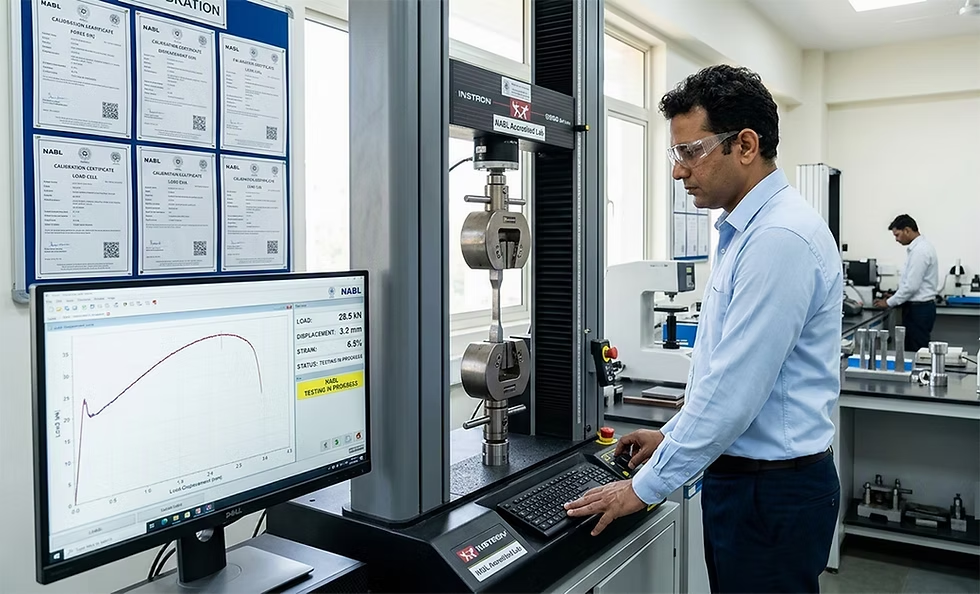
ISO/IEC 17025:2017 is an international standard for the competence of testing and calibration laboratories. It focuses on ensuring that laboratories can produce technically valid and reliable results.
The standard covers areas including laboratory structure, resources, processes and management systems. It also places greater attention on risk-based thinking and the use of information technology compared with earlier versions.
For laboratories, following the standard means having appropriate equipment, trained personnel, suitable testing procedures and systems for maintaining the quality of results.
NABL Accreditation based on this standard therefore provides formal recognition that a laboratory has met defined technical and quality requirements.
ARAI Gets NABL Accreditation
The recent ARAI accreditation provides a practical example of how NABL Accreditation supports specialised testing facilities.
The Automotive Research Association of India (ARAI) received accreditation for its Cylinder Testing Facility at the Mobility Research Centre in Takwe, Pune.
The facility is involved in testing high-pressure gaseous cylinders. Such cylinders can be used in automotive applications and in areas involving hydrogen and other compressed gases.
Testing these cylinders requires accurate methods and specialised equipment because they operate under high pressure. Reliable testing is important for checking their performance, safety and compliance with applicable requirements.
The accreditation strengthens the technical recognition of the facility and supports confidence in the testing work carried out there.
Importance for Hydrogen and Automotive Technology
NABL Accreditation is becoming increasingly relevant as new technologies develop in India.
The growth of hydrogen-powered vehicles and other gaseous-fuel technologies requires specialised testing infrastructure. High-pressure cylinders used to store and transport gases need to meet strict technical requirements.
Accredited testing facilities can support manufacturers and regulators by providing reliable technical results. This becomes particularly important as India develops clean-energy technologies and expands research into alternative fuels.
ARAI’s accredited cylinder testing facility is therefore relevant to the changing needs of India’s automotive and energy sectors.
Global Recognition of Indian Testing Results
Another important feature of NABL Accreditation is its connection with international recognition arrangements.
NABL is a signatory to Mutual Recognition Arrangements with organisations including the Asia Pacific Accreditation Cooperation (APAC) and the International Laboratory Accreditation Cooperation (ILAC).
Such arrangements can help improve international acceptance of results produced by accredited Indian laboratories.
This has significance for exporters because products may need to undergo testing and certification before entering overseas markets. Internationally recognised accreditation can reduce the need for repeated testing in different countries in some circumstances.
Other Accreditation Boards Under QCI
NABL is not the only specialised accreditation board under the QCI framework.
The National Accreditation Board for Certification Bodies (NABCB) deals with certification, inspection and validation and verification bodies. Its work supports confidence in organisations that certify products, systems and processes.
The National Accreditation Board for Hospitals & Healthcare Providers (NABH) focuses on healthcare quality and patient safety. It accredits hospitals, clinics, laboratories and facilities involved in traditional medicine and other healthcare services.
Together, these institutions extend quality assurance beyond laboratory testing to certification, inspection and healthcare.
Why Accreditation Matters to Consumers
Accreditation can have a direct impact on everyday life even when people may not notice it.
Laboratory results can influence healthcare decisions, product safety checks, environmental monitoring and industrial processes. Reliable testing is therefore important for businesses, government agencies and consumers.
For example, medical testing requires dependable laboratory procedures, while industrial products may need to meet specific safety requirements before being placed on the market.
NABL Accreditation provides an independent framework for assessing the technical competence of laboratories and helps build trust in their results.
Supporting Industry and Trade
Accreditation also supports India’s manufacturing and trade ecosystem. Companies often need reliable testing and measurement services when developing products or demonstrating compliance with technical standards.
Accredited laboratories can provide services related to materials, machinery, chemicals, electronics, automobiles, environmental parameters and many other areas.
International recognition of accreditation can also support exporters by making Indian test results more widely accepted.
As India’s manufacturing base expands, the demand for technically competent testing and calibration facilities is expected to remain important.
QCI’s Wider Quality Initiatives
Along with accreditation, QCI works on wider quality improvement programmes. Its activities cover several sectors and aim to encourage better standards and performance.
One such initiative is the QCI Surajya Recognition & Ranking Framework, with its first rankings released in August 2024. The framework focuses on areas including education, health, prosperity and governance.
These initiatives reflect the wider role of quality systems in public services, industry and institutional performance.
Building Reliable Testing Infrastructure
India’s growing focus on advanced manufacturing, electric mobility, hydrogen technology, healthcare and clean energy is increasing the need for specialised testing infrastructure.
NABL Accreditation provides a recognised framework for assessing whether laboratories and testing facilities have the required technical competence and quality systems.
The recent accreditation of ARAI’s cylinder testing facility shows how this framework is being applied to emerging areas such as high-pressure gas systems and hydrogen-related technology.
As new industries develop, accredited laboratories and conformity assessment bodies will remain an important part of India’s quality and industrial infrastructure.