




Bezymianny Volcano Rebuilds After Historic 1956 Eruption

Bezymianny Volcano Rebuilds slowly but steadily in Russia’s remote Kamchatka Peninsula, nearly seven decades after one of the most powerful eruptions of the 20th century reshaped its entire structure. Once left broken and unstable by a catastrophic eruption in 1956, the volcano is now close to reaching its former height. This long and closely watched recovery has turned Bezymianny into a living example of how volcanoes can destroy themselves and then rebuild over time.
Thank you for reading this post, don't forget to subscribe!Scientists across the world see Bezymianny as a rare natural case study. Continuous observation since the mid-20th century has allowed researchers to track each stage of its recovery, helping improve understanding of volcanic behavior and long-term risks.
Bezymianny Volcano Rebuilds After a Violent 1956 Eruption
On March 30, 1956, Bezymianny experienced a dramatic eruption that changed its history forever. The explosion was sudden and extremely powerful. A sideways blast tore away the volcano’s eastern side, causing a massive collapse that reshaped the mountain.
This event created a huge, bowl-shaped crater about 1.3 kilometers wide. Large volumes of ash, rock and hot gases were thrown into the atmosphere, while debris spread across the surrounding landscape. Scientists estimate that around 0.7 cubic kilometers of material were expelled during the eruption. The volcano, once tall and symmetrical, was left broken and flattened at the top.

The eruption closely resembled the later Mount St. Helens eruption in the United States, making it one of the earliest examples scientists could use to compare large volcanic collapses.
Bezymianny Volcano Rebuilds Through Constant Activity
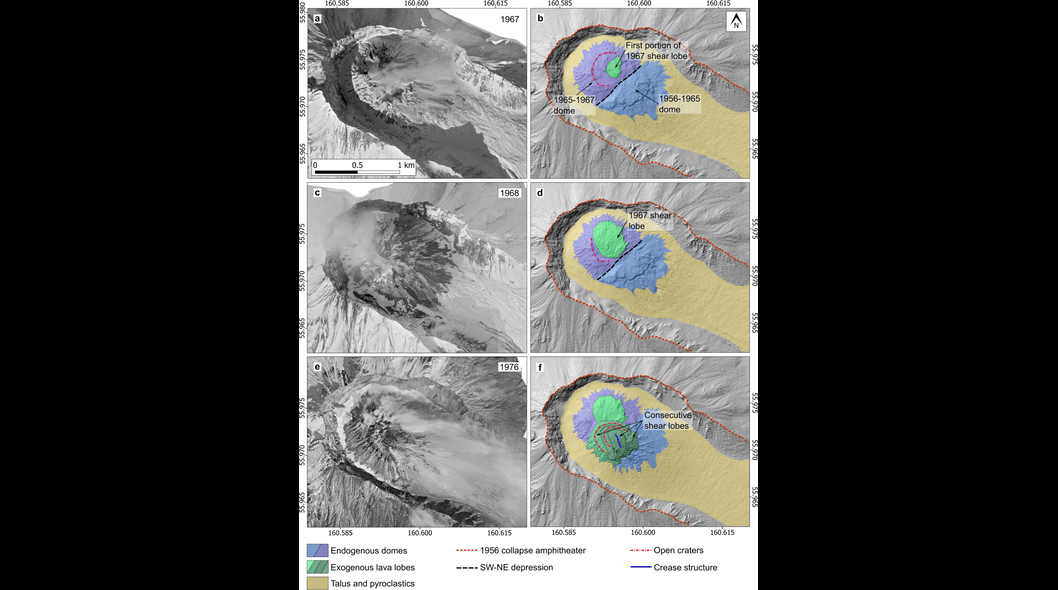
Instead of becoming quiet after the eruption, Bezymianny surprised scientists by becoming active again within months. New lava began rising inside the crater, slowly forming a dome. Over time, this dome grew larger as fresh material continued to flow from below the Earth’s surface.
Small to moderate eruptions became common. Lava flows spread across the crater floor, while hot ash and rock fragments settled around the cone. This steady output added layer after layer of new material, rebuilding the volcano’s shape.
Long-term research shows that between 1956 and 2017, Bezymianny added an average of more than 26,000 cubic meters of volcanic material every day. Over decades, this constant buildup helped the volcano regain much of its lost height and structure.
Bezymianny Volcano Rebuilds Into a Growing Stratovolcano
Bezymianny is classified as a stratovolcano, meaning it is built from layers of lava, ash and rock. These volcanoes often grow tall but can also be unstable. As Bezymianny rebuilt itself, it followed this same pattern forming a steep, layered cone once again.
By 2017, the volcano had reached a height of around 3,020 meters. Before the 1956 eruption, it stood at about 3,113 meters. This means the volcano is now only about 90 meters shorter than it was before the collapse. If current activity continues at a similar pace, scientists believe it could fully regain its original height in the coming years.
Bezymianny Volcano Rebuilds Amid Renewed 2025 Activity
In late 2025, Bezymianny once again showed its power. Several eruptions sent ash clouds high into the sky, reaching up to 10 or 11 kilometers above sea level. Hot flows of ash and gas rushed down parts of the volcano, especially along its southeastern slope.
These eruptions were closely tracked by monitoring agencies using satellites, heat sensors and ground-based instruments. Aviation warnings were issued to ensure aircraft avoided dangerous ash clouds, which can damage engines and reduce visibility.
Thermal data confirmed that lava was still rising beneath the summit, proving that the volcano remains active and energetic.
Bezymianny Volcano Rebuilds Under Constant Watch
One reason Bezymianny is so important to scientists is the level of monitoring it receives. Advanced satellite systems can detect heat changes, ash movement and surface growth. Ground stations record vibrations inside the volcano, offering clues about magma movement below.
This constant flow of data helps scientists better understand how volcanoes behave after major collapses. It also improves early warning systems for future eruptions, both in Kamchatka and in volcanic regions worldwide.
Bezymianny Volcano Rebuilds While Risks Remain
While the volcano’s recovery is remarkable, it also brings new concerns. Rapid growth on a structure that was once weakened increases the chance of future collapses. As new lava piles up, pressure builds inside the cone.
Scientists note that repeated cycles of growth and destruction are common in stratovolcanoes like Bezymianny. Understanding these cycles is essential for predicting hazards such as landslides, explosive eruptions and ash clouds.
The lessons learned from Bezymianny are now used to improve volcanic risk planning, especially in regions with active volcanoes near flight paths or populated areas.
Bezymianny Volcano Rebuilds as a Natural Research Model
Today, Bezymianny stands as one of the best-documented examples of volcanic recovery in the world. From total collapse to near-complete rebuilding, its journey offers valuable insight into Earth’s dynamic forces.
By studying its steady regrowth, scientists gain a clearer picture of how magma systems work over long periods and how landscapes recover after extreme natural events. Bezymianny continues to remind the world that volcanoes are not static mountains but living systems, constantly changing and reshaping the planet.