


Black Hole Spin and X-ray Changes

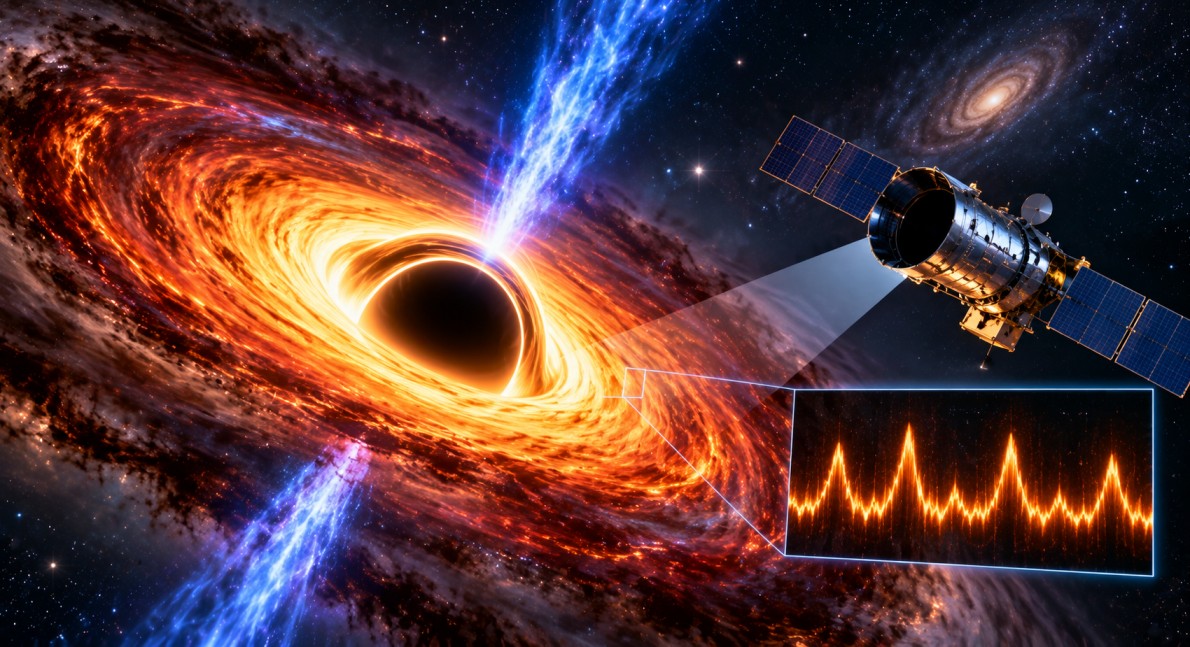
Black Hole Spin is helping scientists understand how black holes affect the hot gas and radiation around them. A study published in the Journal of High Energy Astrophysics on 23 October 2026 examined how a black hole’s rotation can influence changes in X-ray emissions. Researchers from the Aryabhata Research Institute of Observational Sciences (ARIES), the Nicolaus Copernicus Astronomical Center in Poland and MJP Rohilkhand University used computer simulations to investigate the movement of matter near black holes.
The findings offer further insight into how black hole rotation affects the flow of gas and the signals scientists observe from these distant objects.

What Is Black Hole Spin?
Black hole spin describes how quickly a black hole rotates. It is an important property because rotation can affect the space around a black hole and influence the movement of nearby matter.
According to Albert Einstein’s general theory of relativity, a rotating object can drag the surrounding spacetime along with it. This effect is called frame-dragging, or the Lense-Thirring effect. Near a rotating black hole, it can influence the movement and orientation of nearby material.
Studying black hole spin helps scientists understand the behaviour of matter in extremely strong gravitational fields. However, measuring spin is difficult because researchers must interpret signals produced by the hot gas and other material around the black hole rather than observing the black hole’s interior directly.
How Accretion Disks Produce X-rays
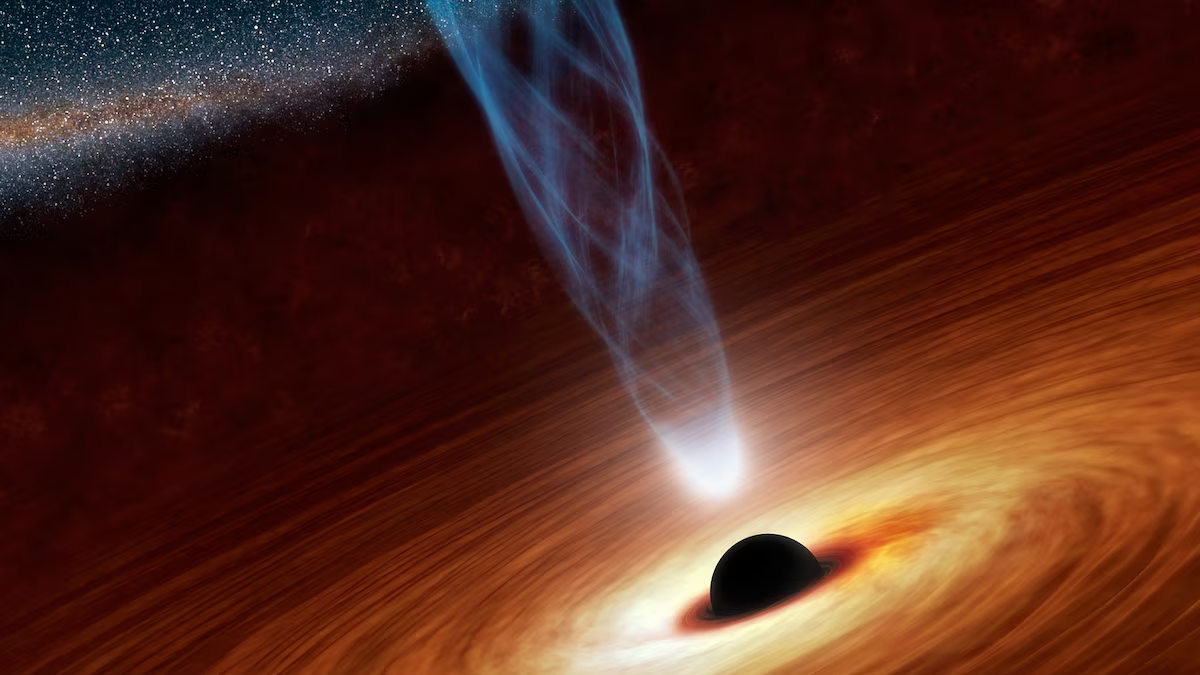
An accretion disk is a rotating structure of gas and other matter that moves towards a compact object, such as a black hole. As the material moves inward, friction and other physical processes heat it to very high temperatures.
The hot material can release electromagnetic radiation, including X-rays. Space-based observatories can detect these X-rays and measure how their brightness changes over time.
Scientists use these changes to study the conditions near black holes. The timing and pattern of the radiation can provide clues about the movement of matter, the structure of the accretion flow and the influence of gravity.
The recent study examined accretion shocks, which are regions where the flowing material experiences sudden changes in speed and physical conditions. These shocks can affect the signals produced by the accretion flow.
How Black Hole Spin Affects X-ray Variability
The researchers used computer simulations of viscous accretion flows to explore the relationship between black hole rotation and X-ray variability.
According to the reported findings, a rapidly rotating black hole pulls the accretion shock closer to itself. This change in the shock’s position can affect the frequency of quasi-periodic oscillations, commonly known as QPOs.
QPOs are repeating patterns in the brightness of astronomical objects. They are observed in some systems containing black holes and other compact objects. Their frequencies can help researchers investigate the physical processes taking place close to these objects.
For black holes with masses around ten times that of the Sun, the simulations produced QPO frequencies above 100 hertz. This means the simulated signals could show repeating variations more than 100 times per second.
These results come from computer simulations. Further observations and comparisons with real astronomical data are important for testing how well the models describe actual black hole systems.
The Role of General Relativity
Black holes provide scientists with a way to study gravity under extreme conditions. General relativity predicts that a rotating black hole can influence the spacetime around it, affecting the movement of matter close to its event horizon.
One possible result is the precession of an accretion disk. Precession means that the orientation of a rotating structure gradually changes, much like the changing direction of a spinning top.
The Lense-Thirring effect can cause the inner parts of an accretion disk to wobble or change orientation. Observing this movement may help researchers estimate the spin of a black hole.
In 2025, observations of the tidal disruption event AT2020afhd provided evidence consistent with Lense-Thirring precession around a rapidly rotating black hole. A tidal disruption event occurs when a star passes close enough to a black hole for strong tidal forces to tear it apart. The disrupted material can produce a bright flare that scientists observe using telescopes.
What Telescopes Reveal About Black Hole Spin
Astronomers use several methods to investigate black hole rotation. X-ray observatories measure radiation from hot accretion flows, while radio telescopes can study jets and structures close to black holes.
The Event Horizon Telescope (EHT) has produced images of the black hole at the centre of the Messier 87 galaxy, known as M87*, and Sagittarius A*, the supermassive black hole at the centre of the Milky Way. These observations allow scientists to study the bright emission surrounding the dark central region and investigate the effects of strong gravity.
Researchers also examine jets, which are powerful streams of particles launched from the regions around some black holes. Observations of M87* have identified an approximately 11-year cycle in its jets, associated with a possible misalignment between the black hole’s spin axis and its accretion disk.
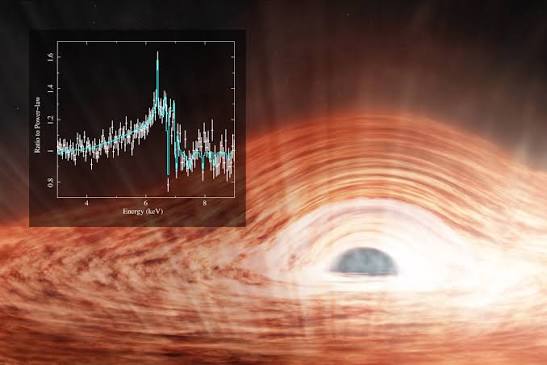
However, not every measurement provides a direct answer. Estimates of black hole spin can depend on the models used to interpret the available data. A 2026 analysis of Cygnus X-1, a binary system containing a black hole, reported a wide range of spin estimates under different models. This highlights the need to compare different methods before drawing firm conclusions.
Why This Research Matters
Understanding Black Hole Spin can help scientists explain how black holes interact with nearby matter and produce powerful emissions. It also provides ways to test predictions of general relativity in environments where gravity is extremely strong.
X-ray variability, accretion-disk movement and jet behaviour offer different sources of information. By combining these signals with computer simulations and observations from space- and ground-based observatories, researchers can improve their understanding of black hole systems.
As astronomical instruments and simulation methods improve, scientists will be able to test existing models more closely and investigate how black hole rotation influences the evolution of matter in the universe.