



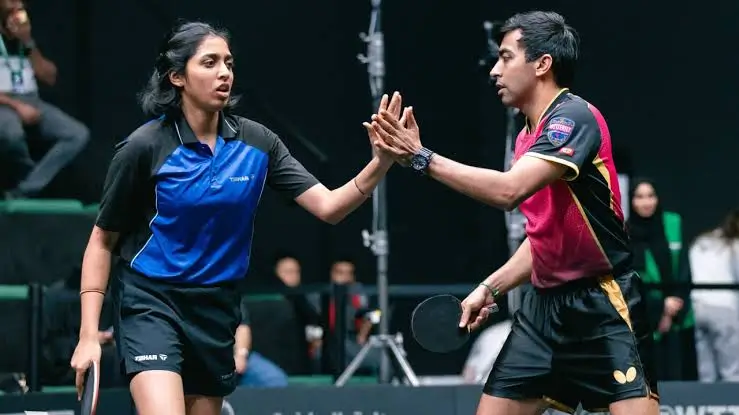
Asian Table Tennis Medal: Ghorpade and Desai Shine

Asian Table Tennis Medal became a proud achievement for India on 23 October 2026, when Indian players Yashaswini Ghorpade and Harmeet Desai secured a medal in mixed doubles at the 29th ITTF-ATTU Asian Table Tennis Championships. The tournament is being held in Tashkent, Uzbekistan. Their achievement marks an important moment for Indian table tennis and highlights the country’s growing presence in international competitions.
The Indian pair competed in the mixed doubles event, in which one male and one female player from the same national association form a team. By securing a medal at the continental championship, Ghorpade and Desai added another notable achievement to India’s table tennis record.

Asian Table Tennis Championships 2026
The Asian Table Tennis Championships is a major continental competition that brings together players and national teams from across Asia. It provides an opportunity for athletes to compete against some of the strongest players in the region.
The 2026 edition is the 29th Asian Table Tennis Championships and is taking place in Tashkent, the capital of Uzbekistan. The event is organised by the Asian Table Tennis Union (ATTU), the continental governing body for table tennis in Asia. The ATTU is affiliated with the International Table Tennis Federation (ITTF), which governs the sport worldwide.
International table tennis championships can include singles, doubles, mixed doubles and team events. Each format tests different skills, including individual control, teamwork, quick reactions and the ability to make decisions under pressure.
The medal secured by Yashaswini Ghorpade and Harmeet Desai came in the mixed doubles category. Their performance brought attention to India’s participation in one of Asia’s important table tennis competitions.
Who Are Yashaswini Ghorpade and Harmeet Desai?
Yashaswini Ghorpade is an Indian table tennis player who has represented India in international competitions. Her participation in the Asian Championships reflects the opportunities available to Indian players to compete at the highest levels of the sport.
Harmeet Desai is also an Indian international table tennis player. He has represented the country in major competitions and is part of India’s table tennis contingent at international events.
In mixed doubles, success depends on how well partners coordinate their movements and playing styles. Both players must react quickly to the opponent’s shots and support each other throughout a match. Serving, returning the ball, positioning and communication can all influence the result.
By securing a medal at the 2026 Asian Championships, Ghorpade and Desai achieved an important result for Indian table tennis. Their performance also underlines the value of developing players who can compete across different formats of the sport.
What Is Mixed Doubles in Table Tennis?
Mixed doubles is a table tennis event in which each team consists of one male player and one female player. Both partners represent the same national association and work together against another pair.
Unlike singles, where one player competes against another, doubles requires close coordination between teammates. Players take turns hitting the ball during a rally. They must move into position quickly after each shot to allow their partner to play the next ball.
Serving rules are also important in doubles. The serve must travel diagonally from the server’s right half of the table to the receiver’s right half. Players must follow the required serving and receiving order under the rules of the sport.
Mixed doubles combines individual skills with teamwork. A strong pair needs accurate serves, controlled returns, quick footwork and the ability to understand each other’s strengths. The format can also require players to adjust their tactics according to the opponents’ playing styles.
Basic Rules of Table Tennis
Table tennis is played on a table divided into two halves by a net. Players use small rackets to hit a lightweight ball across the net, aiming to make it difficult for their opponents to return the shot legally.
A standard game is generally played to 11 points. A player or pair must win by at least two points. If the score reaches 10–10, play continues until one side establishes a two-point lead.
International matches are usually played as the best of an odd number of games, commonly best of five or best of seven. The winner is the player or pair that wins the required number of games.
The International Table Tennis Federation establishes the rules used in recognised international competitions. These rules cover serving, scoring, equipment and other aspects of the game.
Players need fast reactions, good hand-eye coordination and careful control of the ball. They also need to understand their opponents’ tactics and choose the right shot at the right moment.

Standard Table Tennis Table and Equipment
Table tennis uses equipment made according to recognised international standards. The table’s dimensions, net height and ball size help maintain consistency across competitions.
The standard measurements are:
- Table length: 2.74 metres
- Table width: 1.525 metres
- Table height: 76 centimetres
- Net height: 15.25 centimetres
- Ball diameter: 40 millimetres
- Ball weight: 2.7 grams
The ball is lightweight, allowing it to move quickly during rallies. Players use rackets to create different types of shots, including topspin, backspin and sidespin. These techniques can change the ball’s speed, direction and bounce, making it more difficult for opponents to respond.
Although the equipment is relatively simple, the sport requires considerable practice and technical skill. Professional players spend time improving their serves, footwork, timing and control.
Role of the International Table Tennis Federation and Asian Table Tennis Union
The International Table Tennis Federation is the international governing body for table tennis. It establishes the rules and equipment standards used in international competitions and oversees the sport at the global level.
The Asian Table Tennis Union is responsible for continental-level table tennis activities in Asia. It organises regional championships and provides a platform for players and national associations from across the continent to compete.
The ITTF and ATTU have different but connected roles. The ITTF governs the sport internationally, while the ATTU focuses on table tennis within Asia.
The 29th ITTF-ATTU Asian Table Tennis Championships in Tashkent brought together players from across the region. India’s medal in mixed doubles through Yashaswini Ghorpade and Harmeet Desai was a notable achievement at the 2026 event.
Importance of India’s Mixed Doubles Medal
The medal secured by Ghorpade and Desai is an important result for Indian table tennis. Continental championships allow players to test their skills against strong regional opponents and gain experience in high-level competition.
Mixed doubles also gives national teams the chance to build partnerships between players with different playing styles. Good coordination and communication are essential because partners must alternate shots and maintain effective positions during rallies.
India’s participation in international table tennis events helps increase the visibility of the sport and creates opportunities for players to gain experience. Results at continental competitions can also encourage young athletes to take up table tennis and work towards competing at national and international levels.
The achievement in Tashkent placed Yashaswini Ghorpade and Harmeet Desai among the Indian players making their mark at the 2026 Asian Table Tennis Championships.