


Chandrayaan-4 South Pole: ISRO Identifies Safe Landing Site for Lunar Sample Return

India is preparing for an ambitious leap in space exploration with its upcoming lunar mission, Chandrayaan-4 South Pole. Scientists at ISRO’s Space Applications Centre have recently identified a promising landing site near Mons Mouton, located in the Moon’s south polar region. This site is expected to host India’s first lunar sample return mission, which aims to bring back precious lunar material for scientific study. The selection of the landing site follows a detailed terrain assessment using high-resolution imagery from the Chandrayaan-2 Orbiter, ensuring both safety and mission success.
Detailed Terrain Mapping Using Chandrayaan-2 Data
The search for a safe landing zone relied heavily on the data collected by the Orbiter High Resolution Camera (OHRC) aboard Chandrayaan-2. Using stereo images with 32-centimetre resolution, scientists were able to create highly precise digital elevation models at a 0.32-metre grid scale. These models provided a clear understanding of the Moon’s rugged south polar landscape, helping researchers examine surface slopes, crater density, boulder distribution, and sunlight conditions.

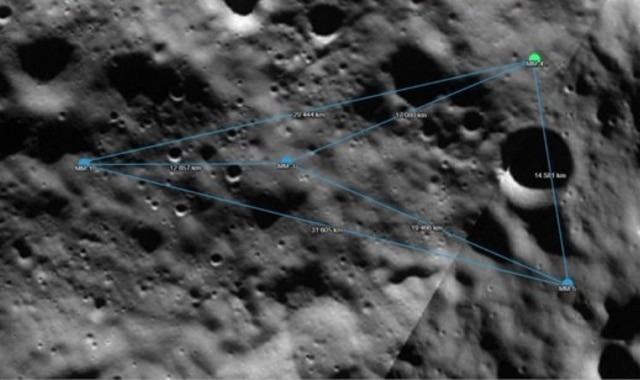
Earlier surveys had identified broad candidate zones between 84° and 90° south latitude. After careful analysis, researchers narrowed down the options to five specific regions around Mons Mouton. One of these regions was eliminated because it remained in permanent shadow, which would make power generation and communication impossible. This high level of precision ensures that Chandrayaan-4 will land in a region that meets stringent mission requirements.
Engineering Constraints for a Safe Landing
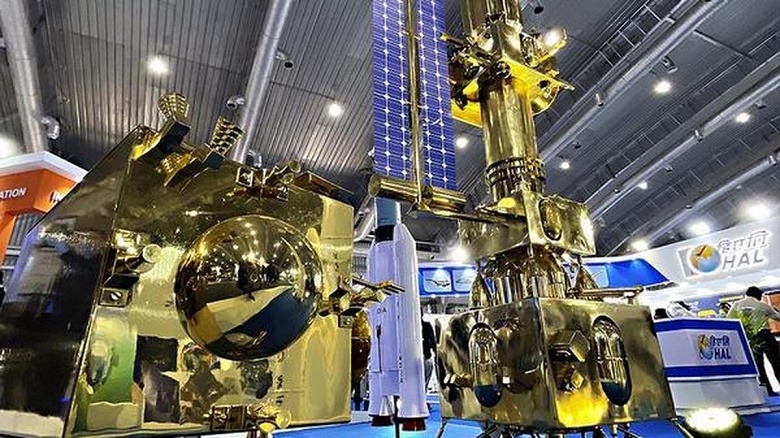
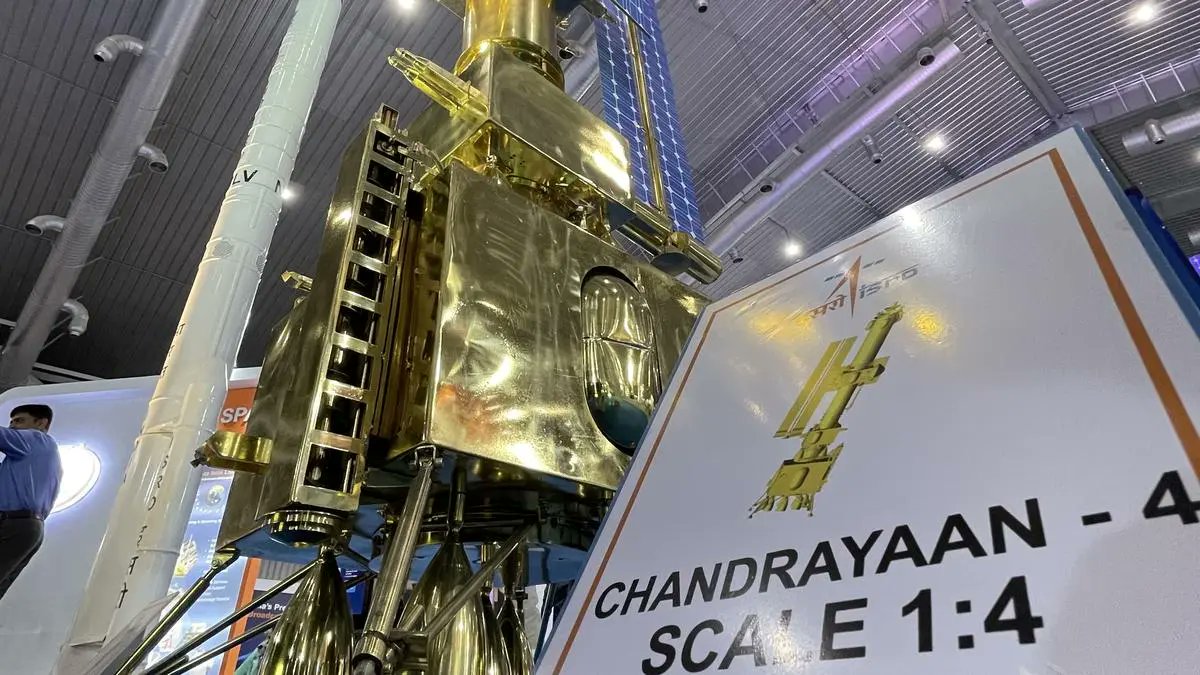
Chandrayaan-4 South Pole is set to be ISRO’s most complex lunar mission to date. The spacecraft will consist of multiple modules, including a propulsion module, descender module, ascender module, transfer module, and re-entry module. The descender and ascender stack will perform a soft landing on the Moon, collect samples, and launch them back to lunar orbit for return to Earth.
The engineering requirements for the landing site are strict. Slopes must be less than 10°, and boulders must be smaller than 0.32 metres to ensure safe touchdown. Additionally, there must be adequate sunlight for 11–12 days to power solar panels, and uninterrupted radio visibility to Earth is essential for communication. Selecting a safe site in the south polar region is challenging due to the uneven terrain, but these constraints are critical to the success of the mission.
MM-4 Emerges as the Front-Runner
After careful evaluation, four shortlisted sites MM-1, MM-3, MM-4, and MM-5 were analyzed in detail. Scientists examined factors such as average slope, elevation variation, and the number of safe 24×24 metre landing grids. Elevations of these sites ranged from 4,800 to over 6,100 metres.
Among the candidates, MM-4 stood out as the safest site for landing. Located at latitude 84.289° and longitude 32.808°, MM-4 showed the lowest hazard level at 9.89% and an average slope of just 5°. It also offered 568 safe grids, the highest number among all options. Other candidate sites either had higher hazard levels or significantly fewer safe landing areas, making MM-4 the preferred choice for the mission.
Significance of High-Resolution Imaging
The success of site selection for Chandrayaan-4 South Pole highlights the importance of high-resolution imaging and precise terrain modeling. By using stereo images and digital elevation models, scientists were able to map the lunar surface with unprecedented accuracy. This precision ensures that the landing site minimizes risks to the spacecraft and maximizes the chances of mission success. The data from Chandrayaan-2 has been crucial in identifying regions that meet the engineering constraints required for safe landings.
Strategic Importance for ISRO
The approval of MM-4 as the landing site would mark India’s first lunar sample return attempt. If successful, this mission will place ISRO among the elite group of space agencies capable of returning extraterrestrial material. The mission will not only enhance India’s planetary exploration capabilities but also demonstrate the value of detailed lunar mapping for precision landings.
Returning samples from the Moon’s south polar region has significant scientific importance. It could provide insights into the composition of lunar soil, the presence of water ice, and the history of the Moon’s surface. The mission will help scientists better understand the Moon’s geology and prepare India for future deep space exploration missions.
Key Facts About Chandrayaan-4 South Pole
- Chandrayaan-4 aims to return lunar samples to Earth from the Moon’s south polar region.
- The Orbiter High Resolution Camera (OHRC) provides 32-centimetre spatial resolution.
- Mons Mouton lies near the Moon’s south pole between 84° and 90° south latitude.
- Safe landing depends on slope limits, boulder size, and sufficient solar illumination.
- MM-4 site has the lowest hazard levels and the highest number of safe landing grids among shortlisted options.
The identification of the MM-4 site demonstrates ISRO’s growing expertise in precision lunar missions. By carefully combining engineering analysis with high-resolution imaging, the agency is set to achieve a major milestone in India’s space exploration journey. The Chandrayaan-4 South Pole mission promises to bring valuable scientific knowledge and cement India’s position as a leading player in space research.