



Chang’e-7 Mission Postponed by China

Chang’e-7 Mission has been postponed by China after a detailed assessment found that the spacecraft was not ready to meet the required launch criteria during the planned launch window. The decision was announced on August 23, 2026, bringing a temporary delay to one of China’s major upcoming lunar exploration projects.
Thank you for reading this post, don't forget to subscribe!The Chang’e-7 mission is an important part of China’s long-term plan to explore the Moon, especially the challenging and scientifically important lunar south pole. The mission is expected to study the Moon’s surface, search for water ice, and collect valuable scientific information from areas that remain difficult for spacecraft to reach.
China has not cancelled the project. Instead, the postponement allows scientists and engineers to carry out further checks and prepare the mission for a future launch opportunity. Space missions often require strict technical and safety reviews because even a small problem can affect a spacecraft worth years of research and development.
China’s Chang’e Programme and Lunar Exploration
The Chang’e-7 mission is part of China’s larger Chang’e lunar exploration programme. The programme is named after Chang’e, the moon goddess from Chinese mythology. Over the years, China has carried out several successful lunar missions involving orbiters, landers, rovers, and sample-return spacecraft.
China’s lunar programme has become an important part of the growing global interest in Moon exploration. Countries around the world are currently studying the Moon for scientific research, future human missions, and possible resources. The lunar south pole has received special attention because scientists believe some permanently shadowed areas may contain water ice.
Water ice could be valuable for future lunar exploration. It may help scientists understand the history of the Moon and could potentially support future space missions by providing resources such as water and, after processing, oxygen and hydrogen.
Multi-Component Design of the Chang’e-7 Mission
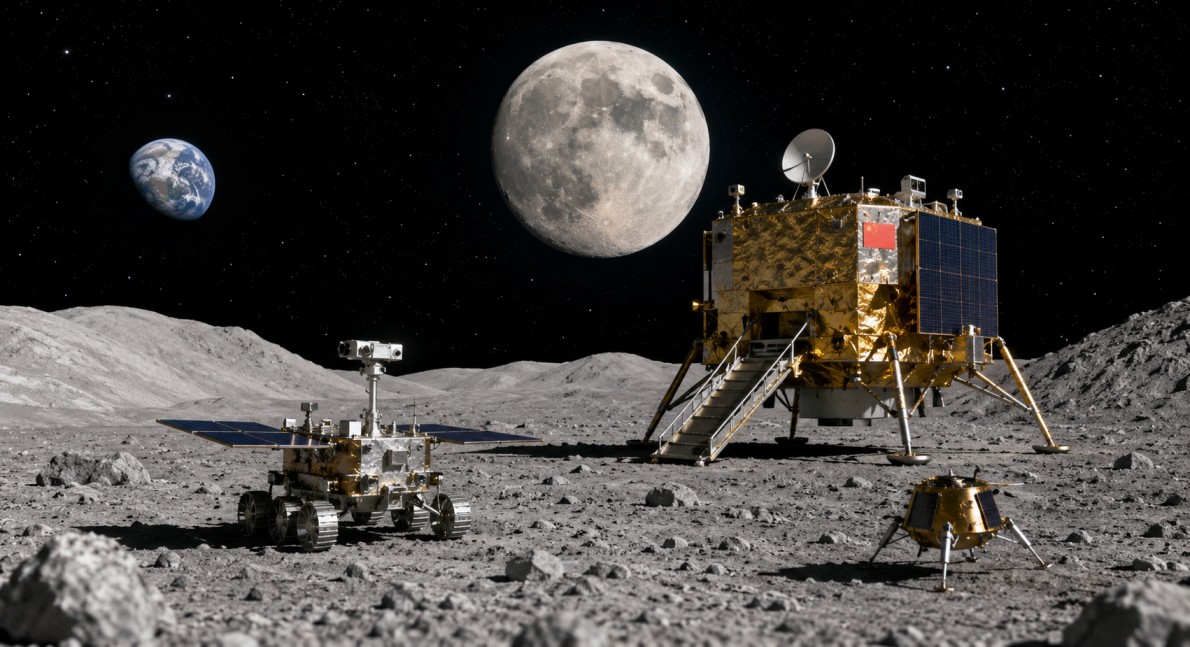
The Chang’e-7 mission has been designed as a complex robotic exploration project. It includes an orbiter, a lander, a rover, and a hopping robot. Each part of the mission has a different role in studying the lunar environment.
The orbiter will study the Moon from space, while the lander is expected to operate near the lunar south pole. The rover will explore the surface and collect scientific information from nearby areas. One of the most interesting parts of the mission is the hopping robot, which is designed to move into difficult and uneven regions that may be hard for a traditional rover to reach.
The spacecraft will carry scientific instruments to study lunar soil, surface conditions, radiation, and volatile materials. These studies are expected to improve scientific understanding of the Moon’s polar environment.
International Scientific Cooperation
The Chang’e-7 mission also includes international scientific participation. Thailand’s National Astronomical Research Institute has contributed a cosmic radiation detection payload called CE-7 MATCH. According to the available information, the scientific payload remains installed on the Chinese orbiter and is not affected by the postponement.
International cooperation has become increasingly important in modern space research. Space agencies and scientific institutions often share technology, research instruments, and scientific data to improve the results of major missions.
Wenchang Spacecraft Launch Site and Long March 5
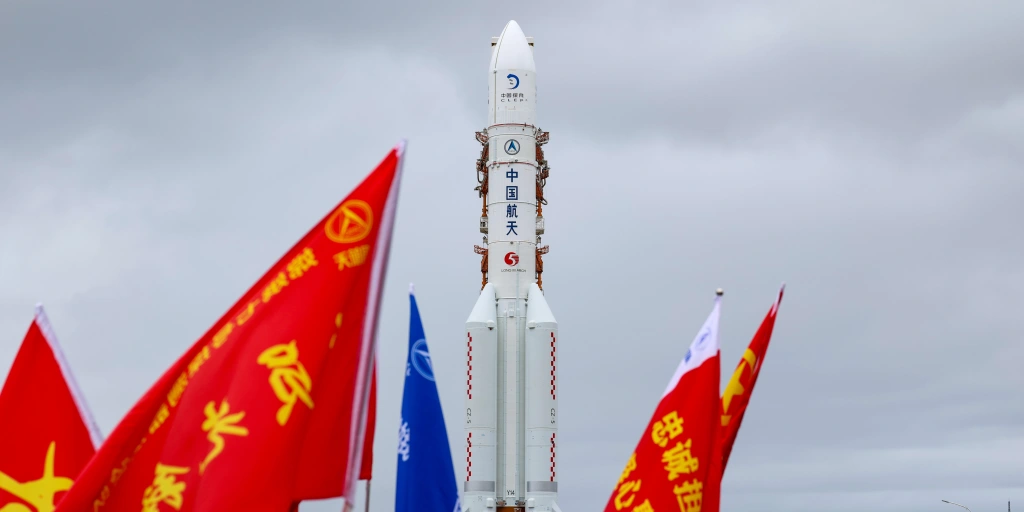
Before the postponement, the Chang’e-7 spacecraft and the Long March 5 Y14 rocket had been moved vertically to the launchpad at the Wenchang Spacecraft Launch Site in Hainan Province on August 19, 2026.
Wenchang is one of China’s major space launch centres and is especially important for large rockets. Its coastal location supports the launch of heavy spacecraft and major deep-space missions.
The Long March 5 rocket is part of China’s powerful heavy-lift launch vehicle family. It has been used for important missions involving space exploration, satellites, and lunar projects. The rocket was expected to carry Chang’e-7 toward the Moon during the planned mission.
Why the Lunar South Pole Is a Difficult Target
The lunar south pole is one of the most challenging regions on the Moon to explore. It contains deep craters and permanently shadowed areas where sunlight may not reach for extremely long periods. These conditions make spacecraft operations difficult and require careful planning.
Mission planners must consider the position of the Sun, lighting conditions, spacecraft power, communication systems, and the exact location of the landing area. Because of these challenges, suitable launch opportunities for polar lunar missions can be limited.
The postponement also comes during a busy period for China’s space programme. Recent launch activities and technical developments have kept attention focused on the country’s growing space capabilities. Weather conditions and technical readiness can both play an important role in determining the final launch schedule.
The Chang’e-7 mission remains a major project in China’s lunar exploration plans. Once launched, it is expected to provide new information about the Moon’s south pole and support future scientific research into one of the most important regions for global lunar exploration.