




GJ 523b: A New Mega-Earth

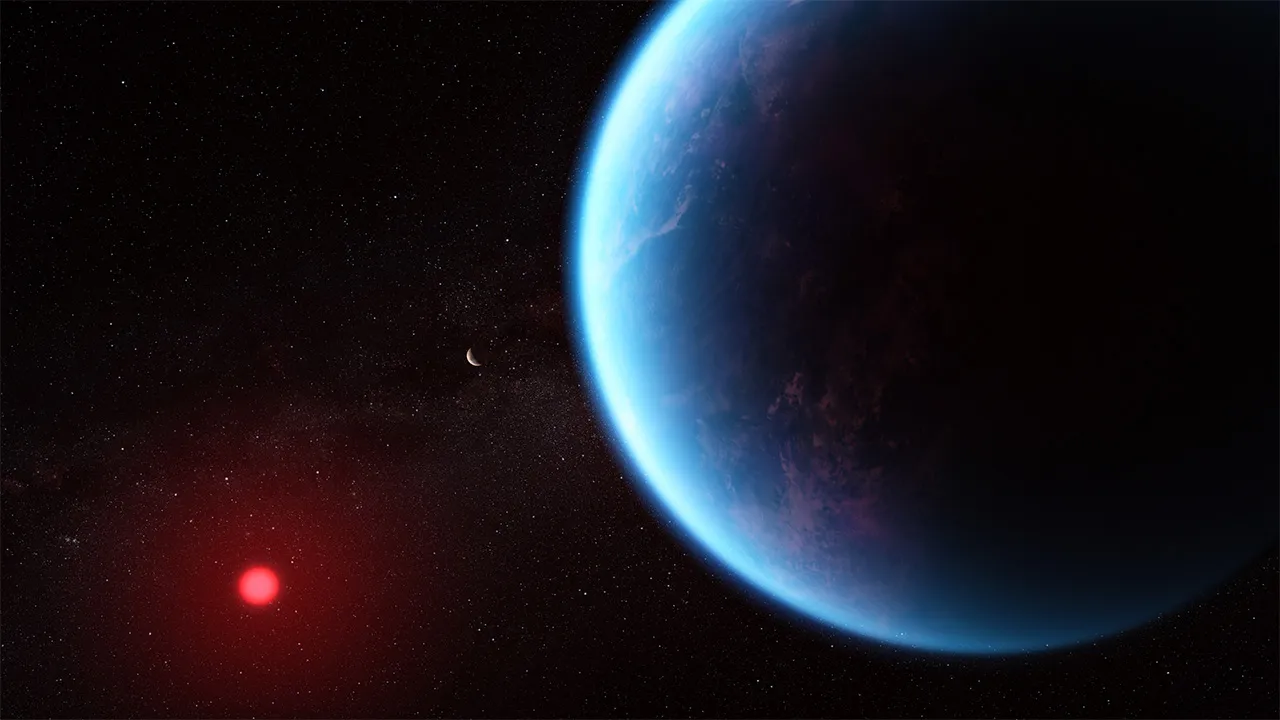
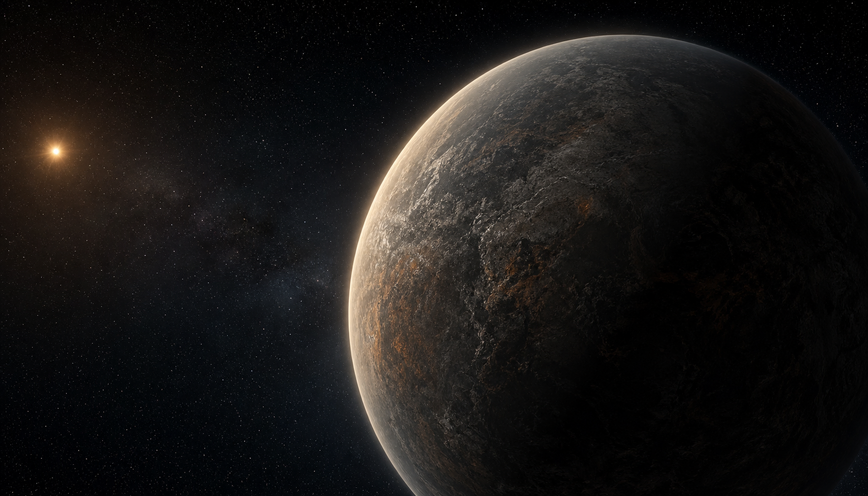
GJ 523b is an unusual exoplanet that has attracted attention because of its very high mass and density. Scientists estimate that the planet is about 2.55 times wider than Earth but has around 23.5 times Earth’s mass. Its properties make it an unusual example of what researchers describe as a “mega-Earth”, a category proposed for very dense, sub-Neptune-sized planets.
Thank you for reading this post, don't forget to subscribe!A Very Dense Planet Outside Our Solar System
GJ 523b is located outside the Solar System and travels around a mid-K dwarf star called GJ 523. The planet completes one trip around its star in only about 17.75 days. Despite its large mass, scientists found that it appears to have a surprisingly small atmospheric component.
The estimated bulk density of GJ 523b is about 7.8 grams per cubic centimetre, which is higher than Earth’s average density. Its combination of large size, high mass and high density is one of the main reasons scientists are interested in studying it.
The term “mega-Earth” is not a standard official planet category like Earth, Jupiter or Neptune. In this research, the scientists propose an observational classification for planets with a radius of at least 2.1 times Earth’s radius and a density of at least 5.5 grams per cubic centimetre. GJ 523b fits within those proposed limits.
How Scientists Studied GJ 523b
The planet was identified through observations made by NASA’s Transiting Exoplanet Survey Satellite (TESS). TESS searches for planets by observing small changes in a star’s brightness when a planet passes in front of it.
This method is called the transit method. When a planet crosses its star from our viewpoint, it blocks a small amount of starlight. By measuring this repeated dip in brightness, scientists can estimate the planet’s size and orbital period.
Researchers then used the NEID spectrograph on the WIYN 3.5-metre Telescope at Kitt Peak National Observatory in Arizona. NEID measures tiny changes in the movement of a star caused by the gravitational pull of an orbiting planet. This is known as the radial velocity method.
Using the two types of observations together allowed scientists to estimate both the radius and mass of GJ 523b more accurately.
GJ 523b Has a Short Year
One of the interesting features of the planet is its short orbital period. GJ 523b takes only 17.75 days to complete an orbit around its host star.
Its estimated zero-albedo equilibrium temperature is about 538 Kelvin, or roughly 265°C. This is a theoretical temperature estimate based on the amount of energy received from the star and assumes no reflection of incoming light. The actual surface or atmospheric conditions could be different.
Scientists also found that the planet appears to follow a strongly tilted orbit. The study estimates a minimum orbital obliquity of about 71.4 degrees, making its orbital orientation particularly unusual compared with many known planetary systems.
A Young Planetary System
The GJ 523 system is relatively young. Researchers estimate its age at around 169 million years, with a large uncertainty in that estimate. That makes the system much younger than our Solar System, which formed about 4.6 billion years ago.
The young age adds another interesting element to the discovery. Scientists generally expect a planet as massive as GJ 523b to collect a significant amount of hydrogen and helium during formation. Such a planet could eventually become more like a gas-rich world.
However, observations suggest that GJ 523b has a much smaller atmospheric mass fraction than expected for a planet of its size and mass. This creates an interesting problem for existing ideas about how planets form and evolve.
Why GJ 523b Challenges Planet Formation Models
A planet with about 23.5 Earth masses would normally be expected to gather a thick gaseous envelope if it formed in the usual way. Instead, GJ 523b appears to be extremely dense and relatively poor in atmospheric material.
Scientists are considering several possible explanations. The planet may have experienced processes that removed much of its original atmosphere. Another possibility is that a major collision during its early history stripped away a large part of its outer layers.
The researchers have stressed that there is not enough evidence yet to determine exactly how GJ 523b formed. Further observations and discoveries of similar planets will be needed to understand whether it is a rare exception or part of a wider population of ultra-dense worlds.
A New Area of Exoplanet Research
The discovery of GJ 523b adds to the growing number of unusual exoplanets being found through missions such as TESS and detailed ground-based observations. Scientists are increasingly able to measure not only whether a planet exists, but also its size, mass, density, temperature and orbital behaviour.
Studying planets like GJ 523b can help researchers understand why some large planets become gas-rich worlds while others remain unusually dense. It may also provide new information about the early stages of planetary formation and the powerful events that can change a planet’s atmosphere over time.
The research on GJ 523b is currently available as a scientific preprint and is being considered for publication in The Astronomical Journal.