



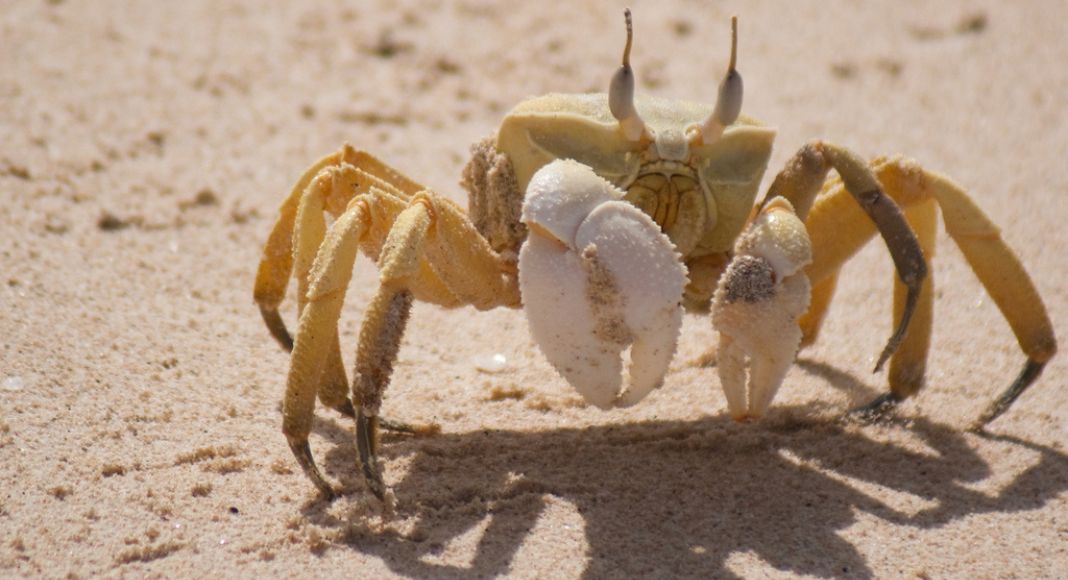
Horn-Eyed Ghost Crab Displays Rare Predatory Behaviour

A research team from the GITAM School of Science in Visakhapatnam has recorded a rare and surprising behaviour on Rushikonda Beach. For the first time, a horn-eyed ghost crab was seen hunting and eating a mottled lightfoot crab. This behaviour has never been confirmed before in India or in earlier scientific records. The team observed this during an evening field visit in April, making it an important scientific discovery for coastal ecology.
A Rare Encounter on Rushikonda Beach
During low tide, the researchers noticed something unusual moving on the sand. As they went closer, they saw a horn-eyed ghost crab feeding on a mottled lightfoot crab. Normally, these two species do not live in the same habitat. The lightfoot crab prefers rocky cracks and crevices, while the ghost crab lives in sandy areas and digs burrows.

This incident shows that both species came close because the shoreline had a mix of rock and sand, allowing their habitats to overlap temporarily.
Horn-Eyed Ghost Crab: New Behaviour and Ecological Meaning

This observation suggests that the Horn-Eyed Ghost Crab is expanding its hunting behaviour and may now be targeting new prey species. It appears to be exploring different food sources during night-time foraging, showing a shift from its usual feeding habits. Since this kind of predation has never been recorded along the Indian coastline before, the discovery is considered scientifically valuable.
Ghost crabs, including the Horn-Eyed Ghost Crab, are generalist feeders, meaning they can adjust their diet based on what prey is available. This sighting highlights how adaptable and flexible they are when environmental conditions or food resources change. It also provides evidence that species behaviour can evolve when habitats overlap or ecosystems experience stress.
Importance of Ghost Crabs in Coastal Ecosystems
Ghost crabs play an important role in sandy coastal environments. They belong to the genus Ocypode and are considered key species because their presence affects other organisms in the food chain. Their burrowing activity also helps shape the structure of beaches and supports natural sand movement.
India has six recorded species of ghost crabs, and three of them—O. brevicornis, O. macrocera and O. cordimanus—are found along Rushikonda shorelines. This makes the area a rich ecosystem for crab diversity and coastal research.
Key Points to Remember
- The event was documented in the November issue of the Journal of Threatened Taxa.
- Horn-eyed ghost crabs can act as strong predators in intertidal food chains.
- Six species of ghost crabs are known in India.
- Lightfoot crabs are usually found on rocky surfaces, unlike ghost crabs which prefer sandy beaches.
Environmental Factors and Future Research Needs
Scientists believe that factors like pollution, changing sand patterns, rising sea temperature and altered tidal cycles may push marine animals to explore new habitats. This could explain why the ghost crab hunted a species normally living in a different environment.
Although this may be a one-time event, it raises important questions about how coastal species are adapting to changing environmental conditions. The coastline of Visakhapatnam—where rocks and sandy beaches meet—provides an ideal natural lab for further research on how species interact in changing habitats.
The discovery opens new opportunities for studying intertidal life and understanding how animal behaviour shifts with environmental stress, climate change and habitat overlap.