


IMEC Expansion Gains Interest From Five Countries

IMEC Expansion is gaining attention as Egypt, Lebanon, Oman, Greece and Cyprus have expressed interest in joining or working with the India-Middle East-Europe Economic Corridor. The development was confirmed on October 6, 2026, by Gérard Mestrallet, French President’s Special Envoy for IMEC. A ministerial-level meeting is expected later in 2026 to discuss the possible geographical expansion of the corridor.
Thank you for reading this post, don't forget to subscribe!The possible addition of these countries could widen the connectivity network linking India with the Gulf region and Europe and create new routes for trade, transport, energy and digital services.
What Is IMEC?
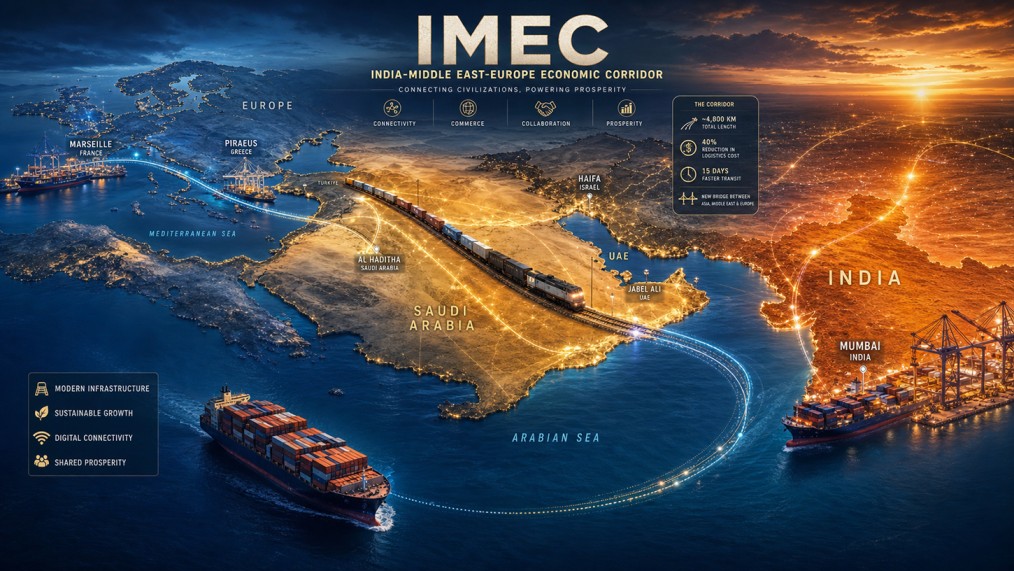
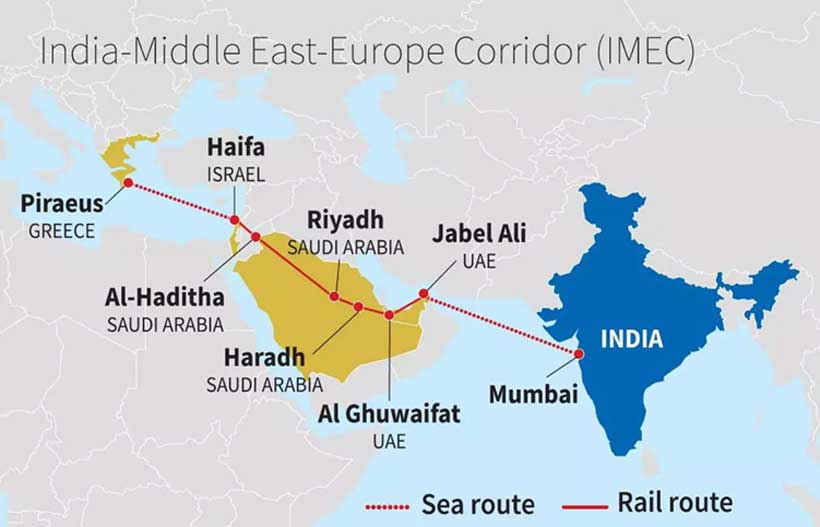
The India-Middle East-Europe Economic Corridor, known as IMEC, is a proposed connectivity project announced in September 2023 during India’s G20 presidency. The initiative aims to develop stronger links between India, the Arabian Gulf and Europe.
The planned corridor is designed to use different forms of transport and infrastructure. These include railway connections, maritime transport, ship-to-rail links and road networks.
IMEC also proposes infrastructure for electricity transmission, digital connectivity and a clean hydrogen pipeline. The project is therefore designed not only as a trade route but also as a wider economic and infrastructure network.
Five Countries Show Interest
Egypt, Lebanon, Oman, Greece and Cyprus have expressed interest in becoming part of the expanding IMEC framework. Greece and Cyprus have shown particular interest in full membership, while Egypt, Lebanon and Oman have indicated interest in joining or cooperating with the corridor.
Gérard Mestrallet visited India from October 5 to 7, 2026, during discussions on the future development of IMEC. His visit comes as participating countries look at ways to strengthen the corridor and expand its geographical reach.
Any formal expansion would require agreement among the original signatories.
Original IMEC Members
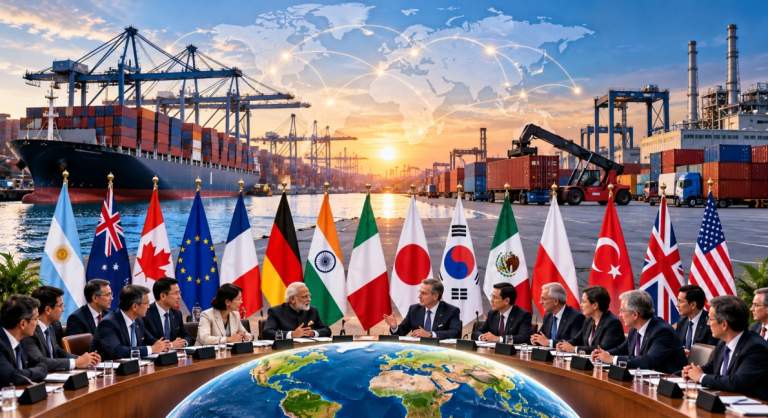
The original IMEC agreement was signed by India, the United States, Saudi Arabia, the United Arab Emirates, France, Germany, Italy and the European Union.
The framework connects an eastern route from India towards the Arabian Gulf with a northern route from the Gulf towards Europe.
The original eight signatories must unanimously approve the addition of new members. This means the five countries currently showing interest cannot become formal members without agreement from all existing signatories.
Greece and Cyprus in the European Connection
Greece and Cyprus could strengthen the European side of the proposed corridor. Their geographical positions in the eastern Mediterranean could provide additional links between the Middle East and Europe.
Greece already has an important position in European maritime transport, while Cyprus is located in the eastern Mediterranean. Their possible participation could provide additional options for trade and transport connections between regions.
The exact routes and infrastructure arrangements would depend on future discussions among the participating countries.
Lebanon Looks at Beirut and Tripoli Ports
Lebanon has also shown interest in the corridor. Discussions about Lebanon’s possible participation took place in February 2026, when Lebanese President Joseph Aoun and Prime Minister Nawaf Salam discussed the possibility of joining IMEC.
The discussions included the potential involvement of Beirut and Tripoli ports.
If Lebanon becomes part of the wider IMEC network, its ports could provide additional maritime connections in the eastern Mediterranean. This could give the corridor another possible route towards European markets.
Oman Could Provide an Alternative Route
Oman’s location could also be important for the proposed expansion. The country has access to the Arabian Sea and lies outside the Strait of Hormuz, the narrow waterway connecting the Persian Gulf with the Gulf of Oman.
Mestrallet has highlighted the importance of having multiple routes because of changing geopolitical conditions in the Middle East. A wider network could provide alternative pathways for trade and transport when individual routes face disruptions.
Oman’s possible participation could therefore provide another gateway connected with the Gulf region and an alternative route to the United Arab Emirates.
IMEC and Trade Connectivity
One of the main goals of IMEC is to improve the movement of goods between India, the Middle East and Europe. A combination of ports, railways and other transport infrastructure could reduce the need for some longer maritime routes.
The corridor is also planned to support digital connectivity and energy infrastructure. Electricity cables and a clean hydrogen pipeline are among the proposed components.
This broader approach means IMEC is being considered as a long-term economic corridor rather than only a traditional transport route.
Possible Ministerial Meeting
A ministerial-level meeting is expected later in 2026 to discuss the proposed expansion. Such a meeting could provide an opportunity for the interested countries and original signatories to examine possible routes, infrastructure links and forms of participation.
The final decision on membership will depend on discussions among all eight original signatories. Until then, the five countries remain interested parties rather than confirmed new members of IMEC.
Wider Role of IMEC
The interest shown by Egypt, Lebanon, Oman, Greece and Cyprus indicates that the proposed corridor could develop beyond its original geography. Additional countries could provide new ports, transport routes and connections between the Indian Ocean, Gulf and Mediterranean regions.
For India, a wider IMEC network could strengthen its connectivity with major markets in Europe and the Middle East. The coming discussions will determine how the corridor develops and whether its membership and geographical reach are formally expanded.