



Lumina Simulation Reveals the Early Universe

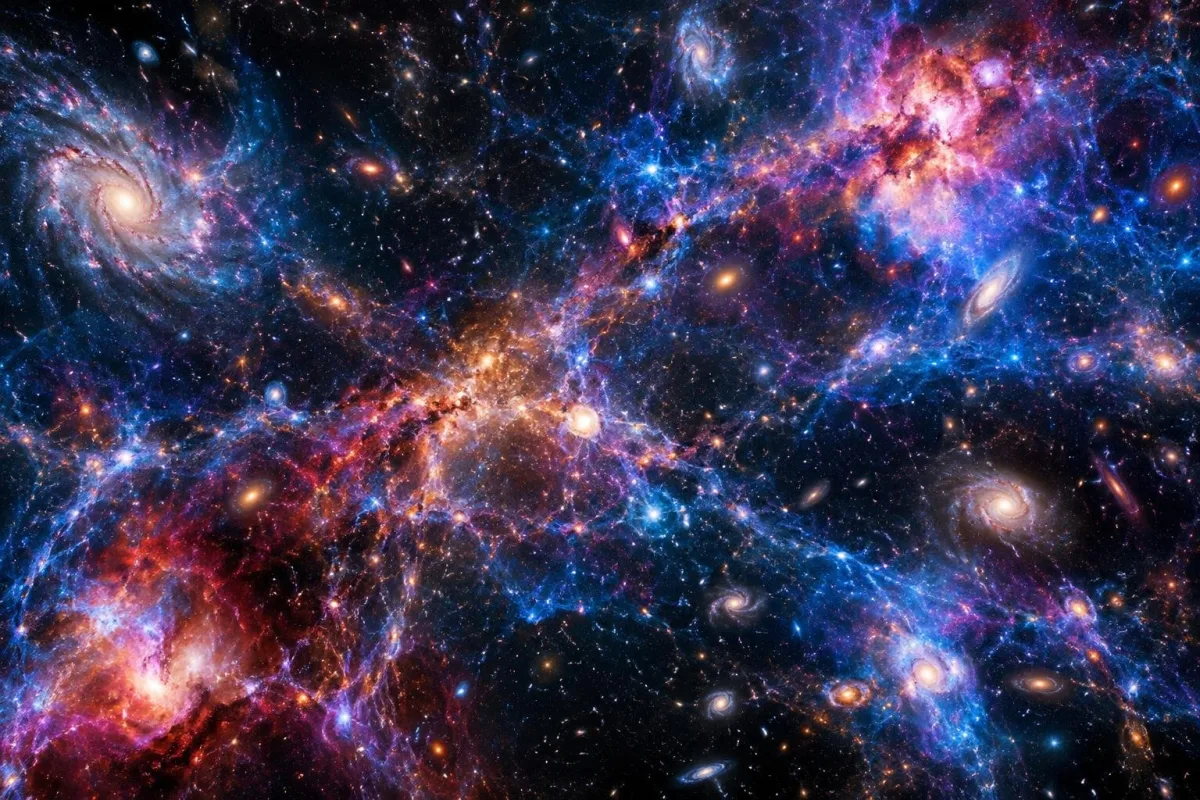
Lumina Simulation is a major scientific development that aims to help researchers understand how the universe developed during its earliest years. Researchers from the Center for Astrophysics | Harvard & Smithsonian, the Massachusetts Institute of Technology (MIT) and Harvard University unveiled the simulation on 26 October 2026. It models the first two billion years of the universe, including the interactions among ordinary matter, dark matter and radiation.
The simulation covers a huge region of space measuring approximately 1.5 to 1.6 billion light-years on each side. A light-year is the distance light travels in one year. By modelling such a large region, scientists can study how matter gathered, how the first stars and galaxies formed, and how the universe changed over time.

The project uses advanced computing technology to recreate important stages of cosmic history. Its results can also be compared with observations from modern telescopes, helping researchers test scientific ideas about the formation and development of the universe.
What Is the Lumina Simulation?
Lumina is a large computer simulation designed to study the evolution of the early universe. It uses scientific models and powerful computing systems to examine how different components of the universe interacted during its first two billion years.
The early universe was very different from the universe we see today. Over time, gravity pulled matter together, creating structures that eventually developed into stars, galaxies and larger groups of galaxies.
Understanding this process is difficult because the universe is extremely large and its evolution involves many physical processes. Scientists cannot observe every stage of cosmic history directly. Computer simulations help them study how the universe may have developed by combining scientific theories with mathematical calculations.
Lumina brings together the effects of ordinary matter, dark matter and radiation within one evolving model. This allows researchers to investigate how these components influenced the formation of cosmic structures.
The simulation’s large scale is particularly important because scientists can study both the development of individual structures and the larger cosmic environment in which they formed.
Understanding the Early Universe and the Big Bang
The Big Bang model explains that the universe expanded from an early state that was extremely hot and dense. As the universe expanded, it cooled, allowing particles and atoms to form. Over a much longer period, gravity helped matter gather into stars and galaxies.
During the first billion years, gas collected in regions where gravity was strong enough to pull matter together. These areas became important sites for the formation of the first stars and galaxies. Black holes also developed during this early period.
The first stars changed their surroundings by releasing energy and radiation. Their formation marked an important stage in the history of the universe because stars helped shape the conditions in which later generations of stars and galaxies developed.
Scientists use simulations such as Lumina to study these changes and understand how early cosmic structures grew.
By following the evolution of matter and radiation over time, researchers can investigate questions about the first galaxies, the formation of black holes and the development of the universe’s large-scale structure.
Role of Ordinary Matter, Dark Matter and Radiation
One of the important features of Lumina is that it models interactions among ordinary matter, dark matter and radiation.
Ordinary matter is the matter that makes up stars, planets, gas clouds and living things. It consists of atoms and their components. Hydrogen and helium are the two most abundant elements in the universe.
Dark matter is a form of matter that does not emit, absorb or reflect light in the way ordinary matter does. Scientists infer its presence mainly through its gravitational effects on visible matter and cosmic structures. It plays an important role in current models of how galaxies and other large structures formed.
Radiation carries energy through space. In the early universe, radiation influenced the conditions under which atoms formed and gas evolved. The interaction between radiation and matter affected the development of early cosmic structures.
By including these components in the simulation, researchers can study how gravity, gas and radiation worked together during the universe’s early history.
The combined model may help scientists understand why some regions developed into galaxies while others remained less dense.
What Is Reionisation?
Lumina also models hydrogen and helium reionisation as part of the evolving universe.
Reionisation refers to a major change in the state of gas in the universe. After the universe cooled enough for neutral atoms to form, energetic radiation from early cosmic sources began removing electrons from these atoms. This process is known as ionisation.
As the first stars, galaxies and other energetic sources developed, their radiation affected the surrounding gas. Gradually, much of the hydrogen between galaxies became ionised. Helium also underwent reionisation through energetic radiation.
These processes are important because they changed the physical conditions of intergalactic gas and influenced how light travelled through the universe.
Modelling hydrogen and helium reionisation together allows researchers to examine how these changes developed alongside the formation of stars and galaxies.
Lumina can therefore help scientists study the relationship between early cosmic objects and the wider environment surrounding them.
Frontier Supercomputer Powers the Simulation
Lumina was run on Frontier, a powerful supercomputer located at Oak Ridge National Laboratory in Tennessee, United States.
The computation used more than 15,000 graphics processing units (GPUs) and over 100,000 central processing unit (CPU) cores. These computing resources allow a system to carry out many complex calculations in parallel.
A simulation covering billions of light-years and billions of years of cosmic history requires enormous computing power. The system must calculate how matter moves, how gravity affects different regions and how radiation changes the surrounding environment.
GPUs are widely used for tasks that require many calculations to be performed at the same time. CPUs manage a broad range of computing operations. Together, these technologies allow researchers to process large amounts of scientific data.
According to the project information, Lumina covers a volume of space more than 100 times larger than those of previous comparable simulations. Its scale gives scientists an opportunity to examine cosmic evolution across a much wider region.
The project demonstrates how advanced supercomputers are becoming essential tools for modern astronomy and theoretical physics.
How Telescopes Can Help Test Lumina’s Predictions
Computer simulations are valuable when their predictions can be compared with real observations. Lumina’s results can be tested against data collected by powerful space telescopes.
The James Webb Space Telescope (JWST) observes the universe primarily in infrared wavelengths. Infrared observations allow astronomers to study distant galaxies whose light has travelled for billions of years. Because the universe expands, light from very distant objects is stretched towards longer wavelengths, making infrared observations especially useful for studying the early universe.
The Nancy Grace Roman Space Telescope is a NASA space observatory designed to carry out wide-field astronomical surveys. Its wide view of the sky is expected to help scientists study large numbers of galaxies and investigate the structure and evolution of the universe.
Observations from these and other telescopes can help researchers compare the number, distribution and properties of galaxies with the predictions of computer models.
If a simulation matches observations, it can support the scientific assumptions used in the model. If differences appear, researchers can investigate whether their understanding of physical processes needs to be improved.
This comparison between computer models and telescope observations is an important part of modern astronomical research.
Lumina Research Published in an Astronomy Journal
Findings from Lumina began publication in the Monthly Notices of the Royal Astronomical Society on 26 October 2026.
The journal is a peer-reviewed scientific publication of the Royal Astronomical Society. Peer review allows other experts to assess scientific work before or during publication, depending on the journal’s process.
Publishing research allows scientists to share their methods, results and conclusions with the wider scientific community. Other researchers can examine the work, compare it with their own findings and use it to develop further studies.
The publication of Lumina’s findings creates an opportunity for astronomers to evaluate how the simulation contributes to current knowledge of cosmic evolution.
As additional studies become available, researchers may be able to compare its predictions with new telescope observations and other simulations.

MEGATRON Project Also Studies the Early Universe
Lumina is part of a wider period of progress in computer-based astronomy research. Another project, called MEGATRON, released simulations in late September and early October 2026.
The MEGATRON project is led by Harley Katz at the University of Chicago. Its models examine the evolution of a galaxy similar to the Milky Way during the first several billion years of the universe.
The research investigates how early galaxies developed, what they were made of and how elements formed over time.
Galaxies are made up of stars, gas, dust and dark matter. Their properties change as stars form, evolve and release material into their surroundings. These processes help determine the chemical composition of later generations of stars and planets.
While Lumina models the early universe across a very large region, MEGATRON focuses on the development of a galaxy similar to the Milky Way. The projects therefore explore cosmic history at different scales.
Together, such simulations can help scientists build a broader picture of how the universe evolved from its early conditions into the complex cosmic structures observed today.
Why Lumina Matters for Astronomy
The Lumina Simulation offers researchers a powerful way to investigate the first two billion years of cosmic history. Its large scale allows scientists to study how ordinary matter, dark matter and radiation influenced the development of stars and galaxies.
Its treatment of hydrogen and helium reionisation also helps researchers examine how energetic radiation changed the gas between galaxies. These processes are central to understanding the transition from an early universe with few luminous objects to one containing many galaxies and stars.
The use of Frontier’s computing resources demonstrates how high-performance computing can support research into questions that cannot be explored through direct observation alone.
As telescope observations continue to improve, scientists will have more data with which to test simulations and refine their models. Lumina’s predictions may help researchers investigate the formation of early galaxies, the growth of cosmic structures and the physical processes that shaped the universe.
The combination of advanced computing, scientific modelling and telescope observations is creating new opportunities to study the history of the cosmos.