




UN AI Report Highlights Global AI Future

UN AI Report has become a major milestone in the global discussion on artificial intelligence. In July 2026, the United Nations (UN) released its first-ever scientific assessment of AI titled “Preliminary Report of the Independent International Scientific Panel on AI.” The report brings together scientific knowledge from experts around the world to explain how artificial intelligence is changing societies, economies, industries, and governments. It is designed to provide trusted scientific evidence that can help countries understand AI before making important decisions about its future use.
The report was prepared by an Independent International Scientific Panel on AI, which includes 40 experts from different countries and fields. The panel is co-chaired by Yoshua Bengio, a Turing Award winner known for his work in deep learning, and Maria Ressa, a Nobel Peace Prize winner recognized for her work in journalism and human rights. Their leadership reflects the report’s focus on both technological progress and responsible use of AI.

Why the UN Released This Report
Artificial intelligence is growing faster than ever before. AI tools are now used in education, healthcare, banking, farming, transportation, customer service, and scientific research. As AI becomes more powerful, governments around the world are discussing how to make sure it is used safely and fairly.
The United Nations believes that countries need reliable scientific information before creating laws or policies related to AI. Instead of recommending specific rules, the report explains the current state of AI research, its opportunities, and the challenges that need attention.
According to UN Secretary-General António Guterres, independent scientific evidence is important for making informed decisions about AI governance.

What is Artificial Intelligence?
Artificial Intelligence, commonly called AI, is a branch of computer science that enables machines to perform tasks that usually require human intelligence.
These tasks include:
- Learning from data
- Understanding language
- Recognizing images and patterns
- Solving problems
- Making predictions
- Supporting decision-making
Recent advances in generative AI have made AI tools more accessible to businesses, students, researchers, and the general public.
Seven Major Themes Covered in the Report
The UN report studies AI from different perspectives rather than focusing only on technology.
Some of the key areas include:
Healthcare
AI is helping doctors detect diseases, study medical images, improve diagnosis, and support drug discovery. Hospitals are also using AI to improve patient care and reduce workload.
Education
AI-powered learning platforms can provide personalized education and help teachers create better learning experiences. At the same time, the report highlights the importance of protecting student privacy.
Agriculture
Farmers are using AI for weather forecasting, crop monitoring, pest detection, and better use of water and fertilizers. These technologies can improve food production while reducing waste.
Economy and Jobs
AI is creating new industries and improving productivity across many sectors. However, the report also discusses concerns about job changes as automation continues to expand.
Many countries are now investing in AI skills so workers can adapt to changing employment needs.
Security
The report explains that AI can improve cybersecurity and disaster management, but it can also be misused for cyberattacks, misinformation, and other security risks if proper safeguards are not in place.
Environment
AI can help monitor climate change, improve energy efficiency, and manage natural resources. However, training large AI models also requires significant computing power and electricity, raising concerns about environmental impact.
Human Rights and Democracy
The report stresses that AI systems should respect human rights, protect privacy, reduce bias, and support democratic values. Responsible AI development is considered essential for building public trust.
AI Governance Around the World
One of the main purposes of the report is to support discussions on AI governance.
AI governance refers to the rules, standards, and systems that guide how artificial intelligence should be developed and used responsibly.
Countries are currently working on different AI regulations to balance innovation with safety. International cooperation is becoming increasingly important because AI technologies often operate across national borders.
The UN hopes that scientific reports like this will encourage countries to work together instead of creating completely separate systems.
Global AI Computing Capacity
The report also provides interesting information about global AI infrastructure.
According to the assessment:
- The United States accounted for around 75% of global AI computing capacity in 2025.
- China accounted for approximately 15%.
AI computing capacity includes the powerful hardware needed to develop and operate advanced AI systems.
This infrastructure includes:
- Advanced computer chips
- High-performance processors
- Large data centres
- Cloud computing platforms
- High-speed networking systems
These resources are essential for training modern large language models and other advanced AI applications.
Growing Global Discussions on AI
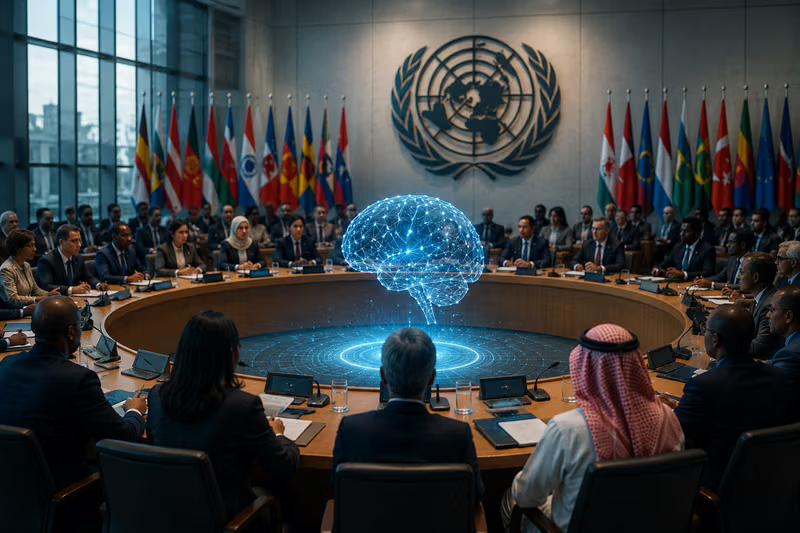
The report was prepared for use in the Global Dialogue on AI Governance, an international platform where governments, researchers, businesses, and civil society discuss the future of AI.
The first Global Dialogue on AI Governance was held in Geneva on 6-7 July 2026. During the event, experts discussed topics such as AI safety, transparency, fairness, innovation, and international cooperation.
The UN plans to continue these discussions through regular scientific assessments that can support future policy debates.
A Bigger Report Expected in 2027
The July 2026 publication is described as a preliminary scientific assessment. A much more detailed report is expected to be released in 2027 ahead of the second Global Dialogue on AI Governance, which is planned to take place in New York.
The future report is expected to include updated scientific findings, new research, and developments in AI technology from around the world.
AI’s Expanding Role Today
Artificial intelligence continues to develop rapidly, with governments and technology companies investing billions of dollars in AI research and infrastructure. New AI models are improving language translation, scientific discovery, software development, and business automation. At the same time, countries are introducing new guidelines to address issues such as privacy, transparency, copyright, misinformation, and cybersecurity.
The release of the UN AI Report reflects the growing need for international cooperation as AI becomes a key technology shaping the future of healthcare, education, industries, public services, and global development.