Aditya-L1: Solar Eruptions Study

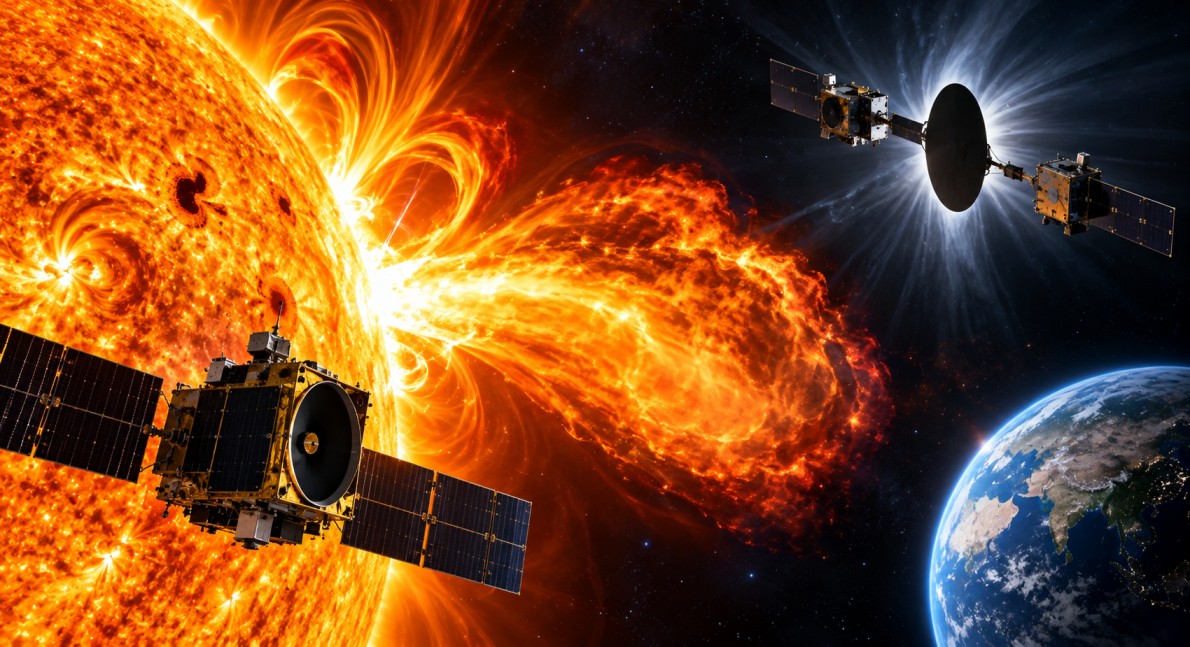
Aditya-L1 has joined the European Space Agency’s (ESA) Proba-3 mission to study solar eruptions and understand how they affect space weather. On 16 October 2026, observations from the two missions were used to measure the mass, density and energy of coronal mass ejections (CMEs) near the Sun. The study combines data from Aditya-L1’s Visible Emission Line Coronagraph (VELC) and Proba-3’s ASPIICS instrument.
This joint effort brings together two different ways of observing the Sun’s outer atmosphere, known as the corona. Better measurements of solar eruptions can help scientists understand how these events develop and improve knowledge of space weather, which can affect satellites, communication systems, navigation services and power networks on Earth.

What Are Solar Flares and Coronal Mass Ejections?
Solar flares and coronal mass ejections are two important types of solar activity, but they are not the same.
A solar flare is a sudden release of energy from the Sun’s atmosphere. It produces intense radiation that can affect the space environment around Earth.
A coronal mass ejection is a large release of plasma and magnetic fields from the Sun’s corona. Plasma is a state of matter made up of charged particles. When a CME travels towards Earth, it can interact with Earth’s magnetic field and cause a geomagnetic storm.
These storms may affect satellite operations, radio communications, navigation systems and electrical power networks. They can also produce auroras, colourful displays of light in the sky near the polar regions.
Scientists study solar eruptions to understand their speed, direction, size and energy. Accurate measurements can help improve models used to predict how solar activity may affect Earth and spacecraft.
Aditya-L1: India’s First Dedicated Solar Mission
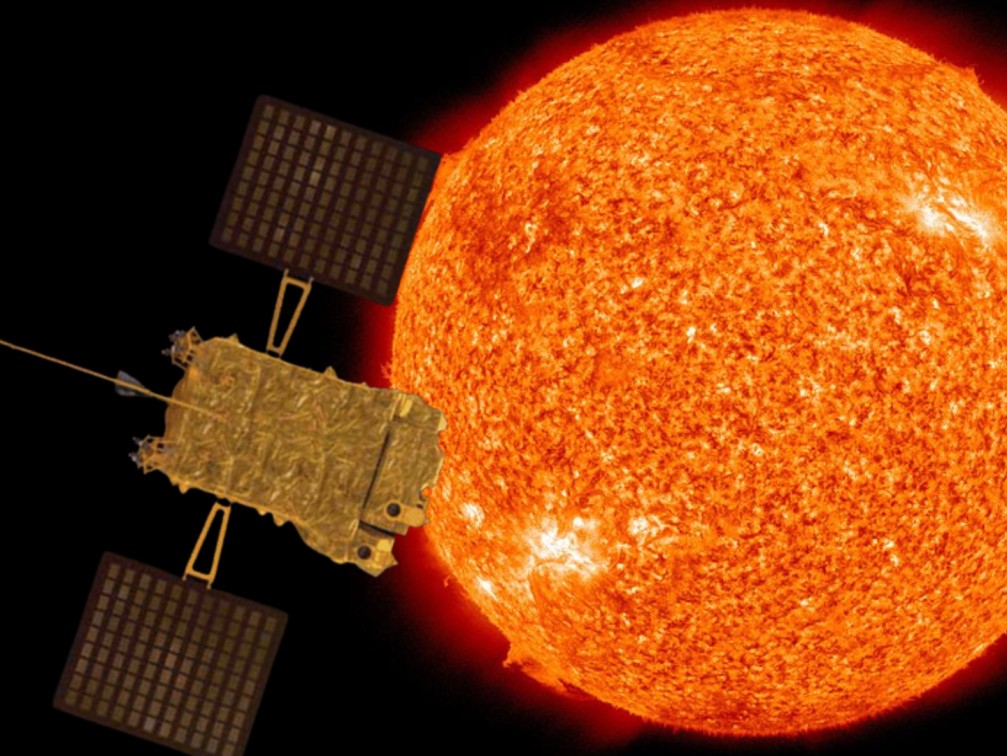
Aditya-L1 is India’s first dedicated solar observation mission, developed by the Indian Space Research Organisation (ISRO). It was launched on 2 September 2023 and entered a halo orbit around the Sun-Earth Lagrange Point 1 (L1) on 6 January 2024.
L1 is a location in space where the gravitational forces of the Sun and Earth allow a spacecraft to maintain a suitable position with relatively low fuel use. A halo orbit around this point gives Aditya-L1 a continuous view of the Sun without regular interruptions caused by Earth blocking its view.
The spacecraft carries several scientific instruments designed to study different parts of the Sun and its activity.
One of its key instruments is the Visible Emission Line Coronagraph, or VELC. It observes the solar corona, the outer atmosphere of the Sun, which is much fainter than the bright solar surface.
VELC helps scientists study the structure and movement of the corona and investigate how solar eruptions begin and develop. Its observations can provide information about the early stages of CMEs and the physical conditions in the solar atmosphere.
Proba-3 Creates Artificial Solar Eclipses
Proba-3 is a European Space Agency mission launched by ISRO aboard a PSLV-XL rocket on 5 December 2024. It consists of two spacecraft designed to fly in a precise formation.
One spacecraft blocks the direct light of the Sun, while the other observes the corona. This arrangement creates an artificial solar eclipse in space.
The method allows scientists to observe the faint corona more clearly than would normally be possible when the bright solar disc is in view. The mission’s ASPIICS instrument is designed to study this region.
On 1 January 2026, ESA confirmed that Proba-3 had achieved autonomous formation flying with millimetre-level precision, according to the supplied report. By 17 December 2025, the mission had produced more than 50 artificial eclipses and over 250 hours of high-resolution coronal video.
This technology allows researchers to observe the corona repeatedly under controlled conditions. It also demonstrates how precise formation flying can support future scientific missions involving multiple spacecraft.
How Aditya-L1 and Proba-3 Work Together
Aditya-L1 and Proba-3 use different observing methods to study the Sun’s outer atmosphere. Their data can complement each other and provide a more complete picture of solar eruptions.
Aditya-L1’s VELC observes the corona from its position near the Sun–Earth L1 point. Proba-3’s ASPIICS uses the artificial eclipse created by its two spacecraft to observe faint structures close to the Sun.
By combining measurements from the two missions, researchers can investigate the mass, density and energy of coronal mass ejections. These properties are important for understanding how eruptions move through space and how their effects may change as they travel away from the Sun.
Joint observations are especially valuable because solar eruptions can change rapidly. Different instruments capture different details, and combining their results can help scientists test their understanding of the physical processes involved.
The collaboration also highlights the role of international cooperation in space science, bringing together Indian and European technology to investigate a common scientific challenge.
Other Recent Findings from Aditya-L1
Aditya-L1 has also contributed to research into the early signs of major solar flares. A 2026 study identified small, short-lived brightenings in the solar atmosphere hours before major flares. These brightenings were found clustered around the areas where the flares later occurred.
Researchers from the Manipal Centre for Natural Sciences at Manipal Academy of Higher Education, ISRO and the Department of Space took part in the work, according to the supplied report.
On 23 July 2026, another reported development highlighted Aditya-L1 observations of photospheric iron fluorescence across 47 X-class flares during the 2024 peak of Solar Cycle 25. The observations also provided spectroscopic information about the onset phase of a CME.
X-class flares are the strongest category in the standard classification of solar flares. Studying these events can help researchers understand the conditions that produce intense solar activity.
These findings show how continuous solar monitoring can contribute to research into the early stages of eruptions and the behaviour of the Sun’s atmosphere.
Why Solar Research Matters Today
Modern life depends on technologies that can be affected by severe space weather. Satellites support telecommunications, weather forecasting, navigation and many other services. Strong geomagnetic storms can disturb satellite operations and radio signals and may create risks for power systems.
Improved observations of solar eruptions can help scientists develop better space-weather models. These models are used to estimate the likely arrival and possible effects of solar events.
The work of Aditya-L1 and Proba-3 also contributes to a broader international effort to understand the Sun. Other missions, including ESA’s Solar Orbiter, provide complementary information about solar activity and the solar wind.
As researchers gather more observations, combining data from different spacecraft can help build a clearer picture of how solar eruptions begin, travel through space and interact with planetary environments.