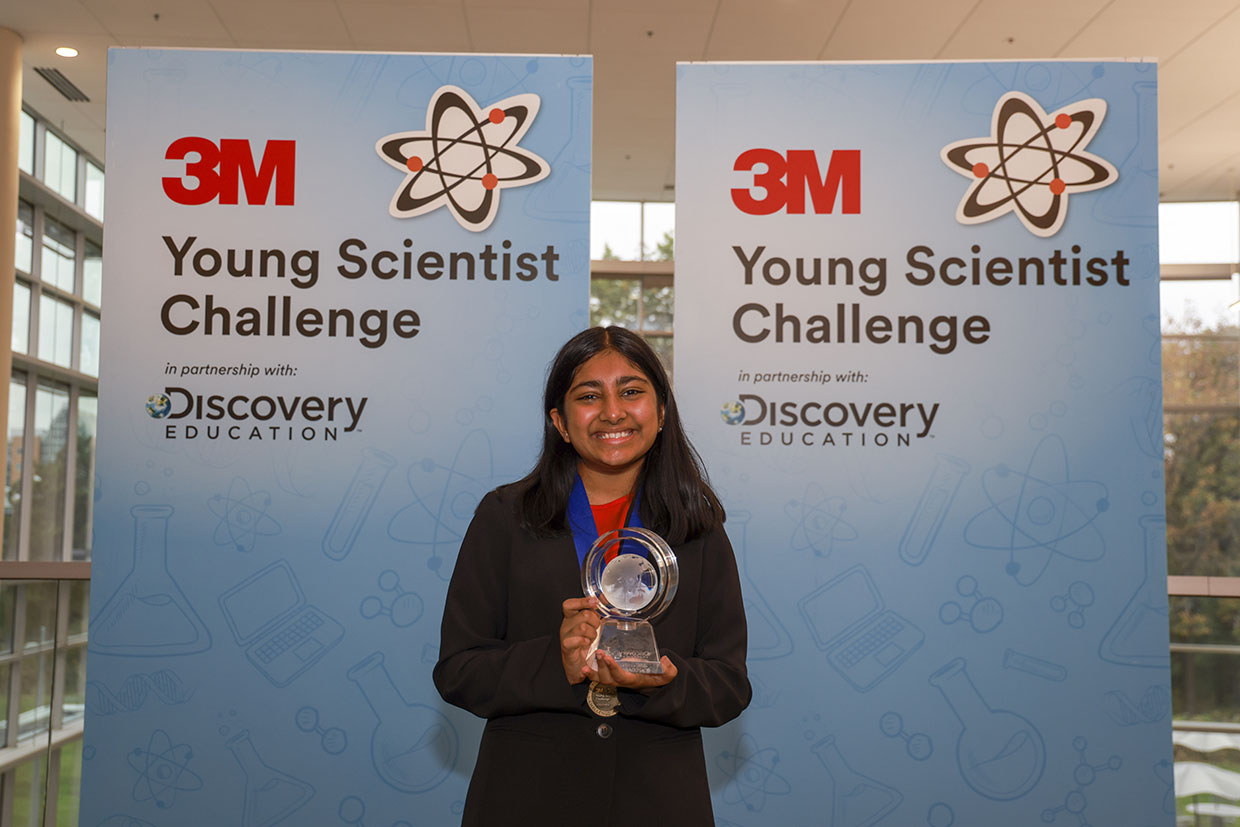
Raji Doshi Wins 3M Young Scientist Challenge

Raji Doshi, a 13-year-old Indian-American student from Farmington, Connecticut, has won the 2026 3M Young Scientist Challenge for developing an innovative idea to address ocean acidification. On October 14, 2026, she was named America’s Top Young Scientist and received a prize of $25,000 for her project, called ALKACORE. Her work focuses on using macroalgae and aragonite to help improve seawater chemistry and protect marine life.
What Is the 3M Young Scientist Challenge?
The 3M Young Scientist Challenge is a science competition organised by 3M in partnership with Discovery Education. It encourages students in grades 5 to 8 to develop creative solutions to real-world problems using science and technology.

The 2026 competition finals were held on October 12 and 13 at 3M’s global headquarters in St. Paul, Minnesota, in the United States. Students presented their ideas and explained how their projects could help address important challenges.
Raji Doshi stood out with ALKACORE, a project focused on one of the major environmental problems affecting the world’s oceans. Her achievement highlights how young people can use scientific thinking to explore solutions to challenges such as climate change and ocean health.
What Is Ocean Acidification?
Ocean acidification is the gradual change in ocean chemistry caused mainly by seawater absorbing carbon dioxide from the atmosphere. When carbon dioxide dissolves in seawater, it reacts with water to form carbonic acid. This process increases the concentration of hydrogen ions and lowers the water’s pH.
The change also reduces the availability of carbonate ions, which many marine organisms need to build and maintain shells and skeletons. Corals and some shell-forming animals can be affected when these materials become harder to obtain.
Ocean acidification is connected to the rise in atmospheric carbon dioxide, much of which comes from human activities such as burning coal, oil and natural gas. Reducing carbon emissions remains important for addressing this wider environmental challenge.
How Does the ALKACORE System Work?
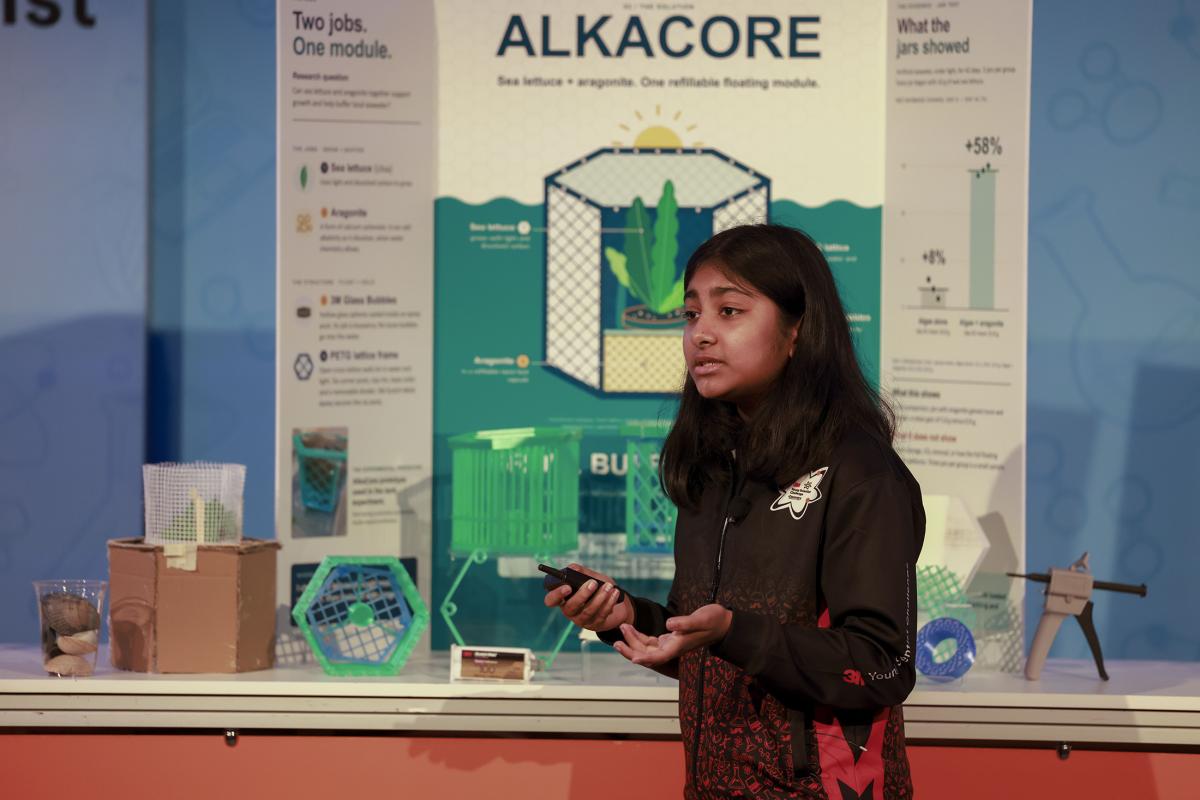
Raji Doshi developed ALKACORE to explore a way to improve seawater chemistry using macroalgae and aragonite. Macroalgae are large algae, including seaweeds, that take up dissolved carbon dioxide during photosynthesis. They use light energy to turn carbon dioxide and water into organic matter.
Aragonite is a naturally occurring mineral made of calcium carbonate. It is also used by some marine organisms to build shells and other hard structures. Doshi’s project combines macroalgae cultivation with aragonite as part of a system designed to increase seawater alkalinity and manage carbon dioxide levels.
A key part of ALKACORE is a computational model that helps determine the appropriate amount of aragonite for the system. This model is intended to guide dosing and support the project’s approach to coastal acidification.
The idea is promising, but its effectiveness would need to be established through careful testing. Researchers would need to assess how the system performs in real coastal conditions, including its long-term effects on marine ecosystems, before its wider environmental benefits could be confirmed.
Why Is This Innovation Important?
Healthy oceans support marine biodiversity, fisheries, coastal communities and food supplies. Changes in ocean chemistry can put additional pressure on corals and other marine organisms, particularly those that depend on calcium carbonate to form shells or skeletons.
Research into ocean alkalinity and seaweed cultivation is exploring different ways to help manage these changes. However, such approaches must be evaluated carefully because altering seawater chemistry can have unintended effects if not properly controlled.
ALKACORE brings these scientific ideas together in a student-developed project. It also shows how computational modelling can help people explore environmental solutions before testing them in the real world.
Other Winners of the 2026 Competition
Raji Doshi received the top prize of $25,000. Two other young scientists also earned recognition for their projects.
- Aaisha Asif, from Sarasota, Florida, secured second place and received $1,000.
- Sharvi Mahajan, from San Diego, California, secured third place and received $1,000.
The results recognised students who used science, creativity and problem-solving to explore practical challenges.
A Young Scientist’s Achievement
Raji Doshi’s success highlights the role young innovators can play in raising awareness of environmental problems. Her ALKACORE project connects marine science with technology and mathematical modelling to investigate a possible response to ocean acidification.
The next step for ideas like this is rigorous research and testing. With further study, student projects can help inspire new questions, encourage scientific learning and contribute to discussions about protecting the oceans.