




Agni-III Missile Test Success Strengthens India Strategic Deterrence

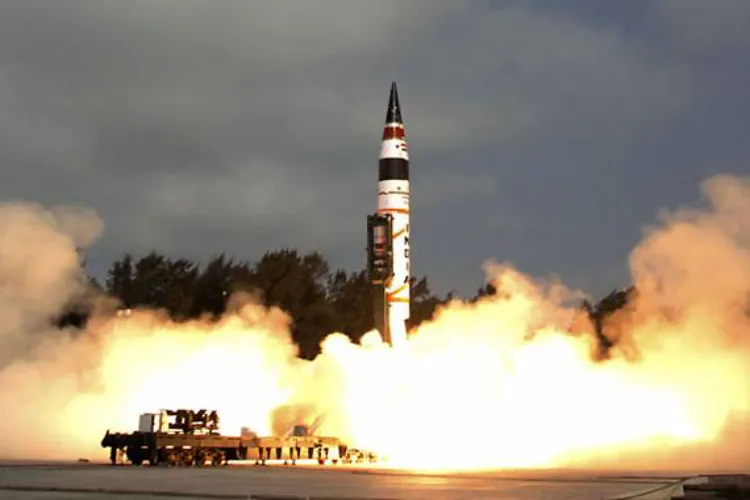
The Agni-III Missile Test Success marks another important milestone in India’s defence preparedness. On Friday, India successfully carried out a test launch of the Agni-III intermediate range ballistic missile from the Integrated Test Range at Chandipur in Odisha. The launch validated all operational and technical parameters of the missile system and reinforced the credibility of India’s strategic deterrence posture.
Thank you for reading this post, don't forget to subscribe!The test once again demonstrated the country’s ability to maintain and upgrade its strategic defence capabilities. Officials confirmed that the missile performed as expected and achieved all mission objectives during the trial.
Launch Conducted by Strategic Forces Command
The launch was executed by the Strategic Forces Command, the body responsible for managing and operating India’s nuclear arsenal. According to official sources, the missile followed its pre designated trajectory with high precision and successfully reached its intended target area.
The successful test highlights the operational readiness of India’s strategic forces. It shows that the country’s defence teams are capable of conducting precision launches under strict monitoring and controlled conditions. Such tests are conducted at regular intervals to ensure that the systems remain reliable and effective.
Defence experts stated that regular validation of missile systems is important for maintaining confidence in a nation’s deterrence capability. The Agni-III Missile Test Success confirms that India’s long range strike systems continue to function as designed.
Agni-III Missile Capabilities
Agni-III is an intermediate range ballistic missile with a strike range of approximately 3,000 to 3,500 kilometres. It has been indigenously developed as part of India’s integrated guided missile development programme. The missile is designed mainly as a nuclear delivery system and plays a central role in India’s land based deterrent forces.
The missile is two stage and solid fuelled. Solid fuel technology allows for quicker launch preparation and improved storage life compared to liquid fuel systems. Agni-III can carry a payload of up to 1,500 kilograms, making it capable of delivering different types of warheads.
In terms of size and structure, the missile measures about 16.7 metres in length and has a diameter of 2 metres. It has a launch weight of around 48,300 kilograms. Reports suggest that the missile is capable of carrying nuclear warheads with yields ranging between 200 to 300 kilotons.
The range of Agni-III allows India to cover significant distances, strengthening its ability to respond effectively to potential threats. Its capability to reach targets at long distances enhances the country’s strategic balance in the region.
Navigation Accuracy and Design Features
One of the key strengths of the Agni-III is its advanced navigation and guidance system. The missile uses a strapdown inertial navigation system supported by GPS technology. This combination improves targeting precision and ensures that the missile remains on its planned trajectory throughout its flight.
The reported accuracy of the system is around 40 metres circular error probable, which reflects a high level of precision for a ballistic missile of this range. Such accuracy ensures that the missile can effectively reach its intended target while maintaining reliability.
In terms of design, the first stage of the missile uses a maraging steel motor case, known for its high strength and durability. The second stage incorporates a carbon fibre motor case, which helps reduce weight while maintaining structural stability. Both stages are equipped with thrust vector control systems. These systems improve flight stability and manoeuvrability and allow adjustments during the missile’s journey.
The advanced materials and control systems used in Agni-III show India’s progress in missile technology and indigenous defence manufacturing.

Role in India Strategic Deterrence
The Agni-III Missile Test Success is significant for India’s overall defence strategy. Agni-III has been in service with the Strategic Forces Command since 2011. Over the years, it has become a critical component of India’s land based nuclear deterrent.
India follows a policy of credible minimum deterrence. This means maintaining a nuclear capability that is sufficient to deter threats without engaging in an arms race. Regular testing of systems like Agni-III ensures long term reliability and technical strength.
By successfully conducting such tests, India sends a message about its preparedness while maintaining a responsible approach to strategic stability. Defence analysts note that in a changing regional security environment, maintaining operational readiness is essential.
The recent Agni-III Missile Test Success also highlights the importance of indigenous development in defence technology. With advanced navigation systems, strong structural design, and proven performance, Agni-III remains one of the key pillars of India’s strategic arsenal.
As global security challenges continue to evolve, India’s focus on strengthening its deterrence capabilities through reliable and tested systems like Agni-III reflects its commitment to safeguarding national security and maintaining regional balance.