



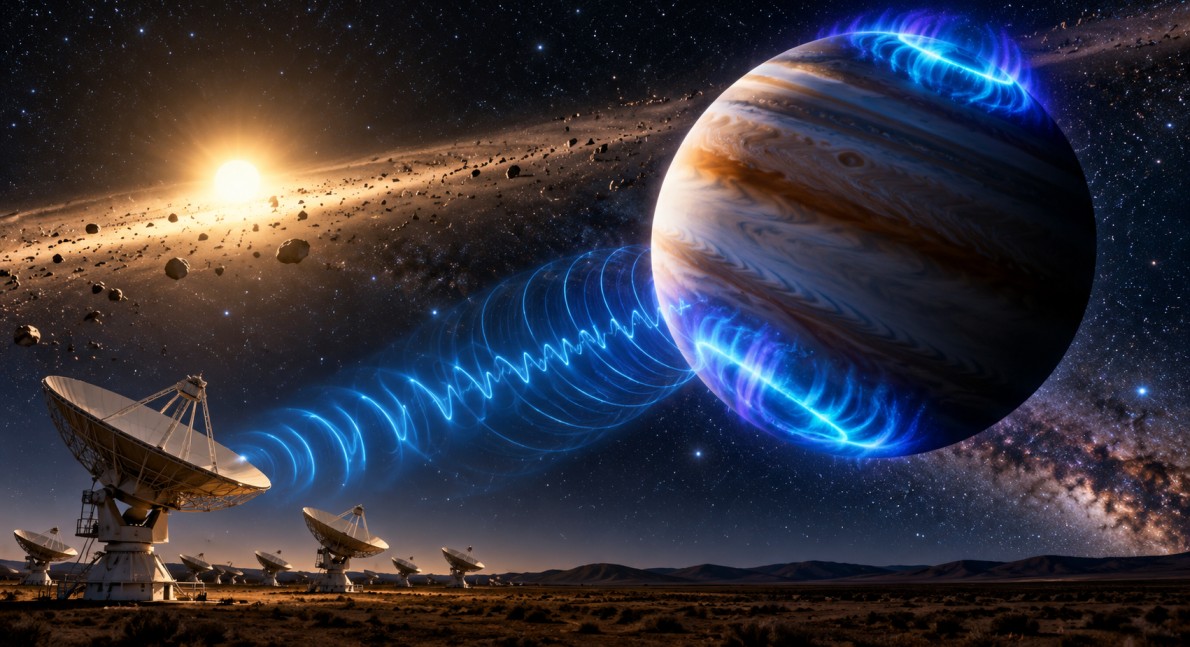
Beta Pictoris b Sends Radio Signals

Beta Pictoris b has become the centre of a major discovery in astronomy after researchers reported radio signals coming directly from an exoplanet outside our Solar System. The signals were detected using South Africa’s MeerKAT radio telescope array and have been linked to auroral activity on the giant gas planet, located about 63–64 light-years from Earth. The research was reported in September 2026 in a preprint, meaning the findings are still awaiting peer review.
Thank you for reading this post, don't forget to subscribe!Radio Signals Detected from an Exoplanet
Astronomers have searched for radio emissions from planets outside the Solar System for many years. One major challenge has been separating a planet’s radio signal from radio activity produced by its host star.
The new observations are important because the research team says the radio source was precisely matched with the position of Beta Pictoris b rather than its star, Beta Pictoris. The study reports that the radio emission was detected during four observing sessions between 2025 and 2026.
The MeerKAT observations covered frequencies from about 0.85 to 3.5 gigahertz. Researchers found rapid, repeating bursts as well as continuing radio emission. Some of the strongest bursts showed high circular polarisation, which is consistent with auroral radio emission.

What Is Beta Pictoris b?
Beta Pictoris b is a young gas giant that orbits the star Beta Pictoris in the constellation Pictor. It is a large planet with a mass estimated at around 12 times that of Jupiter and orbits its star at roughly 10 astronomical units.
The planet is also unusual because it rotates very quickly. Estimates suggest that one rotation takes only around eight to nine hours. Its young age, large size and rapid rotation make it an interesting target for studying planetary magnetic fields and atmospheric activity.
Beta Pictoris b is also among the relatively small number of exoplanets that astronomers have directly observed rather than detecting only through the effects it produces on its star.
Auroras May Be Producing the Radio Emission
The researchers believe the radio signals are linked to auroras. Auroras occur when charged particles interact with a planet’s magnetic environment.
On Earth, auroras are commonly seen near the polar regions when energetic particles interact with the upper atmosphere. Jupiter also produces powerful auroral radio emissions.
In the case of Beta Pictoris b, the radio bursts are consistent with a process known as electron cyclotron maser emission. This process can produce strong radio waves when energetic electrons move through a magnetic field. The circular polarisation seen in the observations provides additional evidence for an auroral origin.
The discovery does not indicate a message from an alien civilisation. The detected radio waves have a natural astronomical explanation and are being studied as evidence of activity around the distant planet.
A Powerful Magnetic Field
One of the most important results from the observation is the estimate of the planet’s magnetic field.
The highest-frequency radio emission reported in the study reaches about 3.5 GHz. Based on the physics of electron cyclotron maser emission, the researchers estimate that the magnetic field in the region producing the radio waves is at least about 1,250 gauss. This would make it far stronger than Earth’s magnetic field.
The result is significant because magnetic fields are difficult to measure directly on distant exoplanets. They can influence how a planet interacts with stellar wind and can also affect the loss of atmospheric material into space.
However, the estimated value should be treated as a research result rather than a final measurement because the study is currently a preprint and has not yet completed peer review.
How Astronomers Confirmed the Source
Finding a radio signal from a distant planetary system is not enough to prove that the planet produced it. The host star can also generate radio emissions.
To solve this problem, researchers used precise positional measurements. They compared the radio observations with the known positions of distant quasars and other reference points to improve the accuracy of the radio image.
According to the research team, the radio source matched the expected position of Beta Pictoris b and was significantly inconsistent with the host star. The analysis also distinguished the source from another planet in the system.
This localisation is a key part of the reported discovery because earlier searches for radio emissions from exoplanets faced difficulties in proving whether the signal came from the planet or its star.
Why the Discovery Matters
The reported detection gives astronomers a new way to study planets that are many light-years away. Instead of depending only on visible or infrared observations, scientists can use radio waves to investigate magnetic activity.
A planetary magnetic field can provide information about the interior and surrounding environment of a planet. It can also help scientists understand how planets interact with radiation and charged particles from their stars.
For young gas giants such as Beta Pictoris b, these observations may help researchers understand how strong magnetic fields develop and how they influence planetary atmospheres.

The discovery also shows the growing role of large radio telescope arrays such as MeerKAT in exoplanet research. Future observations could help determine whether the radio activity changes with the planet’s rotation and whether similar signals can be detected from other exoplanets.
MeerKAT Opens a New Window on Exoplanets
MeerKAT is a major radio telescope array in South Africa consisting of many connected antennas. Its ability to observe faint radio signals across different frequencies made it possible for researchers to study the Beta Pictoris system in detail.
The reported detection is especially important because direct radio observations of exoplanets are extremely challenging. The distance, weak signals and radio activity from stars can make planetary emissions difficult to identify.
The Beta Pictoris b result could therefore lead to more searches for radio auroras around other giant planets. As radio astronomy becomes more sensitive, researchers may be able to compare magnetic fields across different types of exoplanets and better understand how planetary systems evolve.