



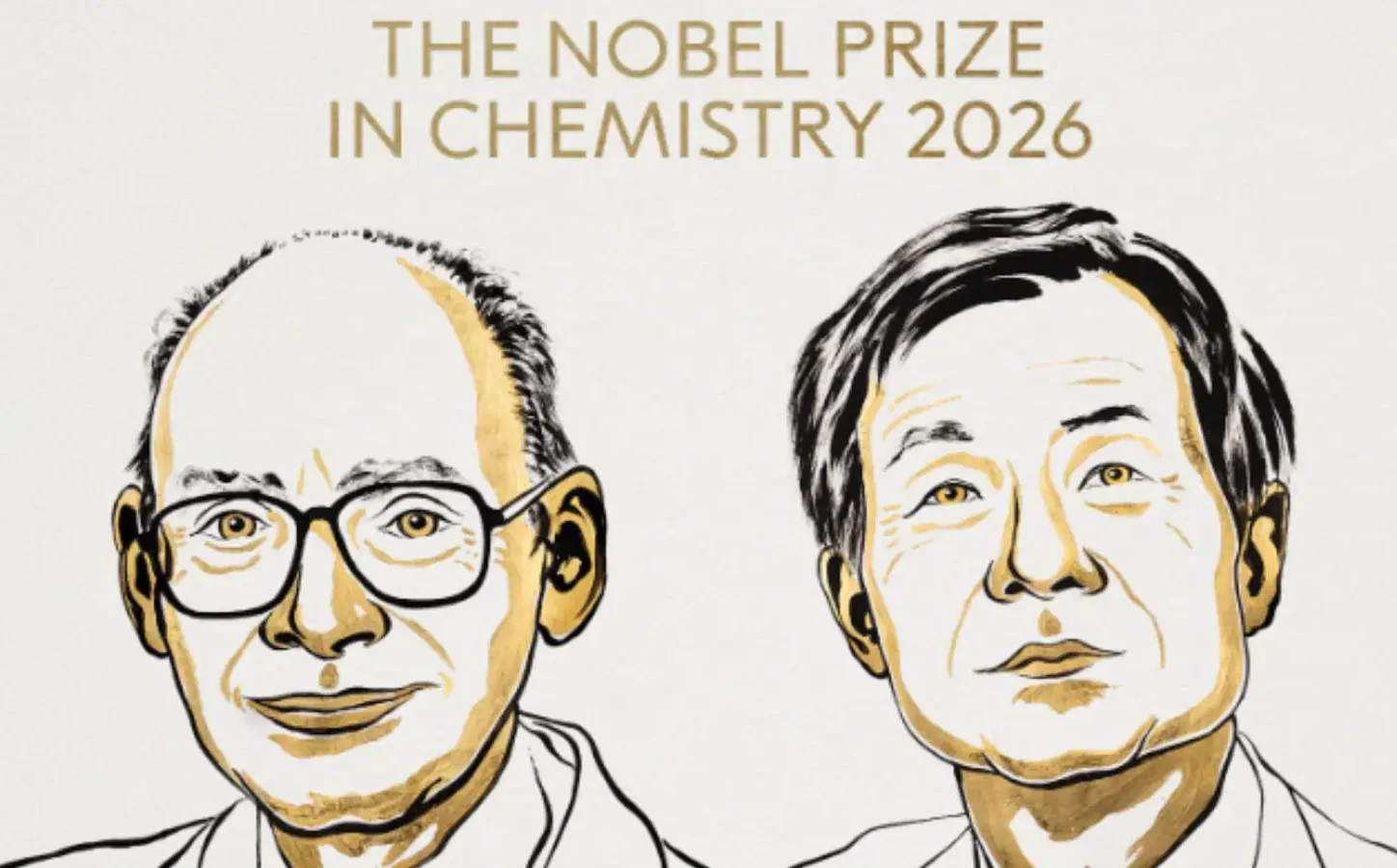
Chemistry Nobel 2026

Chemistry Nobel 2026 has been awarded to Henri B. Kagan and Kenso Soai for their discoveries involving non-linear effects and autocatalysis in asymmetric organic synthesis. The Royal Swedish Academy of Sciences announced the award on October 7, 2026. Their research helped scientists understand how chemical reactions can favour one mirror-image form of a molecule over another, an important area of modern organic chemistry.
Thank you for reading this post, don't forget to subscribe!Kagan and Soai Receive the 2026 Nobel Prize
Henri B. Kagan is associated with Université Paris-Sud in France, while Kenso Soai is affiliated with Tokyo University of Science in Japan. Their work addresses a fundamental question in chemistry: how can a chemical reaction produce mainly one of two possible mirror-image forms?
The two researchers made important contributions to understanding and controlling this process. Their discoveries have helped develop a clearer picture of how molecular “handedness” can be created and strengthened during chemical reactions.
The 2026 Chemistry Nobel carries a prize amount of 12 million Swedish kronor, which will be shared between the two laureates.
What Is Asymmetric Synthesis?
Asymmetric synthesis is a method used to make molecules in which one particular mirror-image form is produced more than the other.

Some molecules can exist in two forms that are mirror images of each other. These forms are called enantiomers. They have the same atoms and chemical connections, but their three-dimensional arrangements are different.
A simple way to understand this is to compare a pair of hands. A left hand and a right hand look similar, but they cannot be placed exactly on top of each other. Molecules with this property are described as chiral.
This difference can be very important in chemistry because biological systems can respond differently to the two forms of the same molecule.
Kagan’s Work on Non-Linear Effects
Henri B. Kagan made major contributions to the study of non-linear effects in asymmetric synthesis.
A non-linear effect occurs when a change in the composition of a chiral catalyst produces a disproportionately large change in the composition of the resulting product. This can help chemists obtain a much larger amount of one desired molecular form.
Kagan’s work provided scientists with important tools for understanding how small differences in molecular handedness can become amplified during chemical reactions.
His research became an important part of the development of modern asymmetric synthesis and helped scientists improve their ability to control the three-dimensional structure of molecules.
Soai and Asymmetric Autocatalysis
Kenso Soai is recognised for his work on asymmetric autocatalysis.
Autocatalysis occurs when a product of a chemical reaction helps speed up the same reaction that produces it. In asymmetric autocatalysis, the product can also influence the reaction so that more molecules with the same handedness are produced.
Soai’s research demonstrated how a small initial imbalance between two mirror-image forms could be amplified through a chemical reaction.
This work helped provide an experimental way to study how a chemical system could move towards producing predominantly one molecular form.
Why Molecular Handedness Matters
The Chemistry Nobel recognition is closely connected to the importance of chirality in biology and medicine.
Living organisms often use one particular form of a chiral molecule. The two mirror-image forms of a molecule can interact differently with biological molecules such as proteins and enzymes.
This difference is especially important in pharmaceutical research. When scientists develop medicines, they need to understand how the structure of a molecule affects the way it interacts with the human body.
Better control of molecular handedness can therefore help chemists produce compounds with specific structures and properties.
A Long-Standing Chemical Question
The work of Kagan and Soai also addresses a much older question in chemistry: how can one molecular form become dominant when two mirror-image forms are possible?
Their discoveries showed how chemical reactions can amplify a small difference instead of simply producing equal amounts of both forms.
The Nobel Committee described their work as providing insight into how homochirality can emerge. Homochirality refers to a situation where one of two possible molecular forms dominates. This concept is particularly important when studying biological molecules and the chemistry associated with life.
Importance for Modern Chemistry
The Chemistry Nobel 2026 highlights the importance of controlling molecular structure during chemical synthesis.

Modern chemistry increasingly focuses not only on making a molecule but also on controlling exactly how its atoms are arranged in three dimensions. This is particularly relevant to pharmaceuticals, advanced materials and other areas where molecular structure can influence how a substance behaves.
Kagan’s research on non-linear effects and Soai’s work on asymmetric autocatalysis provided different but connected insights into this problem.
Their discoveries have helped expand the understanding of asymmetric organic synthesis and the ways chemical reactions can favour one molecular form over another.
Nobel Chemistry Award in 2026
The award to Kagan and Soai is the third science Nobel announced during Nobel Week 2026, following the prizes in Physiology or Medicine and Physics.
The Chemistry Nobel announcement also highlights the international nature of modern scientific research, bringing together work from France and Japan.
The two scientists’ discoveries have connected fundamental questions about molecular structure with practical methods for controlling chemical reactions. Their work continues to influence research into chirality, asymmetric synthesis and autocatalytic chemical processes.