
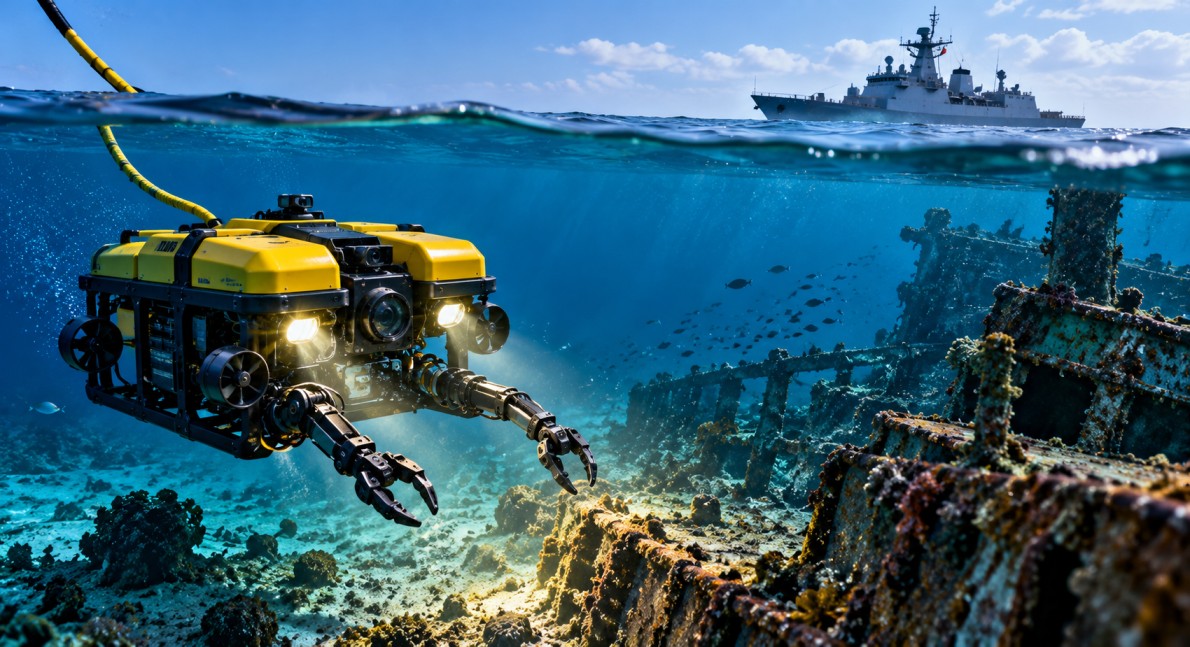
Underwater Robotics in Navy

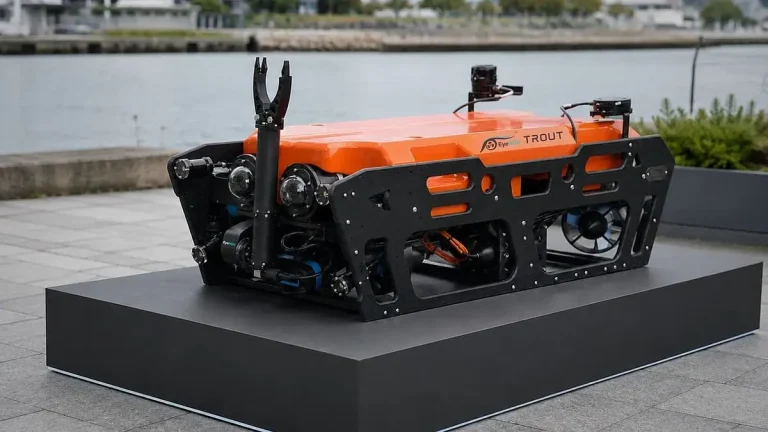
Underwater Robotics is becoming an important part of modern maritime operations, with uncrewed systems now being used for inspection, surveillance, search and recovery, scientific research and underwater infrastructure work. The technology is also gaining attention in India after Kochi-based deep-tech company EyeROV delivered two TROUT military-grade remotely operated vehicles (ROVs) to the Indian Navy on October 7, 2026. The delivery is part of an order for five systems and marks an important step in the development of indigenous underwater technology.
Thank you for reading this post, don't forget to subscribe!What Is Underwater Robotics?
Underwater robotics refers to machines that can operate below the ocean surface without putting a person directly into the water. These systems can carry cameras, sonar, lights, sensors and other equipment to collect information or perform specific tasks.
The technology is particularly useful in deep water, poor visibility, strong currents and other conditions where sending divers can be difficult or risky. Depending on their design, underwater robots can inspect structures, collect data, locate objects and perform physical work below the surface.
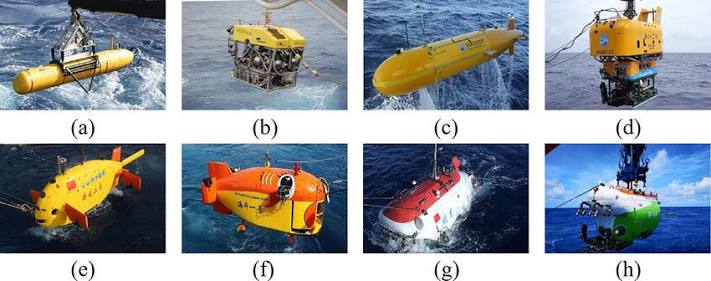
Two major types are remotely operated vehicles and autonomous underwater vehicles.
ROVs and AUVs Have Different Roles
A remotely operated vehicle, or ROV, is controlled by an operator from a vessel or another control station. It is normally connected to the surface through a tether that carries commands and data and, depending on the system, power.
This arrangement allows the operator to see information from the vehicle and control its movements in real time. ROVs can also be equipped with robotic arms for tasks that require physical intervention.
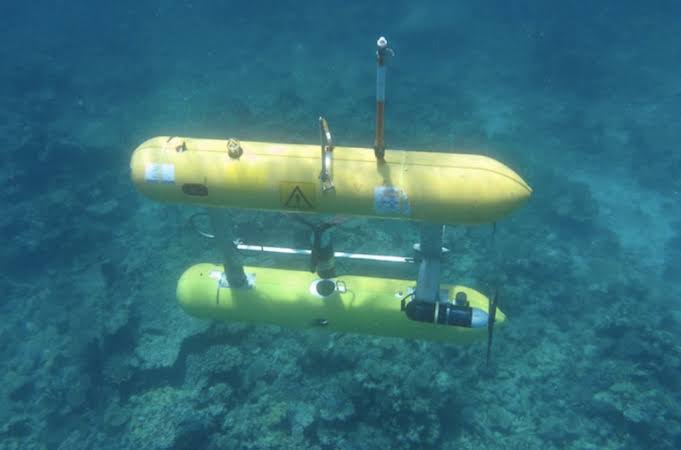
Autonomous underwater vehicles, or AUVs, work differently. They can follow a planned mission without continuous direct control through a tether. They are useful for tasks such as seabed surveys, mapping and environmental data collection.
The choice between an ROV and an AUV depends on the mission. ROVs are useful when operators need direct control, while AUVs can cover larger areas during planned underwater missions.
Indian Navy Receives Indigenous TROUT ROVs
The recent delivery of Underwater Robotics to the Indian Navy has brought the technology into sharper focus in India. EyeROV delivered two TROUT systems as the first part of a five-system Navy order.
TROUT is described as India’s first military-grade ROV built for naval operations. It was developed through the iDEX DISC 7 SPRINT Challenge, which supports the development of strategically important technologies for the Indian Armed Forces.
The system underwent field trials and system-level testing for manoeuvrability, deep-diving capability, navigation, endurance, detection and operation in strong underwater currents. It also went through the quality assurance framework of the Directorate of Quality Assurance (Naval).
Underwater Surveillance and Maritime Security
One of the major uses of Underwater Robotics is maritime security. ROVs can help inspect underwater areas around ports, harbours, ships and other important locations.
Cameras and sensors allow operators to examine areas that may be difficult to reach directly. This can support surveillance and reconnaissance while keeping personnel away from potentially dangerous underwater environments.
The technology can also support maritime domain awareness by providing additional information about underwater conditions and objects.
Mine Detection and Hazardous Objects
Underwater robots can also support mine countermeasure operations. Their sensors can be used to detect and classify suspicious objects on or below the seabed.
Keeping personnel away from potentially dangerous objects is one of the main advantages of using uncrewed systems. Depending on the vehicle and mission, robotic systems may also support further inspection or intervention.
The exact capabilities depend on the sensors, navigation equipment and robotic tools installed on each vehicle.
Search, Recovery and Inspection
ROVs are widely useful in underwater search and recovery operations. They can help locate objects such as wreckage, aircraft components and other equipment beneath the water.
Their cameras can provide real-time images to operators, while other sensors can help locate objects in dark or low-visibility conditions.
Underwater robots can also inspect ship hulls, underwater structures and subsea equipment. These inspections can help identify damage without requiring divers to remain underwater for long periods.
Offshore Energy and Infrastructure
The use of Underwater Robotics extends beyond defence. Offshore oil and gas facilities use ROVs for inspection and maintenance of subsea infrastructure, including pipelines and platforms.
Similar technology is increasingly relevant to offshore wind farms and other marine energy projects. Robots can inspect underwater components, cables and foundations, helping operators monitor equipment in difficult conditions.
India is also exploring underwater robotics for infrastructure inspection and marine conservation. A July 2026 NITI Aayog technology feature highlighted indigenous underwater robots being used for infrastructure inspection and coral reef surveys in areas including the Andaman and Lakshadweep regions.
Cameras, Sonar and Robotic Arms
Modern underwater robots can carry several types of equipment. High-resolution cameras provide visual information, while sonar can help detect objects when visibility is poor.
Environmental sensors can measure factors such as temperature, pressure and water conditions. More advanced vehicles may also carry manipulator arms that allow them to collect samples or interact with underwater objects.
These technologies make underwater robots useful for both observation and physical intervention, depending on the vehicle’s design.
India Builds Indigenous Marine Robotics
The development of TROUT also reflects India’s wider push to build advanced defence technologies domestically. The iDEX ecosystem supports innovators and companies working on technologies for India’s armed forces.
TROUT’s development brought together mechanical engineering, electronics, software, navigation, sensing, communication and robotic control. Its delivery to the Navy moves the system from development and testing towards operational use.
The recent delivery shows how India’s defence technology ecosystem is expanding into underwater systems, an area that requires specialised engineering because equipment must operate reliably under pressure, limited visibility and strong currents.
Growing Role of Underwater Robotics
The growing use of Underwater Robotics reflects a wider change in maritime operations. Navies, industries and research organisations are increasingly using uncrewed systems to collect information and perform tasks in environments that are difficult for humans to access.
For India, the delivery of the TROUT systems adds a new indigenous capability to this field. As underwater technology develops further, ROVs, AUVs, sensors and AI-based analysis could play a larger role in maritime security, infrastructure inspection, ocean research and underwater recovery operations.