

China Export Controls on US Firms

China Export Controls have become a major global topic as China announced new restrictions on several companies from the United States on 22 June 2026. The move reflects rising trade and security concerns between the two countries. These restrictions were introduced by the Ministry of Commerce along with the finance ministry.
Thank you for reading this post, don't forget to subscribe!The decision includes limits on exports and a ban on government purchases from selected US firms. This step highlights ongoing tensions in technology, defence, and trade sectors.
Companies Added to Export Control List
China has added 10 American firms to its export control list. These include Red Cat Holdings, Teal Drones, Ball Aerospace & Technologies, Oshkosh Defense, and L3Harris Maritime Services.
Other firms such as MP Materials and USA Rare Earth are also included. These companies are involved in sectors like defence, drones, and rare earth materials.
The inclusion of these firms shows a focus on industries linked to national security and advanced technology.
What Are Dual-Use Items
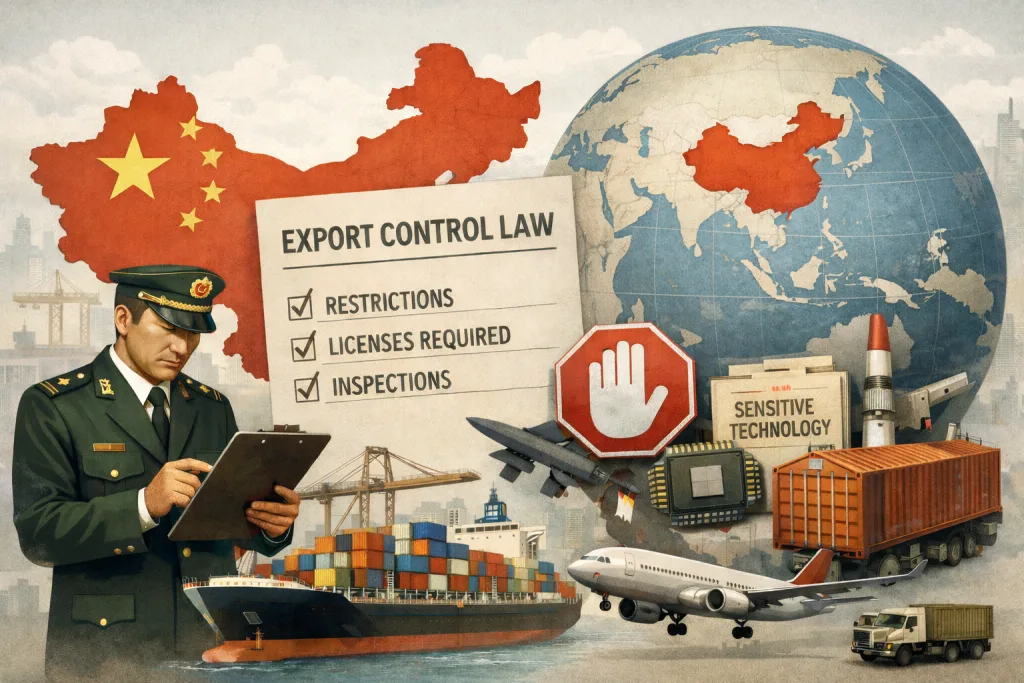
The export controls mainly target dual-use items. These are products, software, or technologies that can be used for both civilian and military purposes.
For example, certain electronics or materials used in communication systems can also be used in defence equipment. Because of this, many countries regulate such items carefully.
Under the new rules, these items cannot be supplied to the listed companies. This restriction applies not only within China but also to global supply chains connected to Chinese products.
Restrictions on Trade and Supply Chains
The new policy requires that all ongoing exports of dual-use items to these companies must stop immediately. Businesses and individuals are also restricted from transferring such items if they originate from China.
This move can affect global supply chains, especially in industries that depend on Chinese materials or components. Companies may need to find alternative sources or adjust their operations.
The restrictions highlight how trade policies can influence global business networks.
Ban on Government Procurement
In addition to export controls, China has also restricted government purchases from 46 US companies. This includes major defence firms like Lockheed Martin, Raytheon Missiles & Defense, and Boeing’s defence division.
This means that Chinese government agencies will no longer buy products or services from these firms. Such actions can have financial and strategic impacts on companies involved in defence and technology.
Background of Rising Tensions
The decision comes after recent developments in US policies. The United States Department of Defense expanded its list of Chinese military-linked companies.
In response, China has taken these measures as part of a broader strategy to protect its national interests. Both countries have been using trade and technology controls as tools in their ongoing competition.
This situation reflects a larger global trend where economic and security policies are closely connected.
Role of Rare Earth Materials
Rare earth elements play an important role in modern industries. They are used in electronics, electric vehicles, renewable energy systems, and defence equipment.
Companies like MP Materials and USA Rare Earth are key players in developing supply chains outside China.
By including these companies in its control list, China is highlighting the importance of rare earth resources in global trade and technology competition.
Global Impact on Technology Sector
The China Export Controls decision may affect industries such as drones, aerospace, and advanced manufacturing. Companies in these sectors rely on international partnerships and supply chains.
Restrictions on technology transfer can slow down projects and increase costs. It may also encourage countries to invest more in domestic production and reduce dependence on foreign suppliers.
This shift is already visible in sectors like semiconductors and clean energy.
Changing Trade Policies Worldwide
Countries around the world are increasingly using export controls and trade restrictions to protect their interests. These policies are often linked to national security and technological leadership.
The current situation between China and the United States is one of the most visible examples of this trend. It shows how global trade is evolving in response to new challenges.
Additional Perspective on Global Economy
The China Export Controls move also reflects how economic decisions are becoming more strategic. Trade is no longer just about buying and selling goods but also about controlling technology and resources. As countries focus on self-reliance and security, such policies may become more common in the future.