


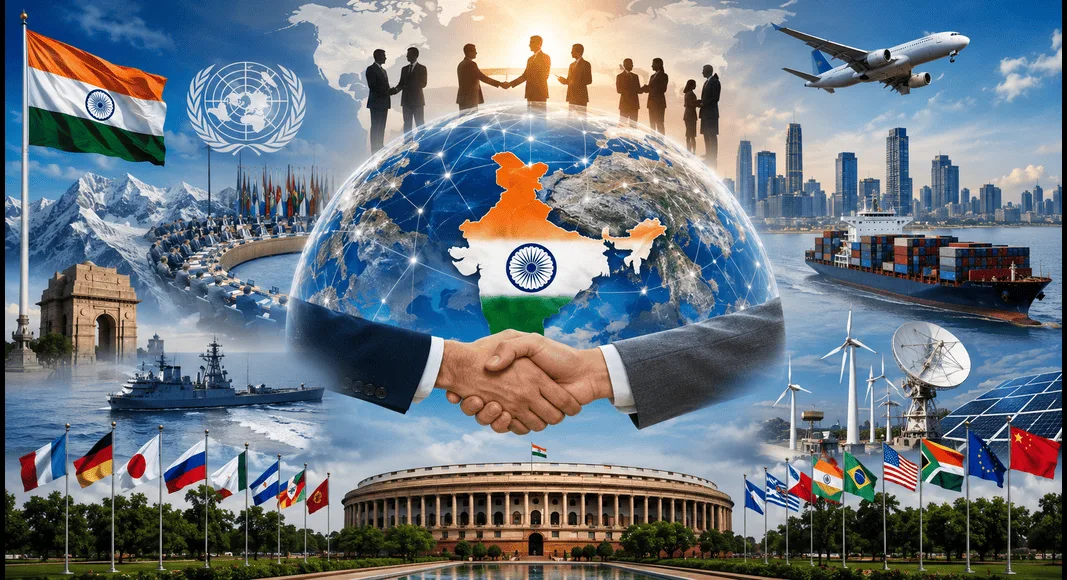
Indian Foreign Policy: Evolution, Phases and Key Developments

Phases of Indian Foreign Policy explain how India’s relations with other countries have changed since Independence in 1947. Foreign policy is the strategy a country follows to protect its national interests, maintain security, promote economic growth, and build friendly relations with other nations. India’s foreign policy has evolved according to changing global situations, national priorities, and international challenges.
Thank you for reading this post, don't forget to subscribe!Since Independence, India has faced many global and regional developments such as the Cold War, the rise of new powers, economic globalization, terrorism, climate change, and technological transformation. These changes have influenced India’s foreign policy over time.
Introduction to Indian Foreign Policy
Foreign policy refers to a country’s approach toward other nations and international organizations. It includes decisions related to diplomacy, trade, security, defense, international cooperation, and global issues.
India’s foreign policy is based on certain fundamental principles:
- Respect for sovereignty and territorial integrity.
- Peaceful coexistence.
- Non-interference in internal affairs of other countries.
- Promotion of international peace.
- Strategic autonomy.
- Protection of national interests.
Since 1947, India’s foreign policy has undergone several changes. Experts generally divide it into six major phases.
Global Changes and Their Impact on India
The world today is very different from what it was in 1947. Several developments have transformed international politics:
- Rise of China as a global power.
- Growing influence of India.
- Return of Russia as a major geopolitical player.
- Conflicts in the Middle East.
- Global terrorism.
- Climate change challenges.
- Technological advancements.
- Expansion of international trade and connectivity.
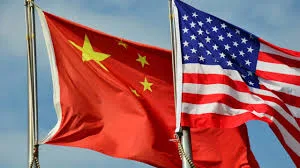
- Competition between major powers such as the United States and China.
These changes have required India to continuously adapt its foreign policy.
First Phase (1947-1962): Optimistic Non-Alignment
The first phase of Indian foreign policy began after Independence in 1947 and lasted until the India-China War in 1962.
Background
The world was divided into two major blocs:
- United States-led Western bloc.
- Soviet Union-led Communist bloc.
This period is known as the Cold War era.
India’s Objectives
India focused on:
- Protecting its newly gained independence.
- Maintaining sovereignty.
- Rebuilding the economy.
- Preserving territorial integrity.
- Supporting decolonization movements.
Policy of Non-Alignment
India did not want to join either the US bloc or the Soviet bloc.
Instead, it adopted the policy of Non-Alignment, meaning:
- Independent decision-making.
- No military alliance with major powers.
- Maintaining friendly relations with all countries.
Non-Aligned Movement (NAM)
India played a major role in creating the Non-Aligned Movement (NAM) in 1961.
Important leaders associated with NAM included:
- Jawaharlal Nehru
- Josip Broz Tito
- Gamal Abdel Nasser
Achievements
- Leadership among newly independent nations.
- Strong moral standing in global affairs.
- Support for Asian and African countries.
Challenges
India’s idealistic approach faced a major setback during the 1962 India-China War.
The conflict exposed weaknesses in India’s defense preparedness and marked the end of this phase.
Second Phase (1962-1971): Realism and Recovery
The defeat in the 1962 war forced India to rethink its foreign policy.
Shift Toward Realism
India realized that moral diplomacy alone was not enough.
National security became a higher priority.
Major Developments
- Expansion of military capabilities.
- Increased defense spending.
- Strengthening international partnerships.
Relations with the United States
In the 1960s, India signed defense cooperation agreements with the United States.
However, disagreements over Pakistan and Kashmir limited deeper cooperation.
Tashkent Agreement (1966)
After the 1965 India-Pakistan War, India and Pakistan signed the:
Tashkent Agreement
Key objectives included:
- Withdrawal of troops.
- Restoration of diplomatic relations.
- Reduction of tensions.
Growing Ties with Soviet Union
Due to Western support for Pakistan, India gradually moved closer to the Soviet Union.
Significance
This period marked India’s transition from idealism to realism in foreign policy.
Third Phase (1971-1991): Regional Assertion
This period witnessed India’s emergence as a major regional power.
Bangladesh Liberation War (1971)
One of the most significant events was the:
Bangladesh Liberation War
India supported Bangladesh’s independence movement.
Outcome
- Creation of Bangladesh.
- Major strategic victory for India.
- Enhanced regional influence.
Nuclear Capability
India conducted its first nuclear test in 1974.
Pokhran-I
Pokhran-I
The test demonstrated India’s scientific and strategic capabilities.
International Reaction
Many Western countries imposed sanctions.
Challenges During This Phase
India faced:
- US-China-Pakistan cooperation.
- Regional security concerns.
- Economic difficulties.
- Dependence on Soviet support.
End of the Phase
The collapse of the Soviet Union in 1991 created major challenges for India.
At the same time, India faced a severe economic crisis.
These developments forced India to rethink both domestic and foreign policies.
Fourth Phase (1991-1998): Strategic Autonomy
The end of the Cold War created a new international environment.
The United States emerged as the dominant global power.
Economic Reforms
India launched major economic reforms in 1991.
These reforms opened the economy to global markets and foreign investment.
New Foreign Policy Priorities
India focused on:
- Economic diplomacy.
- Strategic autonomy.
- Diversified partnerships.
Expanding Global Engagement
India strengthened relations with:
- United States
- Israel
- ASEAN countries
- European nations
Importance of Strategic Autonomy
India wanted to maintain independence in decision-making without becoming dependent on any major power.
Fifth Phase (1998-2013): India as a Balancing Power
This phase marked India’s rise as an important global actor.
Pokhran-II Nuclear Tests
In 1998, India conducted:
Pokhran-II
Impact
- India declared itself a nuclear weapon state.
- Demonstrated strategic capability.
- Increased global attention.
India-US Relations Improve
A major milestone was the:
India-United States Civil Nuclear Agreement
The agreement strengthened strategic cooperation between India and the United States.
Engagement with China
India cooperated with China on:
- Trade
- Climate change negotiations
- Global economic issues
Despite border disputes, both countries expanded economic ties.
Strengthening BRICS
India played an important role in:
BRICS
The group became an influential platform for emerging economies.
Characteristics of This Phase
- Growing global influence.
- Economic growth.
- Strategic balancing among major powers.
- Increased participation in international institutions.
Sixth Phase (2013-Present): Energetic Engagement and Multi-Alignment
The current phase is characterized by active global engagement.
India has moved from Non-Alignment to Multi-Alignment.
What is Multi-Alignment?
India now works with multiple countries simultaneously based on specific interests.
Instead of choosing one bloc, India partners with different nations on different issues.
Key Features
Stronger Global Presence
India is now one of the world’s largest economies.
It actively participates in:
- Climate negotiations.
- Trade discussions.
- Security partnerships.
- Technology cooperation.
SAGAR Initiative
SAGAR
This initiative promotes cooperation in the Indian Ocean Region.
Act East Policy
India has strengthened ties with Southeast Asian countries through:
Act East Policy
Objectives include:
- Trade expansion.
- Strategic cooperation.
- Regional connectivity.
Think West Policy
India has also increased engagement with Middle Eastern countries.
Areas of cooperation include:
- Energy security.
- Trade.
- Investment.
- Diaspora welfare.
India’s Growing Global Role
India now contributes actively to discussions on:
- Climate change.
- Maritime security.
- Terrorism.
- Digital governance.
- Sustainable development.
Important Lessons from the Phases of Indian Foreign Policy
1. Importance of Realism
Foreign policy should be based on practical realities.
The 1962 war showed that idealism alone cannot guarantee security.
Strong defense capabilities are essential.
2. Strong Economy is Essential
Economic strength directly affects global influence.
Countries like China gained international influence largely through economic growth.
India’s future global role depends heavily on economic development.
3. Need for Multi-Alignment
Today’s world is complex and interconnected.
India must maintain relations with multiple partners simultaneously.
Examples include cooperation with:
- United States
- Russia
- Japan
- Europe
- ASEAN countries
- Middle Eastern nations
4. Greater Strategic Confidence
India should participate more actively in global affairs.
Examples include:
- Disaster relief operations.
- Humanitarian assistance.
- Climate diplomacy.
- Maritime security initiatives.
5. Correct Assessment of Global Trends
Foreign policy decisions must be based on a clear understanding of international developments.
Misreading global situations can have long-term consequences.
Careful analysis of global power shifts remains important.
Challenges Before Indian Foreign Policy
Despite many successes, several challenges remain:
Border Disputes
India continues to face border issues with neighboring countries.
Terrorism
Cross-border terrorism remains a major security concern.
China’s Rise
China’s growing influence creates strategic challenges.
Energy Security
India depends heavily on imported energy resources.
Climate Change
Climate-related challenges increasingly affect international relations.
Global Economic Uncertainty
Trade conflicts and economic slowdowns impact India’s interests.
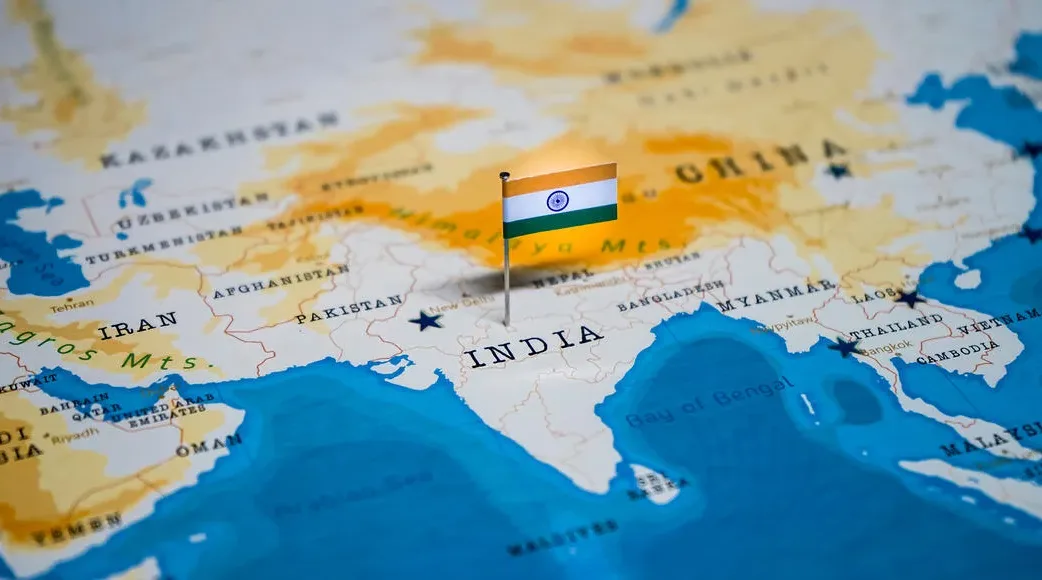
Future of Indian Foreign Policy
The future of Indian foreign policy will likely focus on:
- Economic growth.
- Strategic autonomy.
- Technological leadership.
- Climate cooperation.
- Regional stability.
- Maritime security.
- Stronger global partnerships.
India is expected to play a larger role in international organizations and global decision-making processes.
The country will continue working with different partners while protecting its national interests.
Conclusion
Phases of Indian Foreign Policy reflect India’s journey from a newly independent nation to an emerging global power. Starting with Non-Alignment, India gradually adopted realism, strengthened regional influence, pursued strategic autonomy, became a balancing power, and now follows a policy of multi-alignment.
Each phase has contributed valuable lessons. India has learned that diplomacy must be supported by economic strength, military capability, technological progress, and strategic thinking. In today’s rapidly changing world, India continues to build partnerships across regions while safeguarding its sovereignty and national interests.
As global politics becomes increasingly complex, India’s foreign policy will remain focused on maintaining strategic flexibility, promoting peace, encouraging development, and securing a stronger place in the international order.
FAQs About Indian Foreign Policy
1. What is Indian Foreign Policy?
Indian Foreign Policy is the strategy and approach India uses to manage its relations with other countries and international organizations.
2. What are the main objectives of Indian Foreign Policy?
Its main objectives are protecting national interests, maintaining security, promoting economic growth, and ensuring peaceful international relations.
3. How many phases of Indian Foreign Policy are commonly identified?
Indian Foreign Policy is generally divided into six major phases from 1947 to the present.
4. What was the first phase of Indian Foreign Policy?
The first phase (1947–1962) was known as the period of Optimistic Non-Alignment during the Cold War.
5. What is the Non-Aligned Movement (NAM)?
NAM is an international group of countries that chose not to align with either the US-led or Soviet-led bloc during the Cold War.
6. Why was the 1962 India-China War important for foreign policy?
The war highlighted security weaknesses and pushed India toward a more realistic and defense-focused foreign policy.
7. What was the significance of the 1971 Bangladesh War?
The war led to the creation of Bangladesh and established India as a major regional power in South Asia.
8. What is Strategic Autonomy in Indian Foreign Policy?
Strategic Autonomy means India makes independent foreign policy decisions without being controlled by any major power.
9. What is Multi-Alignment?
Multi-Alignment is India’s approach of maintaining strong relations with multiple countries based on national interests.
10. Why is Indian Foreign Policy important?
It helps protect India’s security, strengthen its economy, promote global cooperation, and enhance its international influence.