Comet 3I/ATLAS Rapid Brightening: Spacecraft Capture Stunning Interstellar Visitor’s Solar Encounter

The Comet 3I/ATLAS Rapid Brightening has drawn the attention of astronomers worldwide as it made its close approach to the Sun on Thursday, October 29, producing a spectacular display captured not by Earth-based telescopes but by spacecraft observing the inner solar system. The comet, which originates from beyond our solar system, underwent a striking surge in brightness as it passed behind the Sun, marking another fascinating chapter in humanity’s study of interstellar visitors.
Thank you for reading this post, don't forget to subscribe!Understanding the Origins of Comet 3I/ATLAS Rapid Brightening
Comet 3I/ATLAS is only the third confirmed interstellar comet observed passing through our solar system, following in the footsteps of ‘Oumuamua (1I/2017 U1) and Borisov (2I/2019 Q4). Unlike comets native to our system, these objects travel on hyperbolic orbits that indicate they entered from the vast interstellar space between the stars. Their brief encounters with the Sun offer scientists invaluable opportunities to study matter that formed around other stars billions of years ago.
As 3I/ATLAS approached the inner solar system, astronomers anticipated a rise in brightness caused by increasing solar radiation. When comets near the Sun, the heat vaporizes volatile materials like ice and carbon compounds, releasing jets of gas and dust that form a visible coma and tail. In this case, despite being hidden behind the Sun from Earth’s direct view, the comet’s transformation was clearly visible in space-based imagery.
Spacecraft Tracking and Geometry of Comet 3I/ATLAS Rapid Brightening
While the comet’s trajectory carried it temporarily behind the Sun, rendering it invisible to ground-based telescopes, a fleet of space observatories continued to track its journey. Observers utilized instruments designed for solar research, which are capable of blocking the Sun’s blinding glare to reveal faint nearby objects such as comets.
Among the key spacecraft involved were:
- NOAA’s GOES-19, whose CCOR-1 coronagraph first detected the comet as it entered the solar vicinity.
- NASA–ESA’s SOHO spacecraft, using its LASCO C3 instrument, provided consistent imaging until October 26, tracing the comet’s brightening arc through the inner heliosphere.
- NASA’s PUNCH mission, consisting of four small satellites designed to study the Sun’s outer corona and solar wind, also captured valuable data as the comet passed through its field of view.
Together, these missions offered a continuous record of 3I/ATLAS’s path and activity, overcoming the viewing limitations imposed by its behind-the-Sun geometry.
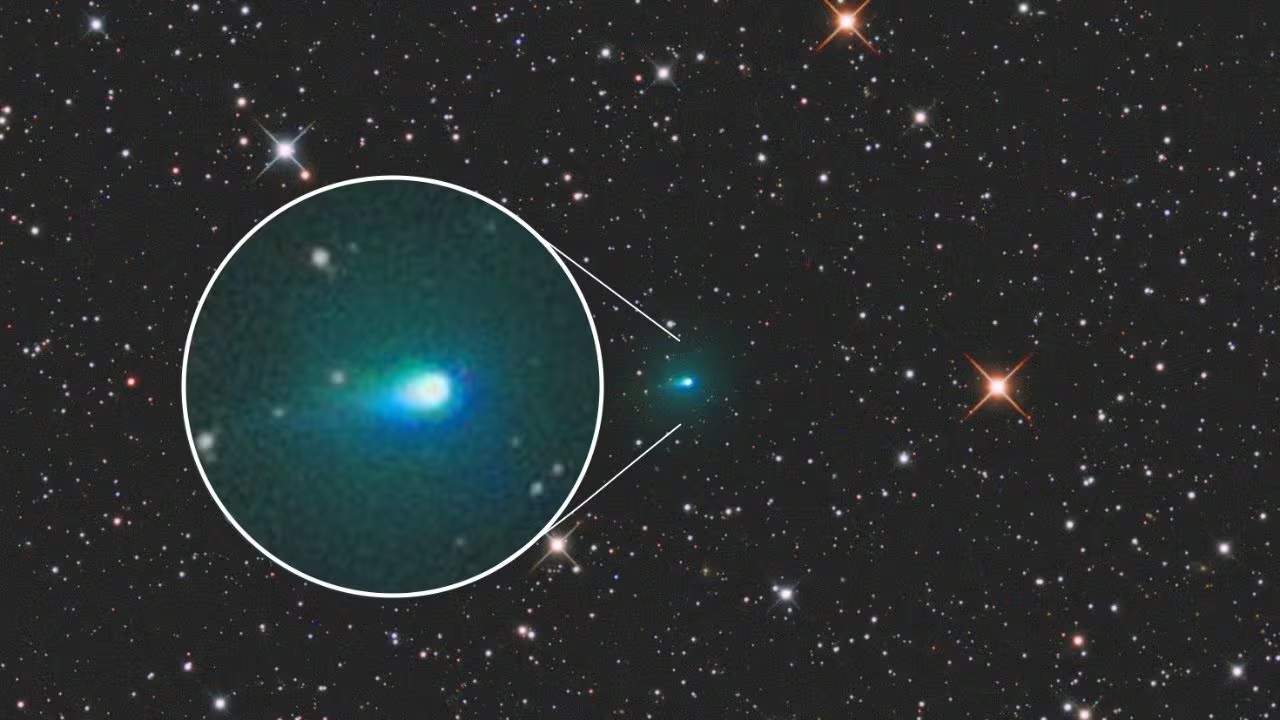
Rapid Brightening and Solar Activity of Comet 3I/ATLAS Rapid Brightening
As 3I/ATLAS neared perihelion its closest point to the Sun astronomers recorded a rapid surge in luminosity, consistent with intensified volatile release from its surface. Early estimates suggested that the comet’s brightness increased from magnitude ~11 to around ~9, a significant change indicating active sublimation of surface materials.
While such brightness levels remain beyond naked-eye visibility, they place the comet within reach of medium-sized amateur telescopes, once it emerges from solar conjunction and becomes observable again from Earth. This brightening not only underscores the comet’s intrinsic activity but also hints at its unique composition, potentially differing from solar system comets in its dust and gas ratios.
What the Instruments Revealed
The comet’s passage was meticulously documented by both professional researchers and skilled amateur astronomers monitoring spacecraft feeds.
One of the first to spot the brightening was Worachate Boonplod, an experienced comet tracker who identified 3I/ATLAS in GOES-19 coronagraph imagery. His observations confirmed that the comet remained visible in the instrument’s field until October 24.
Meanwhile, SOHO’s LASCO C3 imagery provided dynamic views of the comet’s evolving coma as it reacted to intense solar radiation. The data hinted at burst-like activity, possibly due to the fragmentation of volatile-rich layers within the nucleus. NASA’s PUNCH mission added complementary perspectives, revealing how the comet’s dust tail extended and interacted with the solar wind, creating fine streamers of charged particles swept away by the Sun’s magnetic field.
Coronagraphs, by design, block the Sun’s bright disk to expose faint features around it a technique essential for studying both solar phenomena and comets like 3I/ATLAS during such close encounters.
What Makes This Brightening Scientifically Valuable
The Comet 3I/ATLAS Rapid Brightening event offers more than just a visual spectacle; it provides a scientific goldmine for researchers studying the composition and dynamics of interstellar material. Since interstellar comets originate outside our solar system, they carry chemical signatures from the environments where they formed possibly around other stars with very different elemental compositions.
By analysing the rate of brightening, dust-to-gas ratios, and ejection velocities, scientists can infer the thermal properties and structural integrity of the comet’s nucleus. Observations like these could reveal whether interstellar comets have denser refractory materials or more volatile-rich ices compared to solar system comets. This, in turn, helps researchers refine models of planetary formation across different star systems.
Additionally, spacecraft tracking data during perihelion provide insights into how interstellar bodies respond to solar radiation pressure and magnetic interactions, factors that influence their trajectories and surface evolution.
Visibility Prospects as the Comet Re-emerges
With 3I/ATLAS now moving away from its closest solar approach, prospects for ground-based observation are steadily improving. Once the comet gains sufficient solar elongation the angular distance from the Sun in the sky astronomers expect to resume optical and spectroscopic monitoring using both professional observatories and advanced amateur setups.
If the comet maintains its post-perihelion activity, small telescopes under dark skies may reveal a compact coma and a developing dust tail. Continued study will help determine whether 3I/ATLAS remains structurally intact or undergoes fragmentation, a fate common among comets exposed to intense solar heat.
A Rare Glimpse Beyond Our Solar System
Each interstellar visitor like 3I/ATLAS expands our understanding of cosmic diversity. These objects, forged in distant star systems and ejected into interstellar space, carry clues to the chemistry and physics of planetary formation beyond the Sun’s domain.
The comet’s rapid brightening near perihelion, captured beautifully by space-based observatories, stands as a reminder of how interconnected modern astronomical science has become blending planetary defence networks, solar monitoring missions, and cometary research into a unified observation effort.
As Comet 3I/ATLAS continues its journey back into the depths of space, astronomers will keep analysing its behaviour to unlock the mysteries of material born under alien suns.