

Common Envelope Evolution: Giant Star Engulfs Its Companion

Common Envelope Evolution has been directly observed by astronomers for the first time, providing new information about how massive stars interact with smaller companion stars. The event, named AT 2025abao and nicknamed “Bao”, took place in the Andromeda galaxy, around 2.5 million light-years from Earth. During this rare event, a giant star began engulfing its smaller companion as the companion moved through the outer layers of the larger star. The findings were published in the scientific journal Nature on 18 November 2026. This observation gives researchers an opportunity to study a major process involved in the development and final stages of some star systems.
First Direct Observation of Common Envelope Evolution
Astronomers have long studied common envelope evolution through theoretical models and indirect evidence. However, observing the process directly has been difficult because it takes place inside the outer layers of a giant star.

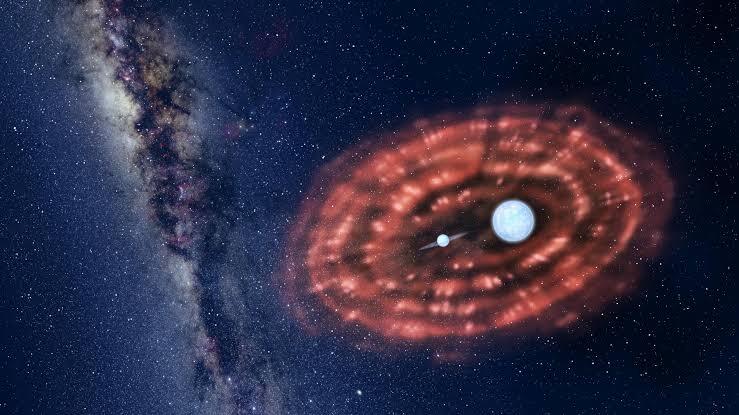
In the AT 2025abao event, scientists observed a smaller companion star moving into the outer atmosphere of a much larger star. As it travelled deeper, the companion interacted with the gas surrounding the giant star. This process caused changes in the system and eventually led to a powerful eruption.
The research team was led by Viraj Karambelkar, a NASA Hubble Fellow at Columbia University. The observation is important because it provides evidence about how two stars interact when one becomes large enough to surround the other.
Researchers believe that studying this event will help improve scientific understanding of binary star systems and the processes that can lead to the formation of different types of stellar objects.
The Seven-Year Stellar Event in the Andromeda Galaxy
The event began in 2018 when the smaller companion started moving into the outer layers of the giant star. It gradually spiralled towards the central region of the larger star over approximately seven years.
The giant star was a puffy supergiant with a mass around seven times that of the Sun. Its radius was approximately 350 times the Sun’s radius. In comparison, the smaller companion had a mass of about 0.7 times the Sun’s mass.
Astronomers first noticed unusual brightening from the system in 2023. This change attracted attention because the brightness did not follow the usual pattern expected from an ordinary star system.
A much stronger eruption occurred on 17 October 2025. During this event, the system reportedly reached a brightness around one million times that of the Sun. The powerful outburst provided researchers with important information about the material being released as the companion moved through the giant star’s outer layers.
James Webb Space Telescope Observes the Event
The James Webb Space Telescope (JWST) also played an important role in studying the stellar event. It observed AT 2025abao in December 2025, around 47 days after the eruption reached its peak.
The telescope’s observations helped researchers examine the material released during the outburst. Estimates suggest that approximately 0.1 to 0.2 solar masses of material were expelled into space.
The James Webb Space Telescope is designed to observe the universe using infrared light. It helps astronomers study distant galaxies, stars, planetary systems and objects that may be difficult to observe with other telescopes.
Its observations of Bao provided additional information about the eruption and the surrounding material. Scientists can use these findings alongside other observations to understand how the interaction developed over time.
However, researchers have not yet confirmed whether the two stars finally merged. Further monitoring of the system is needed to determine its final condition.
What Is Common Envelope Evolution?
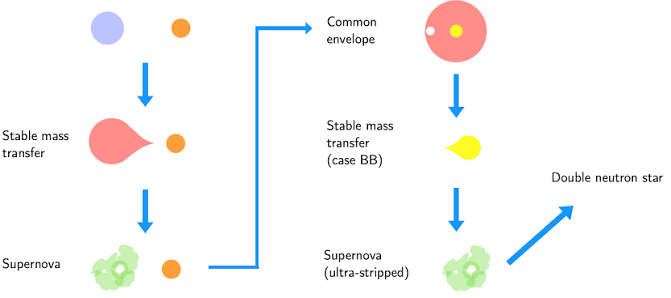
Common envelope evolution is a process that can occur in a binary star system. A binary star system consists of two stars that orbit around a common centre of mass.
When one star expands during a later stage of its life, it can become large enough to surround its smaller companion. The companion then moves inside the outer gas layers of the larger star. These surrounding layers form what scientists call a common envelope.
As the smaller object travels through this gas, it experiences drag. This drag removes orbital energy and causes the two objects to move closer together. Their orbital speed can also increase as the distance between them becomes smaller.
The interaction can release a large amount of energy. Some of this energy may help push the outer layers of the giant star into space.
Common envelope evolution is important in astronomy because it can change the future of a binary star system. It may lead to the formation of a much closer pair of stars or cause both objects to merge.
How Orbital Drag Changes the Star System
Orbital drag is one of the main processes involved in common envelope evolution. When the smaller companion moves through the gas surrounding the giant star, it loses orbital energy because of its interaction with the material.
As the energy decreases, the companion’s orbit becomes smaller. It moves closer to the core of the giant star and may eventually reach a stage where the two objects merge.
The movement also transfers energy to the surrounding gas. If enough energy is released, it can help remove the giant star’s outer envelope. This may leave behind a much tighter binary system.
In some cases, the outer layers are not completely expelled, and the two objects continue moving closer until they combine into a single object.
Possible Outcomes of Common Envelope Evolution
Scientists identify two major possible outcomes of the common envelope phase.
The first possibility is that the smaller companion transfers enough energy to the surrounding gas to eject the giant star’s outer envelope. If this happens, the remaining core and companion may survive as a much closer binary system.
The second possibility is that the two objects fail to separate from the surrounding material and eventually merge into one star or stellar object.
Another related process is Roche-lobe overflow. It occurs when a star expands beyond the region in which its gravity can hold its material within its own gravitational influence in a binary system. This can cause gas to move towards its companion.
If mass transfer becomes too rapid, the receiving star may be unable to handle the incoming material. The orbit can shrink further, increasing the interaction and potentially leading to a common envelope phase.
Why the AT 2025abao Discovery Matters
The direct observation of AT 2025abao gives astronomers an opportunity to compare real observations with existing models of binary star evolution. Until now, common envelope evolution has been difficult to study because much of the interaction takes place inside the gas surrounding a giant star.
The event also shows how long-term monitoring can help scientists identify changes in distant star systems. Observations beginning with unusual brightening in 2023, followed by the major eruption in October 2025 and later JWST observations, helped researchers build a clearer picture of the event.
Further study of Bao may help explain how close binary systems form and how stellar interactions influence the later stages of stellar evolution. Scientists will continue monitoring the system to determine whether the two stars have merged or whether a compact binary system remains.