
DSIR Norms Relaxed for Deep-Tech Startups: A New Push for India’s Innovation Ecosystem

DSIR Norms Relaxed for Deep-Tech Startups marks a significant policy shift by the Union Government aimed at strengthening India’s deep-tech and research-driven startup ecosystem. By removing the mandatory three-year existence requirement for recognition under the Industrial Research and Development Promotion (IRDP) programme of the Department of Scientific and Industrial Research (DSIR), the government has opened new doors for early-stage innovators. This reform is expected to accelerate innovation, reduce entry barriers, and help promising deep-tech startups scale faster in their formative years.
Thank you for reading this post, don't forget to subscribe!A Major Policy Change Announced
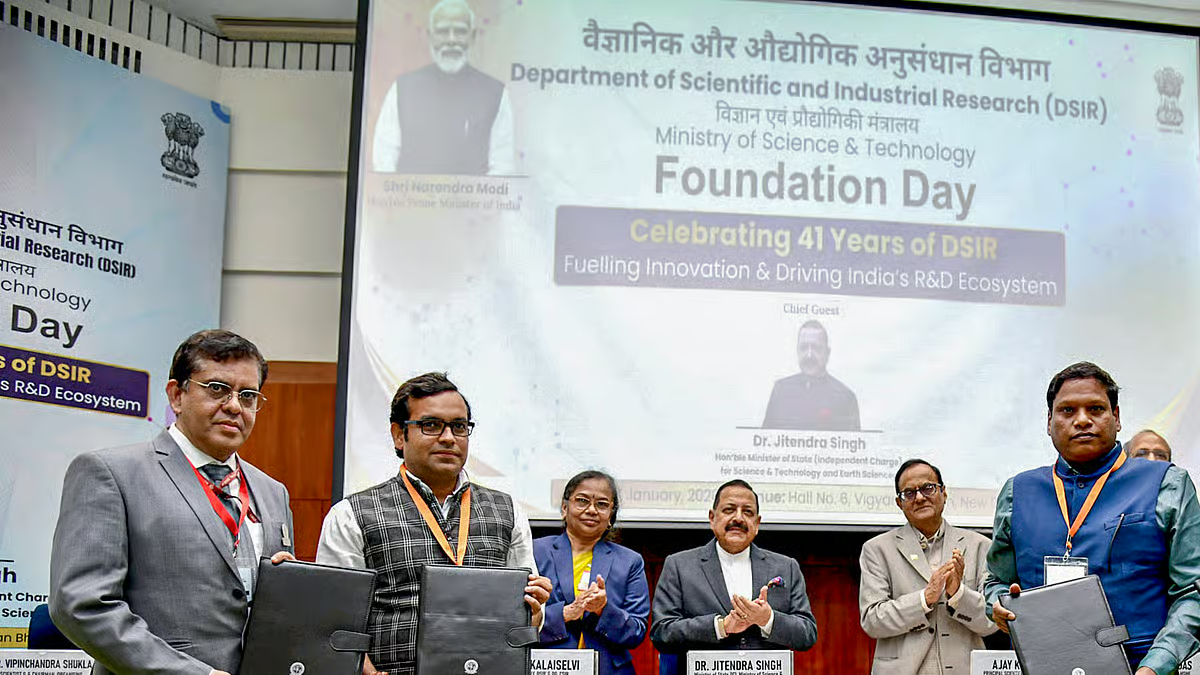
The reform was announced during the 41st Foundation Day of the Department of Scientific and Industrial Research, held in New Delhi. Union Minister for Science and Technology, Jitendra Singh, highlighted that the decision reflects the government’s growing confidence in Indian innovators. He emphasized that the earlier three-year eligibility condition often delayed institutional support for startups working on cutting-edge technologies.
With DSIR norms relaxed for deep-tech startups, recognition can now be granted at a much earlier stage. This change acknowledges the unique nature of deep-tech innovation, where ideas are research-heavy, development cycles are long, and returns may take time to materialize. The move sends a clear signal that the government is willing to back innovation from the idea stage itself.
DSIR Norms Relaxed for Deep-Tech Startups: Why Deep-Tech Startups Need Early Support
Deep-tech startups are different from conventional tech ventures. They often work in areas such as advanced materials, biotechnology, artificial intelligence, clean energy, space technology, and other research-intensive domains. These startups typically require significant funding for research and development before their products or solutions are market-ready.
Earlier, the three-year existence rule meant that many deep-tech startups struggled to access DSIR recognition when they needed it the most. By the time they became eligible, they had often already faced financial and operational stress. With DSIR norms relaxed for deep-tech startups, early-stage firms can now access institutional credibility, incentives, and support systems at a crucial phase of their journey.
DSIR Norms Relaxed for Deep-Tech Startups: Benefits of DSIR Recognition for Startups
Recognition under DSIR is more than just a formal status. It helps startups gain access to a range of benefits that can be critical for growth. These include eligibility for government incentives, easier access to research infrastructure, and improved credibility when engaging with investors, industry partners, and academic institutions.
When DSIR norms are relaxed for deep-tech startups, it allows young firms to build trust and visibility much earlier. This can improve their chances of securing funding, forming collaborations, and attracting skilled talent. Over time, this support can translate into faster commercialization of technologies and stronger contributions to the national innovation ecosystem.
Strengthening India’s Innovation Pipeline
The government’s decision is expected to strengthen India’s innovation pipeline by reducing bottlenecks at the entry level. Many promising ideas fail to progress due to lack of early support, especially in sectors where development costs are high and outcomes are uncertain. By allowing earlier access to DSIR recognition, the reform helps reduce these risks.
This step also aligns with India’s broader goal of becoming a global hub for science, technology, and innovation. With DSIR norms relaxed for deep-tech startups, India can nurture a larger pool of technology-driven enterprises capable of solving complex national and global challenges.
Part of a Larger Reform Agenda
The relaxation of DSIR norms is not an isolated decision. It forms part of a wider set of structural reforms introduced in recent years. Under the leadership of Prime Minister Narendra Modi, several strategic sectors such as space and nuclear energy have been opened to private participation. These changes reflect a shift towards building a more inclusive and competitive innovation ecosystem.
Jitendra Singh noted that the government will continue to introduce reforms that prepare India for emerging and strategic technology domains. The focus is on creating an environment where innovation can thrive, private participation is encouraged, and India’s technological capabilities are strengthened for the long term.
DSIR Norms Relaxed for Deep-Tech Startups: New Initiatives to Support Research and Development
Alongside the announcement that DSIR norms are relaxed for deep-tech startups, the government also unveiled several new initiatives aimed at boosting research and development. New guidelines were introduced for the recognition of in-house research and development centres, as well as centres dedicated to deep-tech startups.
In addition, platforms such as the PRISM Network Platform TOCIC Innovator Pulse were launched to improve connectivity among innovators, researchers, and industry stakeholders. Creative India 2025, introduced under the PRISM scheme, aims to promote indigenous research and encourage innovative solutions across sectors.
DSIR Norms Relaxed for Deep-Tech Startups: Encouraging Industry–Academia Collaboration
One of the key objectives behind these initiatives is to deepen collaboration between industry and academia. Deep-tech innovation often emerges from research institutions and universities, but scaling these ideas requires strong industry partnerships. By ensuring that DSIR norms are relaxed for deep-tech startups, the government is helping bridge the gap between research and commercialization.
This approach supports the development of technologies that are not only innovative but also relevant to real-world needs. Stronger collaboration can lead to better use of research infrastructure, faster transfer of knowledge, and more impactful outcomes for society.
DSIR Norms Relaxed for Deep-Tech Startups: Building an Atmanirbhar and Globally Relevant India
The reform also supports India’s vision of becoming Aatmanirbhar, or self-reliant, in critical technology areas. By backing deep-tech startups early, the country can reduce dependence on imported technologies and build homegrown solutions. Over time, these startups can also emerge as global players, enhancing India’s reputation as a trusted innovation partner.
With DSIR norms relaxed for deep-tech startups, the policy environment becomes more supportive of long-term, research-driven entrepreneurship. This creates a strong foundation for sustainable growth, job creation, and technological leadership.

DSIR Norms Relaxed for Deep-Tech Startups: Looking Ahead
The removal of the three-year existence requirement is a forward-looking step that recognizes the realities of deep-tech innovation. It reflects a shift from rigid eligibility rules to a more flexible and trust-based approach. As more startups gain early access to DSIR recognition and related benefits, India’s innovation ecosystem is likely to become more dynamic, resilient, and globally competitive.
Overall, the decision that DSIR norms are relaxed for deep-tech startups represents a meaningful commitment to nurturing ideas, supporting risk-taking, and enabling the next generation of Indian innovators to succeed.