




Fast Track Immigration India: Revolutionising Air Travel with the Trusted Traveller Programme

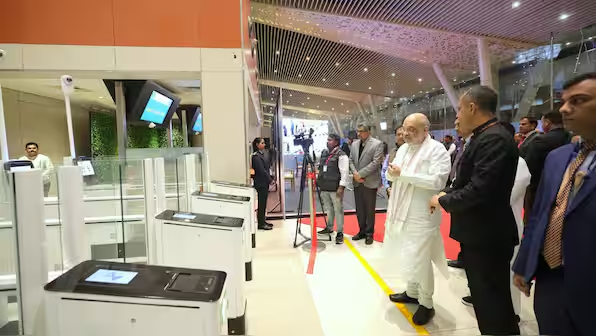
The Fast Track Immigration India initiative marks a major step forward in India’s vision to modernise airport systems and ease international travel. The Fast Track Immigration–Trusted Traveller Programme (FTI-TTP), launched by Union Home Minister Amit Shah in September 2025, is designed to accelerate immigration clearance for pre-verified Indian nationals and Overseas Citizen of India (OCI) cardholders. This forward-looking initiative aligns perfectly with Prime Minister Narendra Modi’s vision of “speed, scale, and scope”, aiming to redefine the passenger experience at Indian airports.
Purpose and Vision
The Fast Track Immigration India programme aims to create a seamless and secure travel environment. With international passenger volumes growing each year, long queues and manual immigration checks have become common challenges. The FTI-TTP addresses these issues by introducing a biometric-driven, automated clearance system that ensures immigration within seconds.

The system not only saves time but also upholds stringent security standards by integrating real-time identity verification. It reflects India’s ambition to match global aviation standards while offering convenience to its citizens and diaspora.
Recent Expansion and Implementation
After its pilot launch in July 2024 at Delhi’s Indira Gandhi International Airport, Fast Track Immigration India expanded rapidly across key airports. The system was soon operational at seven major hubs Mumbai, Chennai, Kolkata, Bangalore, Hyderabad, Cochin, and Ahmedabad. Recognising its success, the Ministry of Home Affairs expanded the programme in 2025 to include five more airports: Lucknow, Thiruvananthapuram, Tiruchirappalli, Kozhikode, and Amritsar.
The ultimate goal is to cover 21 major airports across India, including upcoming aviation hubs like Navi Mumbai International Airport and Jewar International Airport. This extensive rollout demonstrates the government’s commitment to building a travel ecosystem that matches the efficiency of leading international airports such as Singapore’s Changi and London’s Heathrow.
Fast Track Immigration India: Features and Benefits
One of the standout features of Fast Track Immigration India is the ability to clear immigration within 30 seconds through automated e-Gates. Travellers registered under the FTI-TTP can simply scan their passport and boarding pass at the e-Gate, where biometric verification is completed instantly.
Upon successful verification, the gate opens automatically, granting the traveller instant clearance. This process eliminates manual document inspection and significantly reduces congestion at immigration counters.
Key benefits include:
- Faster processing: Immigration completed in under a minute.
- Enhanced security: Advanced facial recognition and fingerprint authentication.
- Paperless process: Digital documentation reduces human error.
- Global compatibility: Aligned with international systems like the US Global Entry and Singapore’s Automated Immigration Clearance.
- Priority access: Especially beneficial for frequent flyers, business travellers, and OCI cardholders.
This blend of technology and convenience sets a new benchmark for passenger facilitation in India’s airports.
Fast Track Immigration India: Registration and Enrolment Process
Enrolment for the Fast Track Immigration India system is straightforward and user-centric. Travellers can register through the official FTI-TTP portal, providing essential personal details, passport information, and travel history.
Biometric data such as fingerprints and facial scans are collected either at Foreigners Regional Registration Offices (FRROs) or during airport transit. The Ministry of Home Affairs encourages individuals to complete registration during passport issuance or OCI card application to avoid redundant procedures.
Once approved, travellers are issued a Trusted Traveller ID, enabling them to use the automated e-Gates at participating airports. This single digital identity ensures smooth processing every time a traveller enters or exits the country.
Fast Track Immigration India: Impact on International Travel
The introduction of Fast Track Immigration India comes at a crucial time when India’s air traffic is expanding rapidly. Between 2014 and 2024, outbound Indian travellers increased by 73%, reaching 6.12 crore, while inbound foreign visitors grew by 31%, totalling 2 crore. Overall, international passenger volume surged by 60%, touching 8.12 crore travellers.
This unprecedented growth created an urgent need for efficient immigration handling systems. The FTI-TTP provides a timely solution by cutting down waiting times and enhancing airport operational efficiency.
Frequent flyers and business travellers are among the biggest beneficiaries, as they often face time-sensitive schedules. The new system ensures that both arrival and departure processes are swift and predictable, contributing to a more pleasant travel experience.
Significance and Global Parallels
The Fast Track Immigration India system positions the country among a select group of nations that have adopted automated immigration clearance for trusted travellers. It mirrors programmes like the US Global Entry, UK Registered Traveller Service, and Singapore’s Frequent Traveller Programme, but is distinctly tailored for Indian nationals and OCI cardholders.
Beyond speed and convenience, the FTI-TTP carries strategic significance:
- It strengthens India’s position as a global aviation hub.
- It improves tourist satisfaction and promotes repeat travel.
- It enhances data-driven security by integrating biometric records with national databases.
- It demonstrates India’s commitment to digital governance and innovation in public services.

The combination of automation, security, and efficiency is a defining feature of the nation’s new approach to travel infrastructure.
Fast Track Immigration India: The Road Ahead
With its ongoing expansion and integration with emerging airports, Fast Track Immigration India is set to redefine how travellers experience airport immigration. Plans are underway to include foreign nationals from select countries in future phases, promoting global collaboration in travel facilitation.
Additionally, the system’s database will soon integrate with the DigiYatra platform, allowing passengers to move through the entire airport from entry to boarding without physical documents. This step will make India one of the first few countries to achieve end-to-end digital air travel.
As the programme evolves, it will continue to support the government’s broader goals of ease of travel, enhanced security, and smart governance.