



Gujarat Giant Snake Fossil Sparks Global Scientific Interest

Gujarat Giant Snake Fossil discoveries are drawing worldwide attention after scientists uncovered fossil remains in western India that point to the existence of one of the largest snakes ever known. Found in ancient rock layers dating back around 47 million years, these remains belong to the early Eocene period, a time when Earth was much warmer than today. Researchers believe this discovery could reshape long-held ideas about prehistoric life and the true size of ancient snakes.
The find highlights India’s growing importance in global fossil research and adds a new chapter to the story of life on Earth during a time of extreme heat and changing continents.

Gujarat Giant Snake Fossil Found in Ancient Rock Layers
The fossil remains were discovered in sedimentary rocks in Gujarat that formed during the early Eocene epoch. This period followed the extinction of dinosaurs and was marked by very high global temperatures. Polar ice was almost absent, and tropical conditions extended across much of the planet.
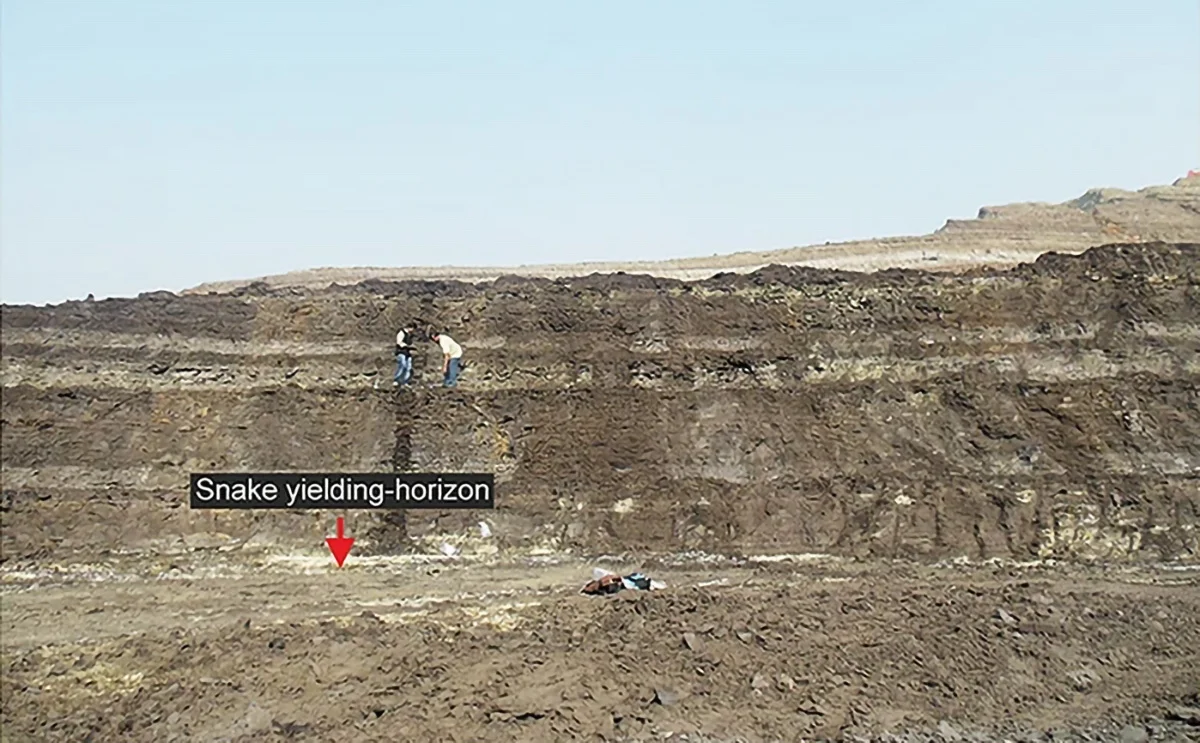
Such warm conditions created an ideal environment for cold-blooded animals like snakes. Reptiles depend on external heat to regulate their body temperature, and warmer climates allow them to grow much larger. Scientists say the Gujarat fossil fits perfectly into this ancient climate picture, helping explain how such a massive snake could exist.
Gujarat Giant Snake Fossil and the Clues Hidden in Vertebrae
The most important remains found are vertebrae, the backbone bones of the snake. In fossil research, snake vertebrae are extremely valuable because they reveal details about body size, strength and movement.
The vertebrae recovered from Gujarat are unusually large, thick and strong. When scientists compared them with vertebrae from both modern and extinct snakes, they noticed clear differences in size and structure. These bones suggest that the snake was not only long but also very heavy and muscular.
Based on detailed analysis, researchers placed the fossil within the madtsoiid group, an extinct family of snakes already known for producing some of the largest species in history. This connection has raised excitement because it suggests India was home to truly massive predators during prehistoric times.
Gujarat Giant Snake Fossil and the Question of the World’s Largest Snake
For years, scientists have debated which snake deserves the title of the world’s largest. Most discussions focus on length, but the Gujarat discovery is changing that approach. Experts now say that body mass and strength are just as important as length when comparing giant snakes.
Because complete snake skeletons are extremely rare, size estimates rely on partial remains. The Gujarat fossil shows that some snakes may have been shorter than others but much heavier and stronger. This opens the possibility that more than one type of “giant snake” existed, each adapted to different environments.
The discovery encourages scientists to rethink how prehistoric animals are compared and classified, especially when fossil evidence is incomplete.
Gujarat Giant Snake Fossil and Eocene Climate Conditions
The Eocene epoch is known as one of the warmest periods in Earth’s history. During this time, regions like present-day Gujarat likely had lush forests, rivers and wetlands. These ecosystems supported a wide range of animals, including early mammals, large fish and reptiles.
Such rich environments could easily support huge predators. A giant snake would have had plenty of prey and suitable shelter. Scientists believe the snake may have been an apex predator, sitting at the top of the food chain in its ecosystem.
Gujarat Giant Snake Fossil and India’s Ancient Journey
Millions of years ago, India was not connected to Asia. It had broken away from the southern supercontinent Gondwana and was slowly moving northward. During this journey, India carried unique plants and animals that evolved in isolation.
Madtsoiid snake fossils have been found in Africa, South America and Australia, showing that these continents were once connected. The Gujarat fossil strengthens the idea that India also had its own megafauna while drifting across the ocean. This discovery helps scientists understand how animals spread across continents before modern landmasses formed.
Gujarat Giant Snake Fossil and Modern Scientific Interest

This discovery comes at a time when interest in climate history and ancient ecosystems is growing. Scientists today are studying past warm periods like the Eocene to better understand how life responds to extreme heat.
The Gujarat fossil provides real evidence of how animals adapted to high temperatures. It shows that climate plays a major role in shaping body size, behavior and survival. Such findings are valuable as the modern world faces rising global temperatures.
Gujarat Giant Snake Fossil Adds to India’s Fossil Record
India has already produced important fossil discoveries, including dinosaurs, ancient mammals and early plant life. The Gujarat giant snake fossil adds another major find to this list.
Researchers believe more discoveries could be waiting beneath India’s ancient rock layers. Each new fossil helps paint a clearer picture of how life evolved on the subcontinent and how India contributed to global biodiversity in deep time.