

H-1B Visa Bill Proposes Higher Fines

The H-1B Visa Bill has drawn attention after a proposal was introduced in the United States House of Representatives to increase penalties for employers who violate rules under the H-1B visa programme. Known as the H-1B Visa Fraud Crackdown Act, the bill is numbered H.R. 10643 and was introduced on October 1, 2026. It proposes higher financial penalties, longer bans on sponsoring foreign workers and increased fines for certain immigration document fraud offences. The bill has been referred to the House Judiciary Committee and has not become law.
Thank you for reading this post, don't forget to subscribe!What Is the H-1B Visa Programme?
The H-1B visa is a temporary, non-immigrant visa that allows US employers to hire foreign professionals for specialised jobs. These positions generally require specialised knowledge and at least a bachelor’s degree or an equivalent qualification.
The programme is widely used in industries such as information technology, engineering, healthcare, scientific research and other professional fields. Many international companies use it to recruit skilled workers for roles that require specific technical knowledge.
The regular annual statutory cap is 65,000 visas, with a separate exemption of 20,000 for eligible applicants who hold a master’s degree or a higher qualification from a US institution. Certain employers, including qualifying higher education institutions, are exempt from the annual cap.
The proposed legislation focuses on penalties for violations rather than changing the basic structure of the visa programme. It seeks to make the consequences of certain forms of employer misconduct more serious.
H-1B Visa Bill Proposes Fines of Up to $250,000
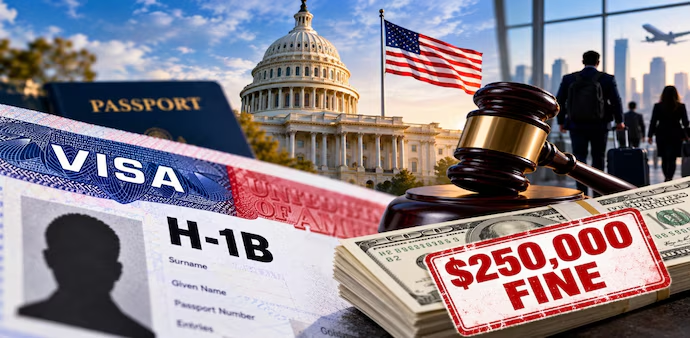
One of the main changes proposed by the H-1B Visa Fraud Crackdown Act concerns serious violations of H-1B rules. Under the proposal, the maximum fine for certain serious violations would rise from $35,000 to $250,000.
These serious violations include cases involving the deliberate displacement of US workers under the relevant H-1B rules. The proposal aims to increase the financial consequences for employers found responsible for such conduct.
The bill would also increase the minimum period during which an employer could be barred from participating in immigration programmes from three years to 10 years for this category of serious violations.
The proposed changes are intended to strengthen enforcement and discourage employers from deliberately breaking the rules. However, the new penalties would apply only if the bill completes the legislative process and becomes law.

Higher Penalties for Other H-1B Violations
The legislation also proposes higher penalties for another category of willful H-1B violations.
Under this provision, the proposed fine would increase from $5,000 to $100,000. The minimum period during which an employer could be barred from participating in immigration programmes would rise from two years to five years.
These changes would increase both the financial cost and the potential long-term impact of violations. Employers found responsible could face a longer period without access to relevant immigration sponsorship programmes.
The proposal is part of an effort to make compliance with H-1B rules more important for businesses that depend on skilled foreign workers.
Increased Fines for Immigration Document Fraud
The H-1B Visa Bill also proposes higher penalties for certain forms of immigration document fraud.
Under the proposal, one existing fine range of $250 to $2,000 would increase to $1,000 to $10,000. Another range, currently set at $2,000 to $5,000, would rise to $20,000 to $50,000.
These changes are intended to increase the consequences of submitting fraudulent documents or engaging in other conduct covered by the relevant immigration law.
Accurate documentation is important in employment-based immigration because applications rely on information about employers, workers, qualifications and job conditions. The proposed increases would make certain document-related violations more costly for those found responsible.
Who Introduced the H-1B Visa Fraud Crackdown Act?
Republican Representative Beth Van Duyne of Texas introduced H.R. 10643 in the House of Representatives on October 1, 2026.
The bill has five Republican co-sponsors, all from Texas: Brandon Gill, Pete Sessions, Keith Self, Brian Babin and Pat Fallon. Following its introduction, the proposal was referred to the House Judiciary Committee for consideration.
The committee referral is an early step in the legislative process. It does not mean that the proposal has been approved by the House or that the penalties are already in effect.
What Happens Next?
For the proposed penalties to become law, the bill would generally need to pass both the US House of Representatives and the Senate and receive the President’s signature, subject to the applicable constitutional process.
During consideration, lawmakers may examine the proposed penalties, debate their effects and consider possible changes to the legislation. Until the bill becomes law, the proposed increases should not be treated as active penalties.
The proposal is particularly relevant to employers that recruit international professionals because it could increase the financial and operational risks associated with certain violations. Companies that use the H-1B programme would need to pay close attention to compliance with immigration rules and the accuracy of their records.
Why the Proposal Matters to Indian Professionals
The H-1B programme is an important route for skilled professionals from India seeking temporary employment in the United States, particularly in technology and other specialised fields.
The proposed bill does not directly change the annual visa cap, educational eligibility requirements or the basic purpose of the H-1B category. Instead, it focuses on raising penalties for specified employer violations and immigration document fraud.
For Indian professionals already working in the United States or considering future opportunities, the key point is to distinguish between a proposed law and a rule that is already in force. H.R. 10643 remains a bill under consideration, so its proposed penalties are not yet law.