

Hera Asteroid Images Reveal Pair

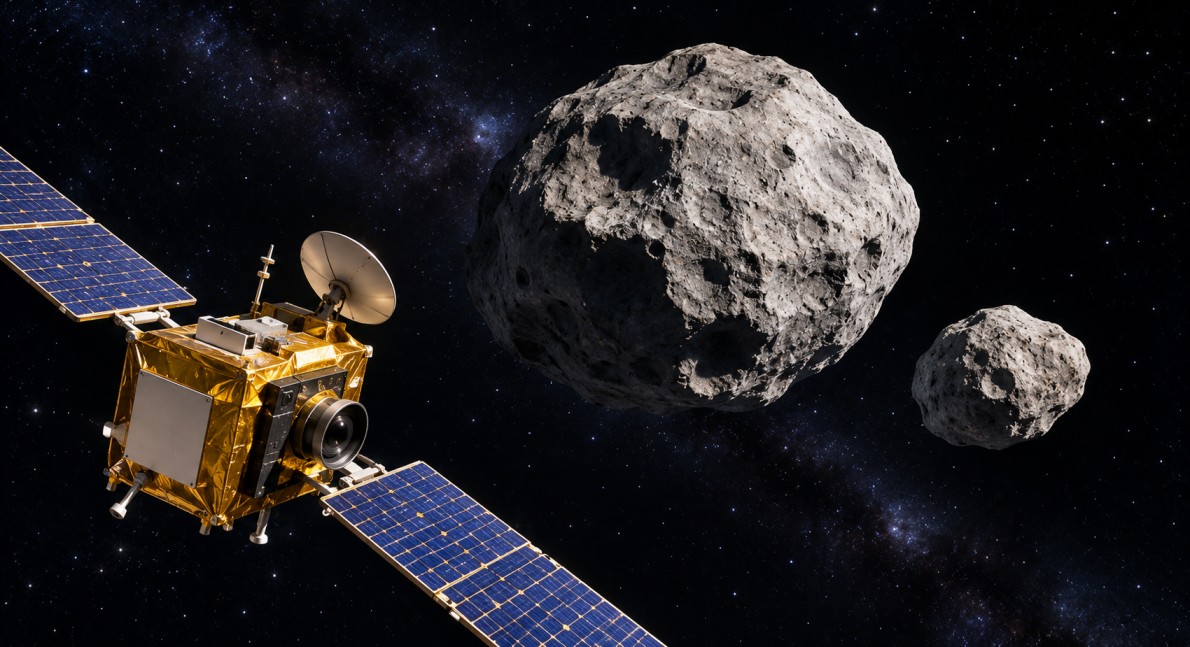
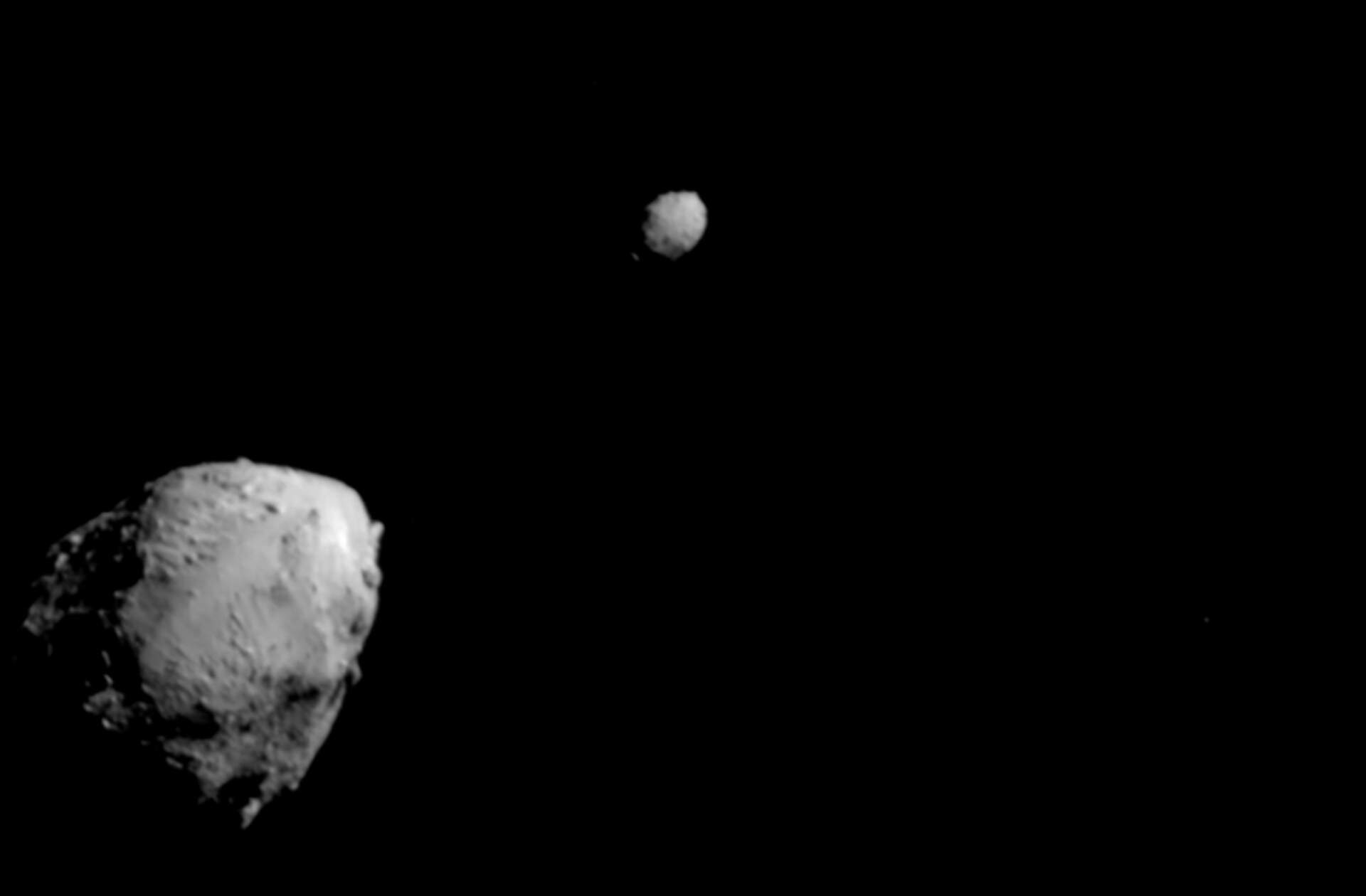
Hera Asteroid Images have given scientists a new view of the two asteroids Didymos and Dimorphos as separate objects. On 18 October 2026, the European Space Agency’s (ESA) Hera spacecraft captured its first clear image showing both asteroids individually. The spacecraft used its black-and-white Asteroid Framing Camera while it was about 1,280 kilometres from the asteroid pair. At that time, the pair was approximately 197 million kilometres from Earth.
The images mark an important stage in Hera’s journey. The spacecraft is travelling towards the Didymos asteroid system to study the results of NASA’s Double Asteroid Redirection Test (DART), which deliberately hit Dimorphos in 2022.

Hera’s Approach to the Asteroid Pair
Hera is designed to study the Didymos system in detail. In early October 2026, the spacecraft carried out two thruster manoeuvres to adjust its movement and reduce its speed relative to the asteroids to about 20 metres per second.
These manoeuvres helped Hera prepare for its closer investigation. Studying an asteroid while moving through space requires careful control of the spacecraft’s speed and direction. The spacecraft must also collect accurate information about the asteroids’ position, shape and movement.
Didymos is the larger asteroid, with a diameter of about 780 metres. Its smaller companion, Dimorphos, measures approximately 151 metres across. Dimorphos orbits Didymos, forming a two-asteroid system that provides scientists with a useful target for studying how an impact can change an asteroid’s motion.
NASA’s DART Mission and Its Impact
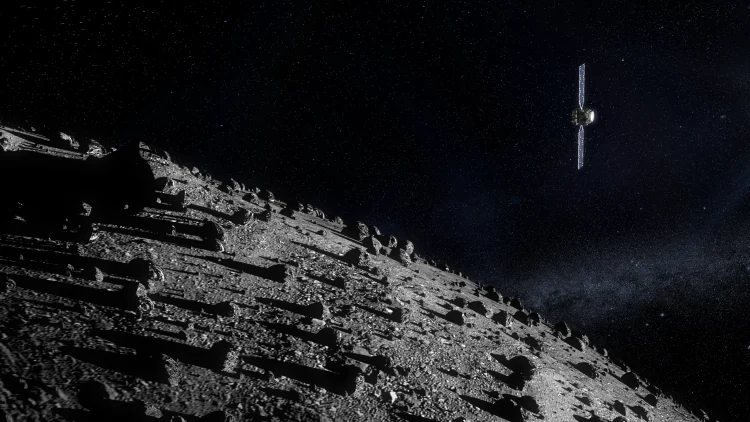
Hera’s investigation is closely connected to NASA’s DART mission. On 26 September 2022, NASA deliberately crashed the DART spacecraft into Dimorphos. The mission tested whether a spacecraft could change an asteroid’s movement through a direct impact.
The collision changed Dimorphos’s orbit around Didymos by about 33 minutes. This was a larger change than some initial predictions had suggested.
The DART mission demonstrated that a spacecraft impact could alter the motion of a small asteroid. However, understanding exactly how the impact changed Dimorphos requires more information about the asteroid’s shape, structure and material.
Hera is intended to provide that closer investigation. Its observations will help scientists understand how much material was displaced during the collision and how the asteroid responded to the impact.
What Will Hera Investigate?
Hera carries 12 scientific instruments designed to study the asteroid system. It will examine the impact site on Dimorphos and gather information about the asteroid’s surface and internal structure.
The spacecraft will investigate several important features, including the impact crater, the asteroid’s mass and its composition. These details can help scientists estimate how efficiently the DART impact transferred momentum to Dimorphos.
The size and shape of the crater are especially important. The impact may have pushed material away from the asteroid, creating additional movement beyond the force of the spacecraft itself. Studying the crater and the debris left by the collision can help researchers understand this process.
Hera’s findings could improve future planetary-defence plans. If scientists understand how different asteroid materials respond to an impact, they can better estimate what might happen during a future attempt to change an asteroid’s path.
CubeSats to Support the Investigation
Hera is also expected to deploy two small CubeSats, named Milani and Juventas. These spacecraft will carry out additional observations close to the asteroids.
Milani is designed to study the surface and nearby dust. Its observations of surface materials can help scientists understand the composition of the asteroid system.
Juventas will focus on the internal structure of the asteroids. It carries a radar instrument designed to investigate layers beneath the surface. The mission also includes plans for close observations and possible landing operations.
Using smaller spacecraft alongside Hera will allow the mission to gather different types of information. The CubeSats can examine the asteroids from closer distances and provide data that the main spacecraft may not be able to collect on its own.
Why the Hera Mission Matters
Asteroids are remnants from the early stages of the Solar System. Studying them can help scientists learn more about the materials and processes that shaped planets.
The Didymos system is especially useful because NASA’s DART mission has already changed the orbit of Dimorphos. Hera can now examine the result of that experiment in detail.
The mission may help scientists improve methods for protecting Earth from potentially dangerous asteroids. Planetary defence depends not only on detecting an asteroid but also on understanding its physical properties and how it might respond to a change in motion.
The European Space Agency plans to unveil the first detailed images of Dimorphos on 25 November 2026. These images and Hera’s future observations are expected to provide more information about the impact site and the structure of the asteroid pair.