James Webb Detects Distant Galaxy: MoM-z14 Opens a New Window into the Early Universe

James Webb Detects Distant Galaxy and once again reshapes how scientists understand the birth of the cosmos. Astronomers using the James Webb Space Telescope have identified the most distant galaxy ever observed, named MoM-z14. This remarkable galaxy dates back to just 280 million years after the Big Bang, offering an extraordinary glimpse into the universe’s earliest era of galaxy formation. The discovery is not only a technical achievement but also a scientific breakthrough that challenges long-standing ideas about how quickly galaxies formed and evolved.
Thank you for reading this post, don't forget to subscribe!A Glimpse into the Universe’s Earliest Time
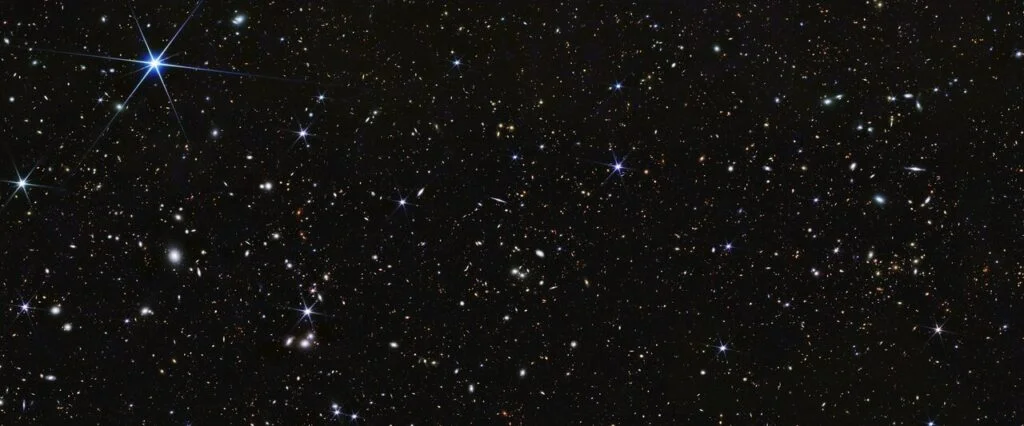
MoM-z14 was discovered through deep-field observations conducted by the James Webb Space Telescope. Deep-field imaging involves pointing the telescope at a small region of space for a long time, allowing it to capture extremely faint and distant objects. In this case, Webb detected faint light that has travelled for more than 13.5 billion years before reaching Earth.
This means astronomers are seeing MoM-z14 as it existed when the universe was still in its infancy. At that time, stars and galaxies were just beginning to emerge from clouds of gas and dust. Finding a galaxy from such an early period provides scientists with direct evidence of what the universe looked like shortly after cosmic dawn, the moment when the first sources of light appeared.
Why MoM-z14 Is Special
What makes MoM-z14 especially important is not only its distance, but also its unexpected physical properties. Early galaxies were thought to be small, faint, and simple in structure. However, initial observations show that MoM-z14 is brighter and denser than expected for a galaxy formed so soon after the Big Bang.
Even more surprising is its chemical composition. Spectroscopic data from Webb suggest that the galaxy contains a relatively high amount of nitrogen. Nitrogen is a heavier element that forms inside stars and spreads through space when stars die. The presence of significant nitrogen indicates that MoM-z14 has already gone through multiple generations of star formation.
This suggests that stars in this galaxy formed quickly and efficiently, producing heavier elements much earlier than scientists once believed possible.
How Webb Made This Discovery Possible
The James Webb Space Telescope was designed specifically to observe the universe in infrared light. As the universe expands, light from very distant objects becomes stretched, shifting from visible wavelengths into the infrared range. Webb’s powerful infrared instruments allow it to detect this stretched light with great sensitivity.
Previous space telescopes, including the Hubble Space Telescope, laid the foundation for deep-space astronomy. However, Webb’s larger mirror and advanced detectors give it the ability to see farther back in time than any telescope before it. MoM-z14 is a clear example of how Webb is extending the limits of observation.
Challenging Existing Theories
For decades, scientists have used computer simulations to model how the first galaxies formed. These models generally predicted a slow and gradual process, with simple galaxies appearing first and growing over time.
MoM-z14 challenges this picture. Its brightness, density, and chemical richness suggest that galaxy formation in the early universe may have been faster and more complex than predicted. According to researchers, this growing mismatch between theory and observation means that current models may need significant revision.
Rohan Naidu of the Massachusetts Institute of Technology, the lead author of the study, has noted that Webb is revealing structures in the early universe that were not expected. Each new discovery adds pressure to update existing ideas about cosmic evolution.
The Role of Spectroscopy
Spectroscopy plays a crucial role in understanding distant galaxies like MoM-z14. By splitting light into its component wavelengths, astronomers can determine a galaxy’s distance, temperature, chemical makeup, and star formation rate.
Follow-up spectroscopic observations are essential to confirm the precise distance of MoM-z14 and to refine measurements of its physical properties. These studies will help scientists better understand how quickly stars formed in the galaxy and how chemical elements were produced and distributed.
What This Means for Our Understanding of the Cosmos
The discovery of MoM-z14 supports a growing body of evidence that the early universe contained more mature and numerous galaxies than previously thought. Rather than being rare and primitive, early galaxies may have formed rapidly and evolved quickly.
This has major implications for cosmology, the study of the universe’s origin and development. It suggests that the processes driving star formation, chemical enrichment, and galaxy growth were already highly active within the first few hundred million years after the Big Bang.
Such findings also raise new questions. How did gas collapse so efficiently to form stars? What physical mechanisms drove such rapid chemical enrichment? And how common were galaxies like MoM-z14 in the early universe?
A New Era of Discovery as James Webb Detects Distant Galaxy
The James Webb Space Telescope is still in the early stages of its mission, yet it has already transformed astronomy. Each new deep-field image and spectroscopic study reveals objects that push the boundaries of what is known.
Astronomers expect that Webb will find even more distant and ancient galaxies in the coming years. These discoveries will help build a clearer timeline of how the first stars ignited, how galaxies assembled, and how the large-scale structure of the universe took shape.
MoM-z14 stands as a powerful reminder that the universe still holds many secrets. As technology improves and observations continue, scientists are poised to uncover an even deeper and richer story of our cosmic origins.