


Marine Biotechnology Policy

Marine Biotechnology Policy is a new initiative launched by Karnataka to strengthen marine research, biotechnology innovation, coastal industries and employment opportunities. Deputy Chief Minister D.K. Shivakumar announced the Karnataka Marine Biotechnology Policy on 17 November 2026 during the 29th Bengaluru Tech Summit. The five-year policy, covering 2026–2031, aims to expand the state’s blue bioeconomy, encourage scientific research and promote the sustainable use of marine resources.
The policy was approved by the Karnataka government on 18–19 September 2026. With a proposed investment of ₹120 crore, it seeks to build a strong marine biotechnology ecosystem by bringing together research institutions, industries, startups and coastal communities.

Karnataka Marine Biotechnology Policy and Its Objectives
The Marine Biotechnology Policy aims to develop Karnataka into an important centre for marine biotechnology and the blue economy. The state plans to use marine resources for scientific research, industrial development, sustainable production and new business opportunities.
The policy focuses on developing technologies and products from marine organisms, seaweed, aquatic resources and coastal ecosystems. Marine biotechnology has applications in healthcare, agriculture, food processing, environmental protection, pharmaceuticals and industrial manufacturing.
The state aims to increase its blue bioeconomy from approximately USD 2 billion to USD 6–8 billion by 2031. This expansion is expected to attract private investment, support research-based businesses and encourage innovation in marine-related industries.

₹120 Crore Investment and New Marine Biotechnology Institute
The Karnataka government has proposed an investment of ₹120 crore under the policy to support infrastructure, research, innovation and industrial growth.
One of the major proposals is the establishment of the Karnataka Institute of Marine Biotechnology and Blue Economy (KIMBE) at the Government Fisheries College. The institute is expected to support advanced research, technology development, training and collaboration between scientists and industries.
The proposed institution will help researchers study marine organisms and explore new uses of marine biological resources. It is also expected to support the development of commercial products and encourage entrepreneurship in the marine biotechnology sector.
Research Laboratories, Biobank and Incubation Centres
The policy proposes the development of laboratories, a biobank and incubation centres in Udupi to strengthen Karnataka’s marine research infrastructure.
Laboratories will support research into marine organisms, biotechnology applications, sustainable aquaculture and marine-based materials. The proposed biobank may help preserve and maintain biological resources for research and future scientific applications.
Incubation centres will encourage startups and entrepreneurs to develop innovative products, technologies and business models. These facilities may also support collaboration between researchers, students, investors and companies working in marine biotechnology.
The policy also proposes dedicated Marine Biotechnology Zones to support research facilities, industries and business activities connected with the coastal economy.
Major Focus Areas of the Policy
The Karnataka Marine Biotechnology Policy covers several sectors that have the potential to create new economic opportunities.
- Fisheries: Improving fish production, processing technologies, resource management and value-added fish products.
- Seaweed: Promoting seaweed cultivation and developing products for food, agriculture, pharmaceuticals and industrial applications.
- Marine biomaterials: Exploring marine biological resources for the development of useful materials and innovative products.
- Biomanufacturing: Encouraging the production of biotechnology-based products using marine resources.
- Sustainable aquaculture: Supporting responsible fish and aquatic organism farming while reducing environmental pressure on coastal ecosystems.
These sectors can help improve the value of marine resources and encourage sustainable economic activities along Karnataka’s coastline.
Employment and Coastal Livelihood Opportunities
Employment generation is one of the important goals of the policy. Karnataka expects the marine biotechnology sector to create around 2,500 high-value technical jobs and 7,500 coastal enterprise and livelihood opportunities.
Technical jobs may emerge in biotechnology research, laboratory operations, marine sciences, product development, manufacturing and quality testing. These opportunities could benefit skilled graduates, researchers, engineers and biotechnology professionals.
The policy also aims to create livelihood opportunities for coastal communities through fisheries, seaweed farming, aquaculture, processing, small businesses and marine-based enterprises. By encouraging local participation, the initiative aims to connect scientific development with income generation for coastal populations.
What Is Marine Biotechnology?
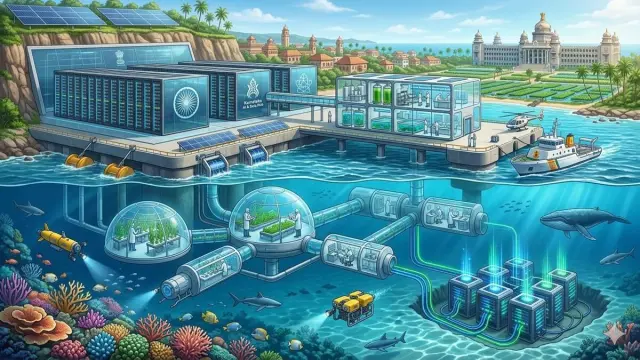
Marine biotechnology involves the use of marine organisms, biological processes and resources to develop useful products, technologies and industrial applications. Oceans contain a wide range of organisms, including algae, bacteria, fungi, fish and other marine life, which can support scientific research and commercial innovation.
Seaweed is an important resource in marine biotechnology. It can be used to produce agar, alginate and carrageenan, which are widely used in food processing, pharmaceuticals, cosmetics and other industries. Marine organisms are also studied for their potential applications in medicine, environmental management, agriculture and advanced materials.
Karnataka’s new policy aims to make better use of these resources through scientific research, sustainable practices, infrastructure development and industrial partnerships.