

Juno Plasma Waves at Jupiter’s Bow Shock

Juno Plasma Waves became an important topic in space science after NASA’s Juno spacecraft detected complex plasma waves and several shock regions in Jupiter’s magnetic environment. The observations were made in December 2024 and provided new information about how the solar wind interacts with Jupiter’s magnetic field. A University of Iowa-led study reporting these findings was published online in Nature Communications on 31 July 2026.
The research helps scientists understand how charged particles from the Sun behave when they encounter a planet’s magnetic environment. It also reveals differences between the shock processes observed at Jupiter and those commonly associated with Earth.

NASA’s Juno Spacecraft Studies Jupiter
NASA launched the Juno spacecraft in 2011 to study Jupiter, the largest planet in our Solar System. The spacecraft reached Jupiter in July 2016 and has been examining its atmosphere, magnetic field, auroras and internal structure.
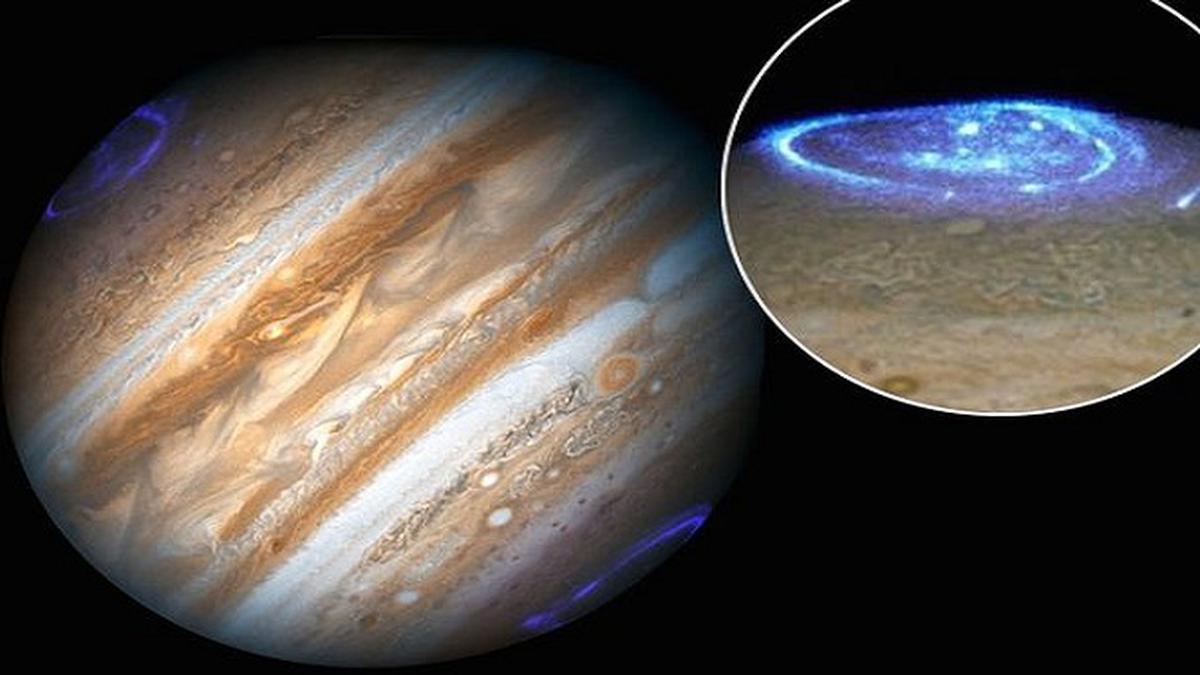
Jupiter has a powerful magnetic field that creates a large region of space called the magnetosphere. This region is strongly influenced by the planet’s magnetic field and its interaction with charged particles from the Sun.
The solar wind continuously carries charged particles and magnetic fields away from the Sun. When this stream approaches Jupiter, it interacts with the planet’s magnetic environment and produces different physical processes.
Juno’s instruments allow scientists to measure these changes directly. The latest findings provide detailed information about the waves and smaller structures formed near Jupiter’s bow shock.
What Is Jupiter’s Bow Shock?
Jupiter’s bow shock is a boundary formed when the incoming solar wind encounters the planet’s magnetic environment. The solar wind travels at high speed, but its flow changes sharply as it meets this region.
At a bow shock, the incoming plasma can be slowed, heated and redirected. Plasma is a state of matter made up of charged particles, including free electrons and ions. It is common in space because much of the material between planets and stars exists in this form.
The bow shock forms ahead of the magnetosphere, where the solar wind first encounters the influence of Jupiter’s magnetic field. Its exact position and structure can change depending on conditions in the solar wind and the planet’s magnetic environment.
The Juno Plasma Waves observations helped researchers examine how this interaction takes place at Jupiter.
Juno Detects Waves at Multiple Frequencies
The research found that Jupiter’s bow shock produces plasma waves at several frequencies, including multiple harmonics. These waves are part of the process through which energy from the incoming solar wind is transferred within the shock region.
The observations suggest that Jupiter’s bow shock has a more complex wave structure than the pattern generally associated with Earth’s bow shock. Earth’s bow shock is often linked to wave activity concentrated around a particular frequency, while Jupiter showed activity at multiple frequencies.
These differences may be related to the conditions within Jupiter’s magnetic environment and the properties of the incoming solar wind.
The waves help scientists understand how energy is transferred from the moving solar wind to charged particles. This process is important because the particles can become slower and hotter as they pass through the shock region.
Studying these waves provides a clearer picture of the physical processes that take place when solar wind meets a planetary magnetic field.
What Are Shocklets?
Another important finding was the identification of smaller structures called shocklets. These are small shock-like features that can form within the solar wind before it reaches the main bow shock.
Shocklets can change the movement and energy of incoming particles. Their presence suggests that the solar wind may undergo several changes before reaching the main boundary of Jupiter’s magnetic environment.
Rather than interacting with the bow shock in one simple step, some particles may encounter smaller structures along the way. These structures can contribute to the complex process of slowing and changing the incoming plasma.
The discovery of shocklets adds to scientists’ understanding of how energy moves through space plasma. It also highlights the importance of making detailed measurements close to planetary shock regions.
Role of the Juno Waves Instrument
The findings were based on measurements from the Juno Waves instrument, which was designed and built by physicists at the University of Iowa. The instrument measures electric and magnetic wave activity around Jupiter.
These measurements help scientists identify different types of waves and examine how they change as the spacecraft moves through the planet’s magnetic environment.
Jayasri Joseph, a postdoctoral researcher in the University of Iowa’s Department of Physics and Astronomy, was the corresponding author of the study. Co-author Bill Kurth is a research scientist at the university and has worked on the Juno mission since its launch in 2011.
The instrument’s observations were important for identifying the multiple wave frequencies and smaller shock structures described in the research.
Why Jupiter’s Bow Shock Matters to Space Science
Jupiter’s bow shock offers scientists a natural laboratory for studying how energy moves through plasma. Although similar shock processes occur around other planets, their structures can differ because of changes in magnetic fields, solar wind conditions and particle behaviour.
Understanding these differences helps researchers improve their knowledge of space weather and the interaction between stars and planets.
Jupiter’s magnetic environment is particularly useful because its magnetic field is much stronger than Earth’s. This creates conditions that allow scientists to investigate plasma behaviour in a setting different from the one around our planet.
The Juno Plasma Waves findings show that the interaction between the solar wind and Jupiter’s magnetic environment involves several connected processes, including waves at multiple frequencies and the formation of shocklets.
Connection to Supernova Remnants
The research may also help scientists understand more powerful shock environments elsewhere in the universe. One example is supernova remnants, which are the expanding remains of stars that have exploded.
Shock waves in these environments can transfer energy to charged particles and influence how particles move through space. Although Jupiter’s bow shock and supernova remnants differ greatly in size and physical conditions, studying the basic processes of energy transfer can help researchers investigate similarities in plasma behaviour.
Jupiter’s bow shock therefore offers valuable information about processes that may also occur in distant astrophysical environments.
The findings from NASA’s Juno spacecraft expand scientific knowledge of planetary magnetic fields, solar wind interactions and plasma waves. Continued analysis of Juno’s measurements can help scientists understand how shock regions form and how energy moves through space.