



Jupiter Size Update NASA: New Discoveries About the Gas Giant

Jupiter Size Update NASA reveals that the largest planet in our solar system is slightly smaller and more flattened than scientists previously believed. These latest findings from NASA’s Juno spacecraft provide the most precise measurements of Jupiter to date, helping researchers better understand its structure, composition, and how it formed.
Thank you for reading this post, don't forget to subscribe!More Accurate Measurements of Jupiter
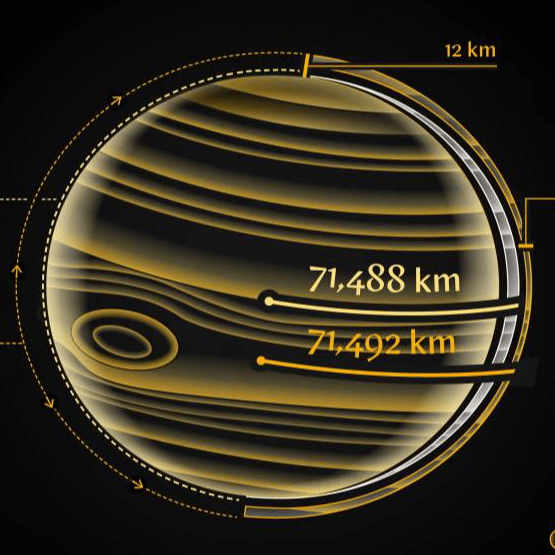
Using advanced radio science data collected by Juno, scientists were able to calculate Jupiter’s equatorial diameter at 88,841 miles (142,976 km). This is about 5 miles smaller than earlier estimates based on data from Voyager and Pioneer missions in the late 1970s. The polar diameter was also measured more precisely at 83,067 miles (133,684 km), which is roughly 15 miles smaller than prior calculations.
These updated numbers may seem like small differences, but in planetary science, they are highly significant. Even a few miles’ variation can change our understanding of how mass is distributed within a planet and how its gravity affects surrounding objects, including moons and rings.
Greater Flattening at the Poles
Jupiter’s shape is not a perfect sphere. The new analysis confirms that it is more oblate, or flattened at the poles, than previously believed. The planet is about 7% wider at the equator than from pole to pole. This flattening is caused by Jupiter’s rapid rotation and its fluid, mostly hydrogen-and-helium composition.
For comparison, Earth’s equatorial diameter exceeds its polar diameter by only 0.33%. Jupiter’s pronounced bulge at the equator indicates that its mass is distributed unevenly and provides clues about the structure of its deep interior. This information helps scientists understand how gas giants form and evolve over billions of years.
How Juno Enabled High-Precision Measurements
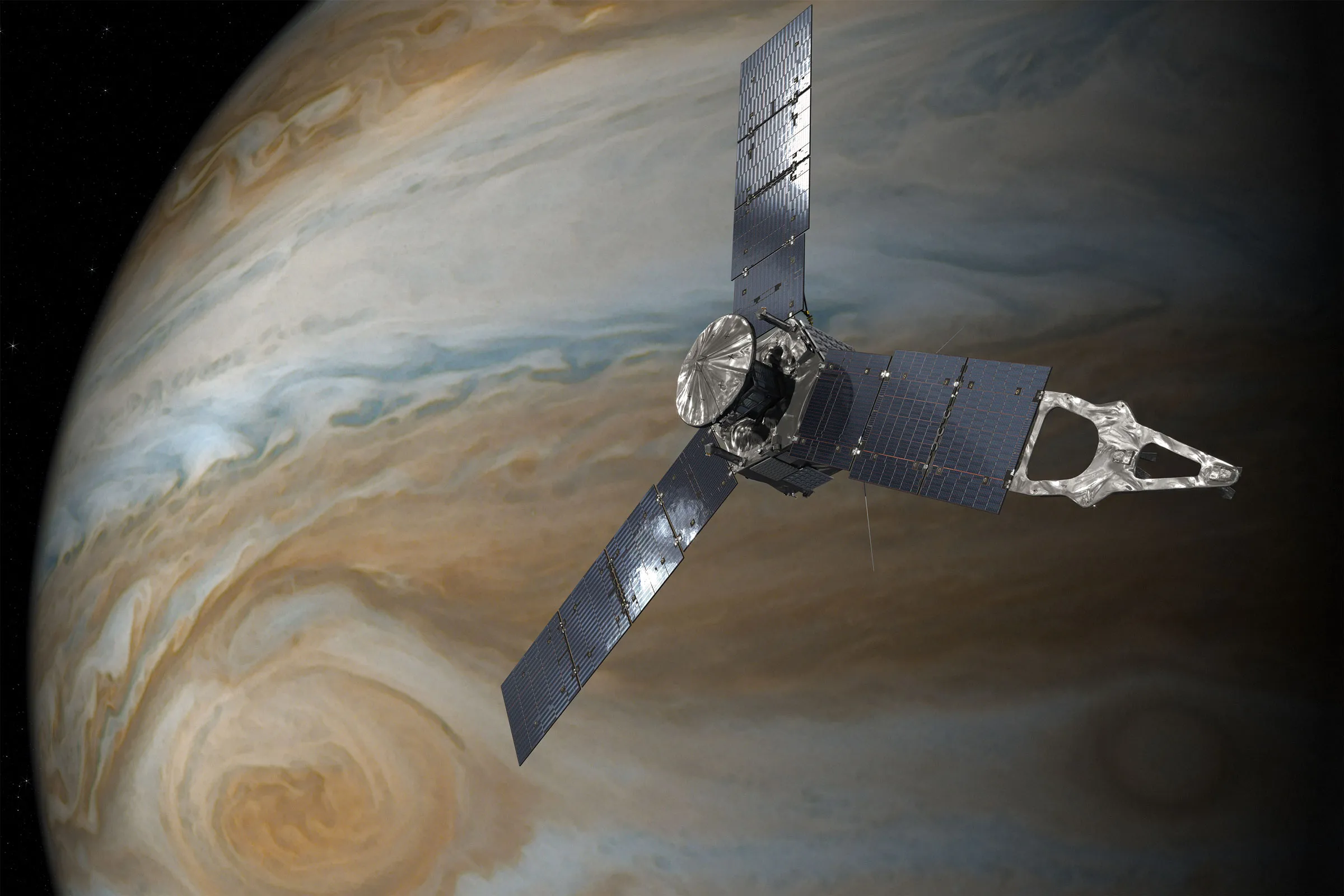
These precise measurements were made possible by a special method involving radio signals. When Juno passed behind Jupiter relative to Earth, its radio waves traveled through the planet’s atmosphere before reaching Earth. Scientists monitored tiny changes in the signals, which revealed details about atmospheric density and temperature.
Planetary scientist Eli Galanti of the Weizmann Institute of Science explained that this method allowed researchers to determine Jupiter’s size and shape with exceptional accuracy. The data were collected after NASA extended the Juno mission in 2021, enabling longer observation periods and more refined measurements.
Understanding Jupiter’s Interior
Knowing Jupiter’s precise size helps scientists make better models of its internal structure. Because Jupiter is the largest and most massive planet in the solar system, its internal dynamics affect not just the planet itself but also the solar system’s formation. Understanding its size, rotation, and flattening allows researchers to estimate how density, pressure, and composition vary inside the planet.
The new measurements also shed light on the distribution of mass in Jupiter’s core and surrounding layers. This knowledge helps scientists determine how elements like hydrogen and helium behave under extreme pressure and temperature, which is not possible to reproduce in laboratories on Earth.
Jupiter’s Role in Solar System Evolution
Jupiter’s size is not just a scientific curiosity it has played a key role in shaping the solar system. Its strong gravity influenced the orbits of other planets and helped deliver important materials, such as water and ammonia, to the inner planets, including Earth.
By refining Jupiter’s dimensions, scientists can improve simulations of solar system formation. This allows them to understand how giant planets affect smaller bodies, the movement of asteroids, and the migration of icy objects from the outer regions of the solar system toward the inner planets.
Why This Update Matters
The Jupiter Size Update NASA provides a more accurate picture of the gas giant, which helps answer long-standing questions about planetary formation and dynamics. Scientists can now model Jupiter’s atmosphere, magnetic field, and gravity more precisely, improving our understanding of not only Jupiter but also other giant planets, both in our solar system and beyond.
These findings remind us that even familiar planets can hold surprising secrets. Despite decades of study, each new mission, like Juno, offers fresh perspectives and advances our knowledge of the universe.
Continuing the Exploration
NASA’s Juno mission has been orbiting Jupiter since 2016, collecting invaluable data on its atmosphere, magnetic field, and structure. As the mission continues, scientists expect to refine their measurements further and uncover even more about this majestic gas giant.
With each update, Jupiter becomes not only a symbol of the solar system’s scale but also a window into its history and evolution. The new measurements emphasize the importance of continued exploration and demonstrate how advanced technology, like Juno, allows humanity to unlock the mysteries of distant worlds.