



Mizoram’s First Railway Line: A Historic Leap in Northeast Connectivity and Development

The inauguration of Mizoram’s First Railway Line marks a historic milestone in India’s northeastern infrastructure development. The Bairabi–Sairang broad-gauge railway, spanning 51.38 km, was inaugurated by Prime Minister Narendra Modi in 2025. This transformative project represents not just a transportation achievement but also a significant leap toward the government’s Act East Policy, designed to enhance economic, social, and strategic connectivity across the Northeast. For the first time, the capital city of Mizoram, Aizawl, is directly linked to India’s expansive railway network, ushering in a new era of accessibility and growth for the region.
Thank you for reading this post, don't forget to subscribe!Project Overview of Mizoram’s First Railway Line
The Mizoram’s First Railway Line project was sanctioned during 2008–09, and actual construction commenced in 2015 under the supervision of Indian Railways. The project was completed at a cost of approximately ₹8,070 crore. Spanning 51.38 kilometers from Bairabi to Sairang, this route demonstrates remarkable engineering excellence amid challenging Himalayan terrain.
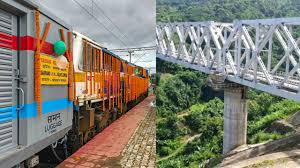
The line includes 45 tunnels, 55 major bridges, and 87 minor bridges, with nearly 54% of the alignment consisting of tunnels and bridges an indicator of the region’s rugged topography. Among its engineering marvels stands Bridge No. 144 near Sairang, which holds the record as India’s tallest pier railway bridge at 114 meters. Constructing this railway involved dealing with difficult geological conditions, requiring engineers to convert loose sand layers into stable rock formations to ensure tunnel safety and durability.
This railway’s construction symbolizes perseverance, innovation, and a commitment to integrating Mizoram with the rest of India.
Strategic Importance of Mizoram’s First Railway Line
The Mizoram’s First Railway Line connecting Bairabi, located on the Assam–Mizoram border, to Sairang, which lies just 20 kilometers from Aizawl, holds immense strategic value. This makes Mizoram the fourth northeastern state capital after Guwahati, Agartala, and Itanagar to gain access to the national railway grid.
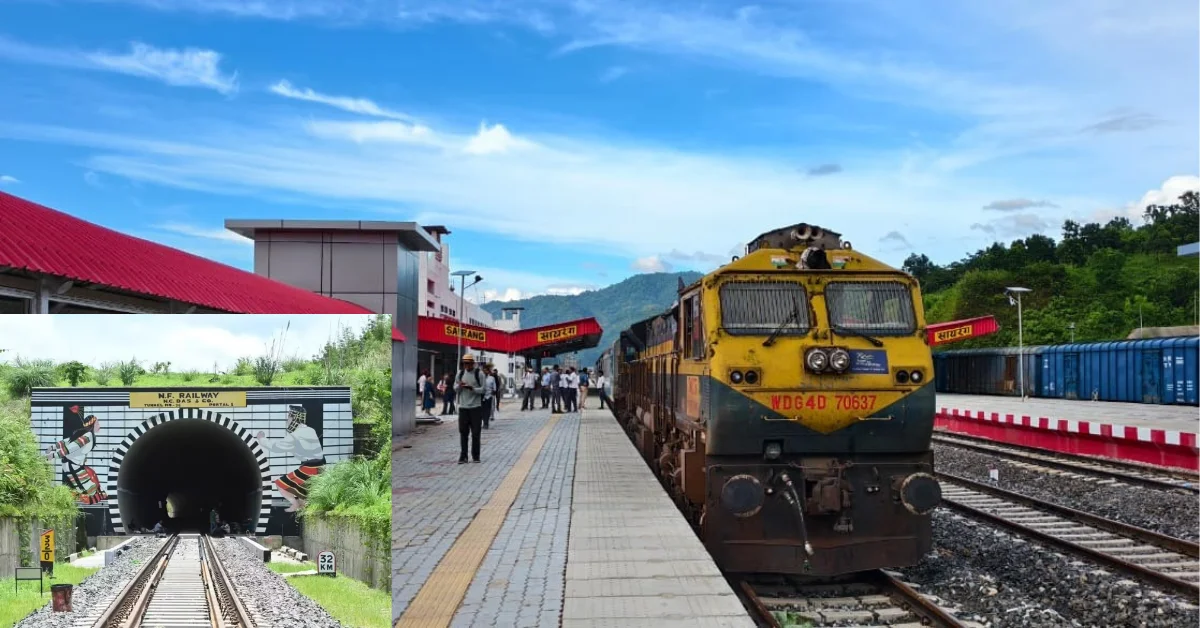
This development is set to revolutionize logistics and passenger movement in the state. The new line will drastically reduce travel time, boost tourism potential, and ensure the timely transport of essential commodities such as food grains, petroleum, and fertilizers. For a landlocked region like Mizoram, efficient connectivity means faster access to markets and improved livelihood opportunities.
Additionally, this project enhances India’s defense preparedness in the Northeast by enabling better troop and material movement near international borders. It also strengthens the region’s position in India’s Act East Policy, facilitating deeper trade and cultural ties with Southeast Asia.
New Train Services Under Mizoram’s First Railway Line
The launch of the Mizoram’s First Railway Line also introduced three new long-distance train services that mark a turning point for regional mobility. These trains include:
- Sairang–Delhi Rajdhani Express – A weekly premium service connecting Mizoram directly with the national capital.
- Sairang–Guwahati Express – A daily service providing direct connectivity to Assam’s major commercial and administrative hub.
- Sairang–Kolkata Express – Operating three times a week, linking Mizoram with one of India’s most vital economic centers.
These trains are equipped with modern facilities to ensure comfort and safety for passengers. The new services will encourage business travel, tourism, and inter-state trade. For local farmers and entrepreneurs, the rail network offers an affordable, efficient mode of transporting products like bamboo crafts, handloom goods, and agricultural produce to wider markets.
Complementary Infrastructure Projects Linked to Mizoram’s First Railway Line
To complement the Mizoram’s First Railway Line, Prime Minister Narendra Modi also announced several supporting infrastructure initiatives worth over ₹9,000 crore. These projects aim to strengthen connectivity and stimulate economic development across the state.
Key highlights include:
- Aizawl Bypass Road (45 km) – Designed to decongest city traffic and facilitate smoother inter-district movement.
- Regional Road Projects – Construction and upgradation of routes such as Thenzawl–Sialsuk and Khankawn–Rongura, aimed at improving access to rural markets.
- Chhimtuipui Bridge – An essential link under the Kaladan Multimodal Transit Transport Project, promoting all-weather road connectivity and cross-border trade with Myanmar.
- LPG Bottling Plant and Storage Facilities – Ensuring stable fuel supply and reducing dependency on long-distance road transport.
- Educational and Sports Infrastructure – New schools, colleges, and sports complexes to nurture talent and empower youth through government-sponsored schemes.
Collectively, these projects form an integrated development plan, ensuring that rail, road, and trade networks grow in tandem to uplift Mizoram’s economy.
Economic and Social Impact
The economic and social ripple effects of Mizoram’s First Railway Line are expected to be profound. The improved connectivity will open new opportunities in trade, tourism, education, and industry. By reducing the logistical costs of goods transportation, the project will make Mizoram more attractive to investors.
Key benefits include:
- Employment Generation: Construction and operation phases have already created thousands of direct and indirect jobs, boosting local income.
- Tourism Promotion: Easier travel access will attract domestic and foreign tourists eager to explore Mizoram’s scenic landscapes and cultural heritage.
- Market Expansion: Farmers and artisans can now transport produce and crafts efficiently to urban markets in Guwahati, Kolkata, and beyond.
- Educational Mobility: Students will gain better access to institutions in other states, while Mizoram can host new learning centers due to improved accessibility.
- Healthcare and Emergency Services: Rail transport ensures faster delivery of medicines, medical supplies, and emergency assistance during natural disasters.
The railway is also an environmentally sustainable mode of transport compared to road vehicles, reducing carbon emissions and supporting India’s green growth initiatives.
Integration and Future Vision with Mizoram’s First Railway Line
The Mizoram’s First Railway Line is more than an infrastructure achievement it is a vision for inclusive growth and integration. It represents the government’s commitment to connecting every corner of India, ensuring that border states like Mizoram are not left behind in the nation’s progress.
With this development, Mizoram moves closer to becoming a trade and tourism hub within the Indo-Myanmar subregion. The railway’s success could also serve as a blueprint for similar connectivity projects in Arunachal Pradesh, Nagaland, and Meghalaya, reinforcing the central government’s long-term developmental strategy for the Northeast.