




Phoenix Planet Found Around White Dwarf

Phoenix Planet is the name being used for a candidate second-generation planet found around the white dwarf HS 0209+0832. Astronomers from the University of Warwick and other institutions reported the finding in Nature Astronomy on October 5, 2026. The research suggests that the planet may have formed from material released when its host star was dying, making it different from the planets that formed around the star during its earlier life.
Thank you for reading this post, don't forget to subscribe!A Planet That May Have Formed After Stellar Death
Most planets are thought to form from the disc of gas and dust surrounding a young star. The new research points to a different possibility. The candidate around HS 0209+0832 may have formed after the original star had already gone through its giant phase and expelled material into space.
The researchers believe some of this material could have collected into a new disc and eventually produced a giant planet. This makes the world a possible second-generation planet, sometimes described as a “reborn” or “phoenix” planet.
The finding is important because no second-generation planet had previously been identified orbiting a white dwarf, although similar planets have been proposed around pulsars.
What Is HS 0209+0832?
HS 0209+0832 is a hot, young white dwarf. A white dwarf is the compact remnant left behind after a star similar to the Sun has exhausted its nuclear fuel and lost its outer layers.
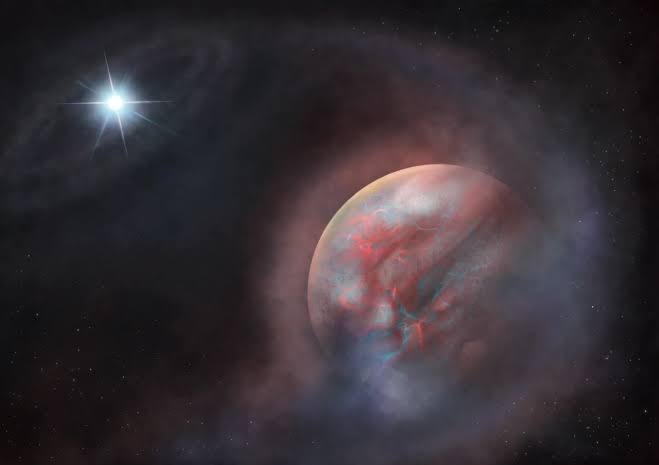
The white dwarf is estimated to have a surface temperature of about 35,800 kelvin and a cooling age of only about 5 million years. Scientists have known for years that its atmosphere contains unusual amounts of metals, but the source of those elements was not fully understood.
Researchers reanalysed observations from the Hubble Space Telescope, the Far Ultraviolet Spectroscopic Explorer and the Very Large Telescope. Their analysis revealed an unusual chemical pattern in the material falling onto the white dwarf.
Unusual Chemical Signature Provides a Clue
One of the strongest clues came from the presence of heavy elements such as zinc, copper and niobium. Niobium was especially important because it was found at more than three orders of magnitude above its abundance in the Sun.
The material was also unusual because it contained very little iron and silicon, which are common components of rocky bodies in our Solar System. Instead, it showed strong enrichment in elements created through the slow neutron-capture process, commonly called the s-process.
These elements are produced inside stars during advanced stages of stellar evolution. Their presence provides a chemical clue that the material came from the dying star itself.
How the Phoenix Planet May Have Formed
The researchers propose that the original star lost a large amount of material during its late stage of evolution. Under the right conditions, some of that material could have remained in orbit and formed a disc around the dying star.
A planet could then have formed from this material. Because the material had already been processed inside the original star, the resulting planet would have a chemical composition very different from a normal first-generation planet.
The researchers also suggest that a companion star may have helped pull some of the expelled material back into orbit. This could have helped create the disc needed for a new planet to form.
TESS Detects a 4.4-Day Signal
NASA’s Transiting Exoplanet Survey Satellite, or TESS, provided another important clue. Researchers found a repeating brightness variation from the HS 0209+0832 system with a period of about 4.4 days.
The measured period was 4.399 ± 0.026 days. Scientists interpret this signal as being consistent with thermal emission changes from a close-in giant planet or material associated with an evaporating planetary atmosphere.
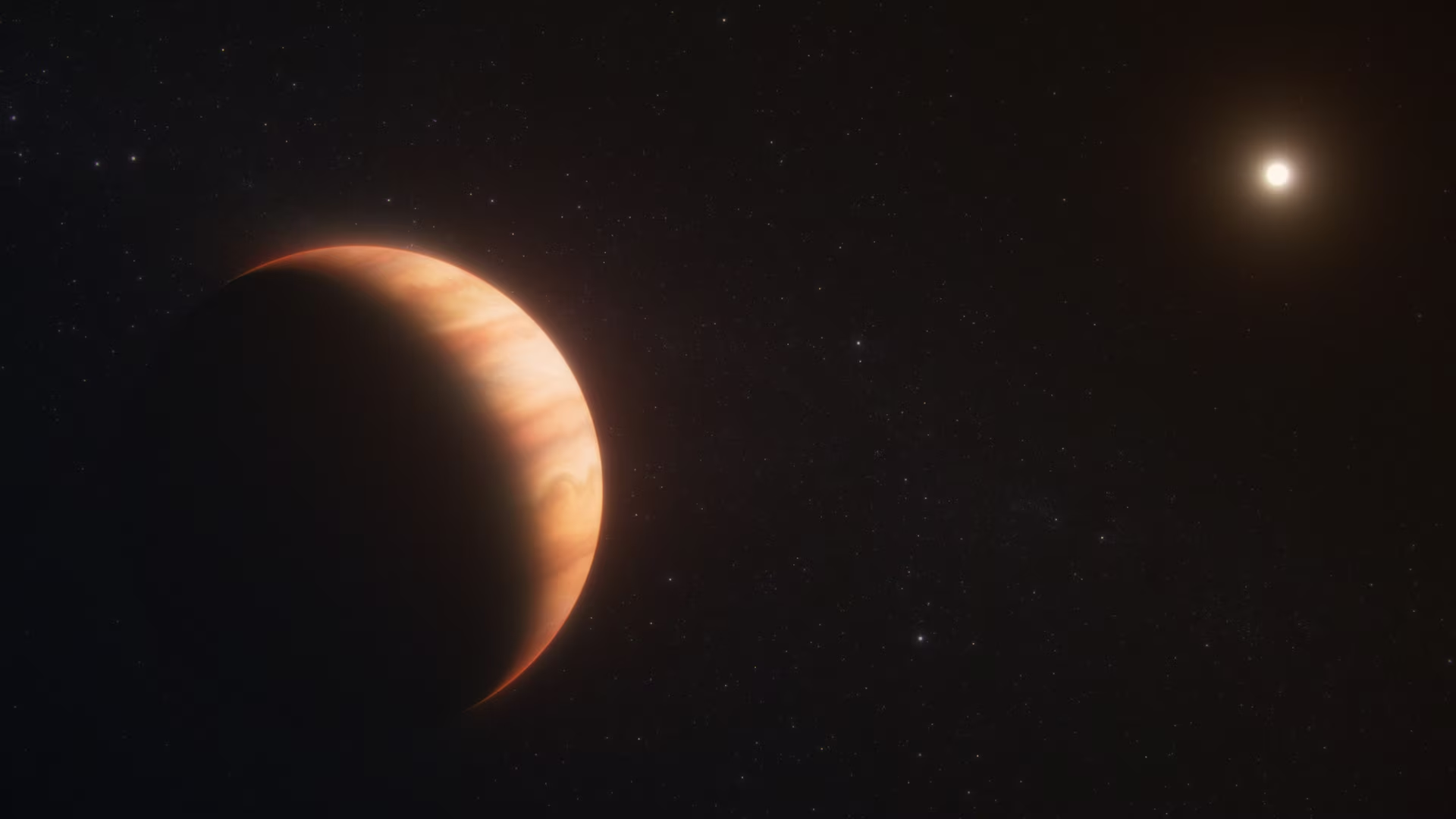
The Warwick team says the signal is consistent with a Jupiter-sized gas giant in a very tight orbit. However, the researchers describe it as a candidate rather than a confirmed planet because the available observations do not provide a direct image of the world.
A Very Different Kind of Planetary System
The possible discovery gives astronomers a new way to study what happens to planetary systems after their stars die.
Our Solar System will also experience major changes in the distant future. The Sun is expected to leave its current main-sequence stage, expand into a red giant and eventually become a white dwarf. The new research does not mean that a similar second-generation planet will necessarily form around the future white dwarf Sun, but it provides scientists with a real system in which such a process may be happening.
Studying systems like HS 0209+0832 can help researchers understand how planets survive, move and potentially form again during extreme stages of stellar evolution.
Why the Discovery Matters
The Phoenix Planet candidate is unusual because its possible origin is connected to the death of its host star. Instead of being a planet that simply survived the star’s evolution, it may have formed from material released during that process.
The researchers say the combination of the unusual chemical composition and the 4.4-day brightness signal supports the second-generation planet interpretation. Further observations will be important to confirm the nature of the candidate and determine how such a planet could have formed so close to a young white dwarf.
The discovery also suggests that astronomers could search for more second-generation planets by looking for hot white dwarfs with unusually high carbon and s-process element abundances. Finding a larger group of these systems could provide new evidence about planet formation after the death of a star.