



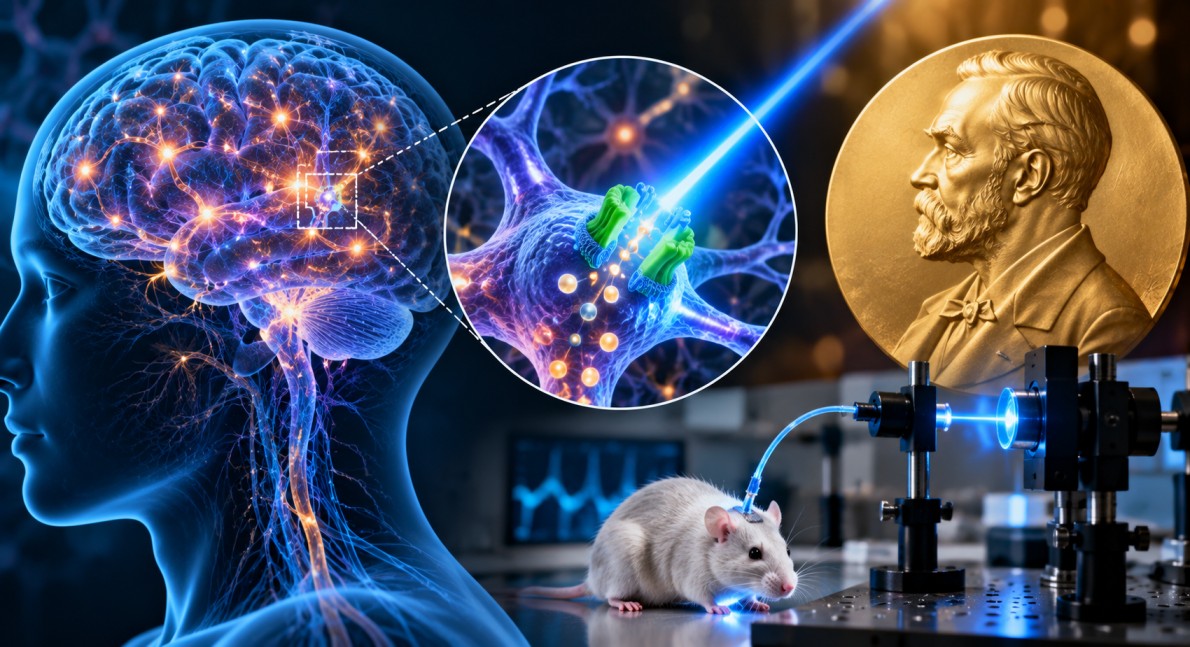
Optogenetics Wins Nobel Prize

Optogenetics has won the 2026 Nobel Prize in Physiology or Medicine, with Karl Deisseroth, Peter Hegemann and Georg Nagel receiving the award for discoveries that helped scientists control nerve cells using light. The Nobel Assembly at Karolinska Institutet announced the prize on October 5, 2026, recognising their work on light-gated ion channels and the development of optogenetics.
Thank you for reading this post, don't forget to subscribe!Why Optogenetics Won the 2026 Nobel Prize
The three scientists made important discoveries that changed the way researchers study the brain. Their work showed how light-sensitive proteins can be used to control the activity of specific cells.
This is especially important in neuroscience because the brain contains billions of nerve cells that work together. Researchers need ways to identify what individual groups of neurons do. Optogenetics provides a highly precise method by allowing scientists to activate or silence selected nerve cells with light.
The Nobel Assembly said the discoveries have allowed researchers to investigate how individual nerve cells influence functions such as movement, memory, emotions and behaviour.
What Is Optogenetics?
Optogenetics is a biological technique that combines genetics and light. Scientists introduce genes that make cells produce light-sensitive proteins. When light reaches these proteins, they can change the electrical activity of the cell.

In neuroscience, this technique can be used to control selected neurons. This gives researchers a way to study brain circuits with much greater precision than many traditional methods.
The technique has become an important research tool in modern neuroscience and has helped scientists investigate how different parts of the brain communicate and influence behaviour.
Discovery of Channelrhodopsin
A key part of the story began with research on a single-celled alga. Peter Hegemann and Georg Nagel studied light-sensitive proteins in microorganisms and helped identify channelrhodopsins.
Channelrhodopsin is a light-sensitive protein that forms an ion channel in the cell membrane. When exposed to light of the appropriate wavelength, the channel opens and allows ions to move across the membrane.
This discovery provided the biological tool needed for later developments in optogenetics.
Karl Deisseroth and the Development of Optogenetics
Karl Deisseroth played a major role in turning the discovery of light-sensitive proteins into a practical method for neuroscience.
His research helped show that these proteins could be introduced into selected nerve cells and then controlled with light. This created a new way to study the activity of specific neurons in living animals.
Instead of simply observing that a group of neurons becomes active, researchers can use optogenetic methods to test what happens when those neurons are switched on or off. This has helped scientists explore the connections between brain activity and behaviour.
Why the Discovery Matters for Brain Research
The brain is an extremely complex network. A change in one group of neurons can affect many other cells and circuits. Earlier research methods often made it difficult to control a particular group of neurons without affecting nearby cells.
Optogenetics changed this by providing a much more targeted approach. Researchers can combine genetic methods with light stimulation to study specific cell types and neural pathways.
This has contributed to research into areas such as memory, movement, emotions and neurological disorders.
Possible Medical Applications
Optogenetics is mainly a research technique, but its development has also influenced medical research. Scientists are exploring how light-sensitive proteins and related technologies could eventually contribute to treatments for some neurological and sensory conditions.
One area of research is vision restoration. Researchers have investigated whether optogenetic approaches could help some people with severe retinal disorders by making remaining retinal cells responsive to light. However, such approaches are still part of a developing field and should not be confused with routine medical treatment.
The technology is also helping researchers understand disease-related changes in neural circuits.
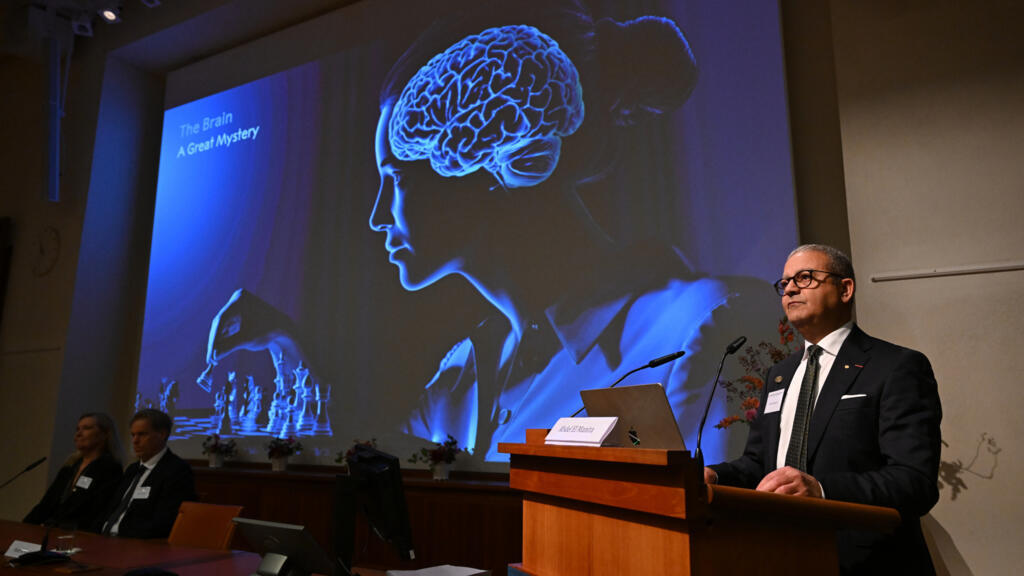
Nobel Prize in Physiology or Medicine
The Nobel Prize in Physiology or Medicine is awarded by the Nobel Assembly at Karolinska Institutet in Stockholm. It is one of the original Nobel Prize categories established through Alfred Nobel’s will. The prize recognises major discoveries that have advanced knowledge in physiology or medicine.
The 2026 award was announced during Nobel Week, which began with the Medicine prize announcement on October 5. The formal Nobel Prize ceremonies are held in December, with the Stockholm ceremony traditionally taking place on December 10.
The 2026 recognition of Deisseroth, Hegemann and Nagel highlights how a discovery involving a light-sensitive protein from a microscopic organism eventually became a powerful tool for studying the living brain.
Their work has connected molecular biology, genetics, optics and neuroscience, opening new ways to understand how nerve cells control complex functions in the brain.