



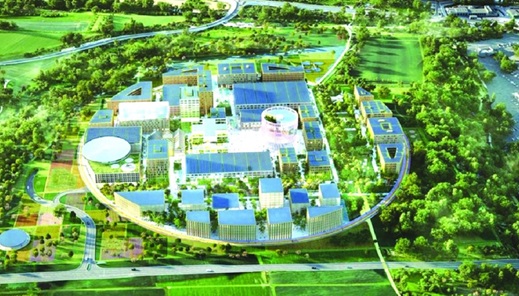
Quantum AI University in Andhra Pradesh

Quantum AI University is set to come up in Amaravati, Andhra Pradesh, after the state government approved India’s first dedicated university campus focused on quantum technology and artificial intelligence on 27 August 2026. The project will be developed by the National Institute of Electronics and Information Technology (NIELIT), which functions under the Ministry of Electronics and Information Technology (MeitY).
The proposed campus is designed to become a specialised centre for higher education, research, innovation and skill development in advanced technology fields. It will focus on areas such as quantum computing, artificial intelligence, VLSI and semiconductor fabrication, which are becoming increasingly important for India’s technology and digital economy.

Quantum AI University to Focus on Deep-Tech Education
The proposed Quantum AI University will offer education and training across several levels. Students and working professionals will have access to undergraduate, postgraduate, PhD, diploma and executive programmes.
The academic structure will focus on technologies that are expected to influence the future of computing, electronics and manufacturing. Quantum computing can provide new ways of processing information by using principles of quantum mechanics. Artificial intelligence, meanwhile, is being used in areas such as healthcare, finance, manufacturing, defence, transport and digital services.
The university will also cover VLSI and semiconductor fabrication. VLSI, or Very Large Scale Integration, is related to designing complex electronic circuits and chips. Semiconductor fabrication involves manufacturing integrated circuits on silicon wafers.
₹730.70 Crore Project for Amaravati
The proposed campus has an estimated cost of ₹730.70 crore, which will be spent over a period of five years. The Ministry of Electronics and Information Technology will provide 100% Grant-in-Aid for the project.
A major part of the campus will be a 1.25 lakh square foot Quantum Research, Innovation and Incubation Block. The facility is planned with solar-powered Net Zero features, reflecting the growing focus on energy-efficient infrastructure.
The campus will also have residential facilities with a planned capacity of around 500 beds. These facilities are expected to support students, researchers and other participants associated with the university.
Classes to Begin Before Permanent Campus
Although the permanent Quantum AI University campus is planned for Amaravati, academic activities are scheduled to begin earlier.
Programmes are expected to start in September 2026 at Acharya Nagarjuna University in Guntur. This interim arrangement will allow education and training activities to begin while the permanent campus is being developed.
There have been different reports regarding the exact land area of the proposed campus. Some details refer to an 8.5-acre plot in Amaravati, while another site mentioned in connection with the project is a 10-acre location at Nidamarru.
NIELIT to Develop the Campus
NIELIT will be responsible for developing the specialised institution. The organisation works under MeitY and is involved in education, training, skill development and capacity building in electronics and information technology.
The choice of NIELIT reflects the growing need for specialised institutions that can connect education with emerging technologies. The proposed university is expected to combine classroom learning with research, innovation and incubation activities.
Its focus on advanced technologies could also create opportunities for students and researchers to work on new products, software, semiconductor technologies and technology-based businesses.

MoU Signed Earlier in 2026
The project was preceded by an agreement between NIELIT and the Government of Andhra Pradesh.
On 20 February 2026, NIELIT signed a Memorandum of Understanding with the Andhra Pradesh government during the India AI Impact Summit. The agreement provided the foundation for developing the specialised technology campus in the state.
The latest approval moves the project forward and places Amaravati at the centre of a major initiative focused on quantum technology and artificial intelligence.
Planned Intake of More Than 8,000 Learners
The project is expected to serve 8,250 learners over five years.
Of these, around 1,650 learners are projected to participate in degree programmes. Another 6,600 learners are expected to receive training through skilling and certification programmes.
This structure gives the project a broader role than a traditional university. Along with full-time academic programmes, it is expected to provide shorter technology-focused courses for people who want to improve their skills or enter emerging technology sectors.
Growing Importance of Quantum Computing
Quantum computing is one of the major technology areas being promoted through the proposed campus. Unlike traditional computers, quantum computers use quantum bits, or qubits, to process information.
Quantum technology has potential applications in areas such as scientific research, cryptography, drug discovery, materials science and complex optimisation. Although the technology is still developing, governments and technology companies around the world are investing heavily in research and infrastructure.
India has also been increasing its focus on quantum technologies through research programmes, skill development and technology initiatives. A dedicated academic and research campus could help create a larger pool of trained professionals in this field.
Artificial Intelligence and Semiconductor Focus
Artificial intelligence will be another major area of the university. AI systems are increasingly being used for automation, data analysis, language processing, image recognition and decision-making support.
The inclusion of semiconductor fabrication and VLSI is also significant because India is working to strengthen its domestic semiconductor ecosystem. Chip design and manufacturing require specialised technical knowledge, skilled workers and research infrastructure.
By bringing AI, quantum computing, VLSI and semiconductor fabrication together, the proposed campus is designed around several technologies that are closely connected to the future of computing and electronics.
Innovation and Startup Support
The planned Quantum Research, Innovation and Incubation Block is expected to support more than academic research. Incubation facilities can help researchers and students turn technology ideas into prototypes, products and startups.
This could create opportunities for collaboration between universities, technology companies, researchers and entrepreneurs. Such connections are increasingly important as governments seek to build domestic capabilities in deep-tech sectors.
The focus on incubation also supports India’s wider push to develop technology-based businesses and reduce dependence on imported technologies in strategic areas.
Amaravati’s Emerging Technology Role
The project adds to Amaravati’s planned development as an important administrative and economic centre of Andhra Pradesh. A specialised technology university can contribute to the development of a skilled workforce and attract research and technology-related activities.
The combination of government funding, specialised courses, research facilities and incubation support is intended to create an ecosystem around emerging technologies rather than only providing conventional classroom education.