

Medicine Margin Caps Under Supreme Court Review

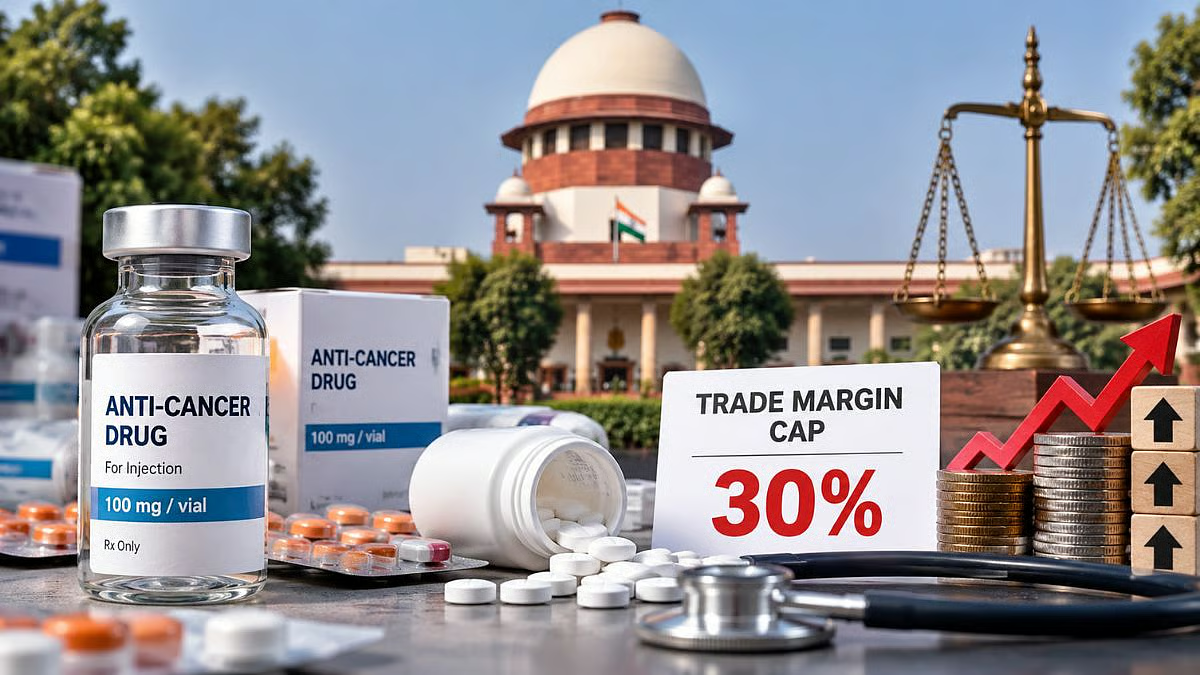
Medicine Margin Caps came under discussion in the Supreme Court of India on 12 October 2026, when the Court questioned why limits on trade margins for anti-cancer medicines could not be extended to other medicines. The Central Government informed the Court that it had decided to cap trade margins on anti-cancer medicines at 30% of the Maximum Retail Price (MRP). This measure is expected to save patients around ₹2,500 crore every year.
The case has brought attention to the difference between the cost of medicines and the prices paid by patients. The Court asked the Centre to consider wider price-control measures and submit details of its proposed plan at the next hearing, scheduled for 27 October 2026.

Supreme Court Seeks Wider Medicine Margin Caps
A bench of Justices Vikram Nath and Sandeep Mehta examined the issue of high medicine prices and the need to make treatment more affordable. The judges questioned why the government’s decision to limit trade margins on anti-cancer medicines could not be considered for other drugs.
Trade margins are the difference between the price at which a product is purchased by a seller and the price at which it is sold, before accounting for other costs. In the medicine supply chain, manufacturers, distributors, wholesalers and retailers may all play a role in bringing medicines to patients.
The Court raised concerns about large differences between the cost of certain medical products and the prices charged to patients. It referred to a saline drip costing ₹11 but being sold for ₹270. It also cited an India-made cardiac stent costing about ₹5,000, while hospital prices could exceed ₹25,000.
The judges also questioned the difference between the cost and selling price of the antibiotic Azithromycin. These examples were discussed to highlight concerns about pricing transparency and the affordability of healthcare.
The Centre was asked to submit the details, or modalities, of possible wider price-control measures before the next hearing.
Government Decision on Anti-Cancer Medicine Prices
The Central Government informed the Supreme Court that it had decided to limit trade margins on anti-cancer medicines to 30% of the Maximum Retail Price. The measure is expected to generate annual savings of about ₹2,500 crore for patients.
Anti-cancer medicines can involve substantial treatment costs, especially when patients require long-term medication. High prices can place a heavy financial burden on patients and their families.
Limiting trade margins is one way to address the difference between medicine prices and the costs faced by consumers. However, the final price paid by a patient also depends on factors such as manufacturing costs, taxes, distribution expenses and the applicable price-control rules.
The Centre argued that trade margins help support the supply of medicines, including in remote areas. Distributors and retailers may need sufficient returns to cover transport, storage and other operating expenses.
The Supreme Court emphasised that ensuring the availability of price-controlled medicines to patients is a government responsibility. The wider issue is how to make medicines affordable while maintaining a reliable supply across the country.
How Medicine Price Control Works in India
India regulates the prices of certain medicines through the Drugs (Prices Control) Order, 2013, commonly known as DPCO 2013. The order operates under the Essential Commodities Act, 1955, and provides a framework for controlling the prices of specified medicines.
The Department of Pharmaceuticals administers the framework through the National Pharmaceutical Pricing Authority (NPPA). The NPPA fixes and revises medicine prices according to the applicable rules.
For medicines included in the scheduled list under the DPCO, the authority sets a ceiling price. Manufacturers cannot set the Maximum Retail Price above the applicable ceiling price, subject to the rules governing the formulation.
Under the pricing method described in the supplied report, the ceiling price for a scheduled formulation is calculated using the simple average of the prices to retailers of eligible brands and generic versions with at least 1% market share, based on moving annual turnover. A 16% margin is then added to the average.
This method aims to establish a price limit based on market prices rather than allowing each manufacturer to set any price without restriction.
Medicine price control does not mean that every drug in the market has the same price limit. The applicable rules depend on whether a medicine or formulation falls within the relevant scheduled category and other provisions of the pricing framework.
Role of the National Pharmaceutical Pricing Authority
The National Pharmaceutical Pricing Authority is responsible for implementing important parts of India’s medicine price-control system. It was established in 1997 and operates under the Department of Pharmaceuticals.
Its responsibilities include fixing and revising prices of medicines covered by the applicable rules and monitoring compliance with price-control requirements.
Price regulation is important because medicines are essential for treating illnesses and managing long-term health conditions. Without appropriate controls, patients may face difficulties when prices rise or when different sellers charge widely varying amounts.
The NPPA’s work forms part of a broader system involving the government, medicine manufacturers, healthcare providers and sellers. The aim is to balance the affordability of medicines with their availability in the market.
The Supreme Court proceedings have brought renewed attention to how the existing system works and whether similar margin limits could be considered for a wider range of medicines.

National List of Essential Medicines and Its Importance
The National List of Essential Medicines (NLEM) identifies medicines considered important for meeting the healthcare needs of the population. It is prepared by the Ministry of Health and Family Welfare with advice from the Standing National Committee on Medicines.
The review process considers factors such as the World Health Organization’s Essential Medicines List, national health programmes, the Indian Pharmacopoeia and the National Formulary.
The 2022 NLEM contains 388 drugs and more than 900 formulations, according to the supplied report.
The NLEM and DPCO are connected parts of India’s medicine policy. Inclusion in the NLEM can influence whether a medicine is considered for price control under the relevant framework, but the two lists and systems are not identical.
The NLEM helps identify medicines that should be available to meet priority health needs. Price-control rules can then help limit the cost of specified medicines and improve affordability for patients.
Essential Commodities Act, 1955
The Essential Commodities Act, 1955, provides the legal basis for regulating the production, supply and distribution of certain essential commodities. It supports government action under relevant orders, including the Drugs (Prices Control) Order, 2013.
The Act allows the government to regulate specified commodities in the public interest under the conditions set by law. Medicine price control is one area in which this legal framework is used to protect consumers.
The DPCO provides the specific rules used to regulate prices of covered medicines. The Department of Pharmaceuticals and the NPPA play key roles in implementing those rules.
These measures are particularly relevant to healthcare because patients may have limited choices when they need prescribed medicines. Price regulation can help prevent excessive charges for products covered by the applicable provisions.
Next Hearing Scheduled for 27 October 2026
The Supreme Court has scheduled the next hearing for 27 October 2026. The Central Government is expected to present the proposed methods for considering wider medicine margin caps.
The proceedings raise important questions about the affordability of medicines, the role of distributors and retailers, and the government’s responsibility to ensure access to essential treatments.
Any expansion of margin limits would need to consider how the policy affects patients, medicine suppliers and availability, particularly in remote areas. The impact would depend on the scope of the proposed measures and how they are implemented.
The next hearing is expected to bring further attention to India’s medicine pricing framework and the possibility of extending margin-related controls beyond anti-cancer medicines.