

Voyager 1 Light-Day Milestone

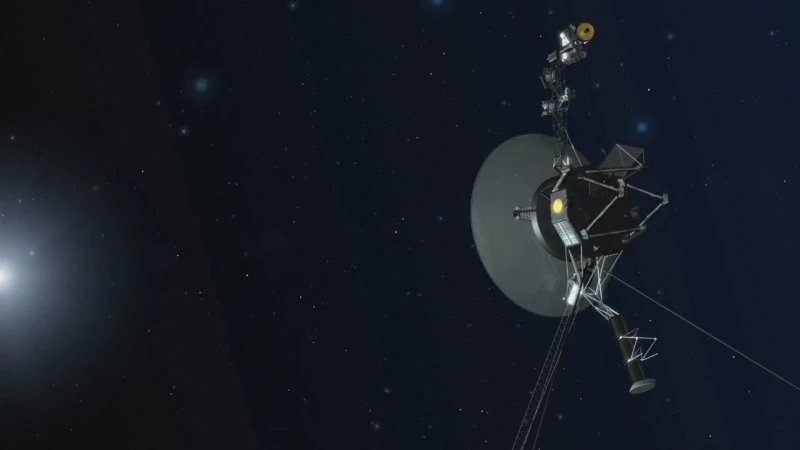
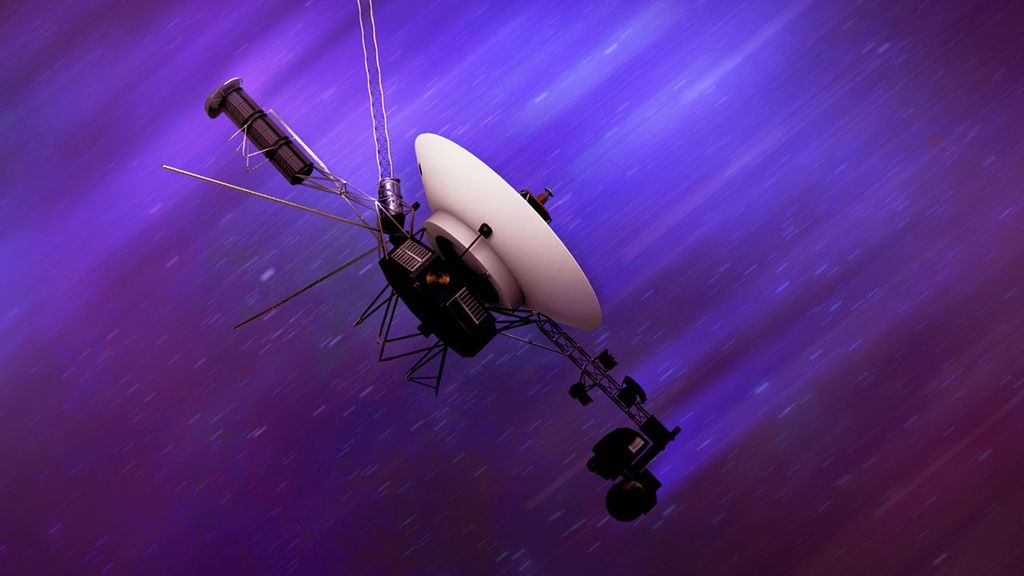
Voyager 1 Light-Day is a major milestone that NASA’s distant spacecraft is expected to reach on 18 November 2026. According to the supplied report, Voyager 1 is projected to become the first human-made object to travel one light-day from Earth at around 10:16 UTC. At that point, it will be approximately 25.902 billion kilometres, or 16.094 billion miles, away from our planet.
Voyager 1 has been travelling through space for nearly five decades. Its journey has taken it beyond the planets and into interstellar space, where it continues to send scientific information back to Earth.

What Does One Light-Day Mean?
A light-day is the distance light travels in one day. Since light moves at about 300,000 kilometres per second, one light-day is roughly 25.9 billion kilometres.
The milestone does not mean Voyager 1 will reach another planet or star on that date. It refers to the distance between the spacecraft and Earth. At such a great distance, even a radio signal travelling at the speed of light needs almost a full day to reach the spacecraft or return to Earth.
As of 3 November 2026, Voyager 1 was reported to be about 25.86 billion kilometres from Earth. Its radio signal took approximately 23 hours, 57 minutes and 49 seconds to reach us.
Communication Takes Almost Two Days
Voyager 1 communicates with Earth using radio signals. Because the spacecraft is so far away, NASA cannot control it in real time.
A command sent from Earth takes nearly 24 hours to reach Voyager 1. The spacecraft’s response then takes almost another 24 hours to return. This means a complete exchange can take around two days.
The long delay makes spacecraft operations challenging. Engineers must plan commands carefully and allow enough time for the spacecraft to respond. They also need to rely on systems that can keep the probe operating when immediate help from Earth is not possible.
Recent Communication Interruption
Voyager 1 experienced a communication problem in October 2026, according to the report. During scheduled communication attempts, NASA’s Deep Space Network did not detect the spacecraft’s signal, and contact was lost for about 48 hours.
Communication was restored on 20 October. Engineers at NASA’s Jet Propulsion Laboratory traced the interruption to a group of thrusters that had gone offline. Backup thrusters took over, and the spacecraft’s fault protection system was activated.
Thrusters help Voyager 1 maintain the position needed for its antenna to point towards Earth. Without that alignment, the spacecraft may have difficulty sending signals back to mission teams.
Extending Voyager 1’s Mission
Voyager 1 was launched on 5 September 1977. It was designed to explore the outer planets, but its mission continued long after its original planetary encounters.
The spacecraft is now travelling through interstellar space at a reported speed of about 61,000 kilometres per hour. It is heading in the direction of Gliese 445, also known as AC+79 3888, a star located in the constellation Ursa Minor. Voyager 1 is not expected to reach that star in the near future.
The spacecraft’s power supply is gradually decreasing. It uses radioisotope thermoelectric generators, which produce electricity from the heat released by radioactive material. As the power output falls, NASA has been turning off or replacing power-hungry systems, including heating devices, to preserve energy for essential operations.
These steps are intended to keep the spacecraft working for as long as possible.
Voyager 1 and the Interstellar Journey
Voyager 1 crossed the heliopause on 25 August 2012. The heliopause is the boundary where the influence of the solar wind gives way to the surrounding interstellar environment. The crossing made Voyager 1 the first spacecraft to enter interstellar space.
Its twin spacecraft, Voyager 2, is also travelling beyond the outer planets. The report estimates that Voyager 2 will reach a distance of one light-day from Earth in November 2035.
The Voyager missions continue to provide information about the space beyond our Solar System. Their long journeys also show how spacecraft can keep operating far beyond their original mission plans, even as communication delays and limited power become increasingly difficult to manage.