



Youngest Planet: Elias 2-24 b Confirmed

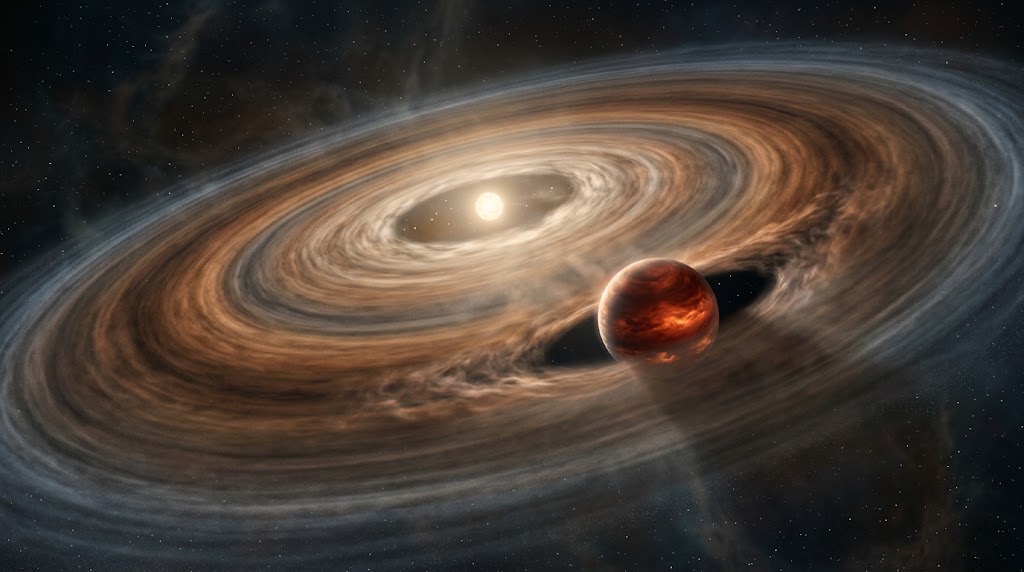
Youngest Planet Elias 2-24 b has been confirmed as the youngest known planet discovered so far, giving astronomers a rare chance to observe a giant planet while it is still forming. The planet is less than 1 million years old and orbits the young star Elias 2-24, located about 450 light-years from Earth. It is still surrounded by the gas and dust of the planet-forming disk from which it developed. NASA reported the discovery on September 16, 2026, based on research published in The Astrophysical Journal Letters.
Thank you for reading this post, don't forget to subscribe!Elias 2-24 b Is Still Growing
Elias 2-24 b is roughly as massive as Jupiter and is located inside a prominent gap in the disk around its host star. Unlike older planets, this world is still gathering material from its surroundings.
Young stars are commonly surrounded by rotating disks made of gas, dust, ice and rocky material. Over time, this material can come together to form planets. Scientists believe that Elias 2-24 b is currently going through an active stage of this process.
The planet is particularly important because it gives researchers an opportunity to study planetary growth while it is happening, rather than trying to reconstruct the process from much older planetary systems.
A Planet Found Inside a Disk Gap
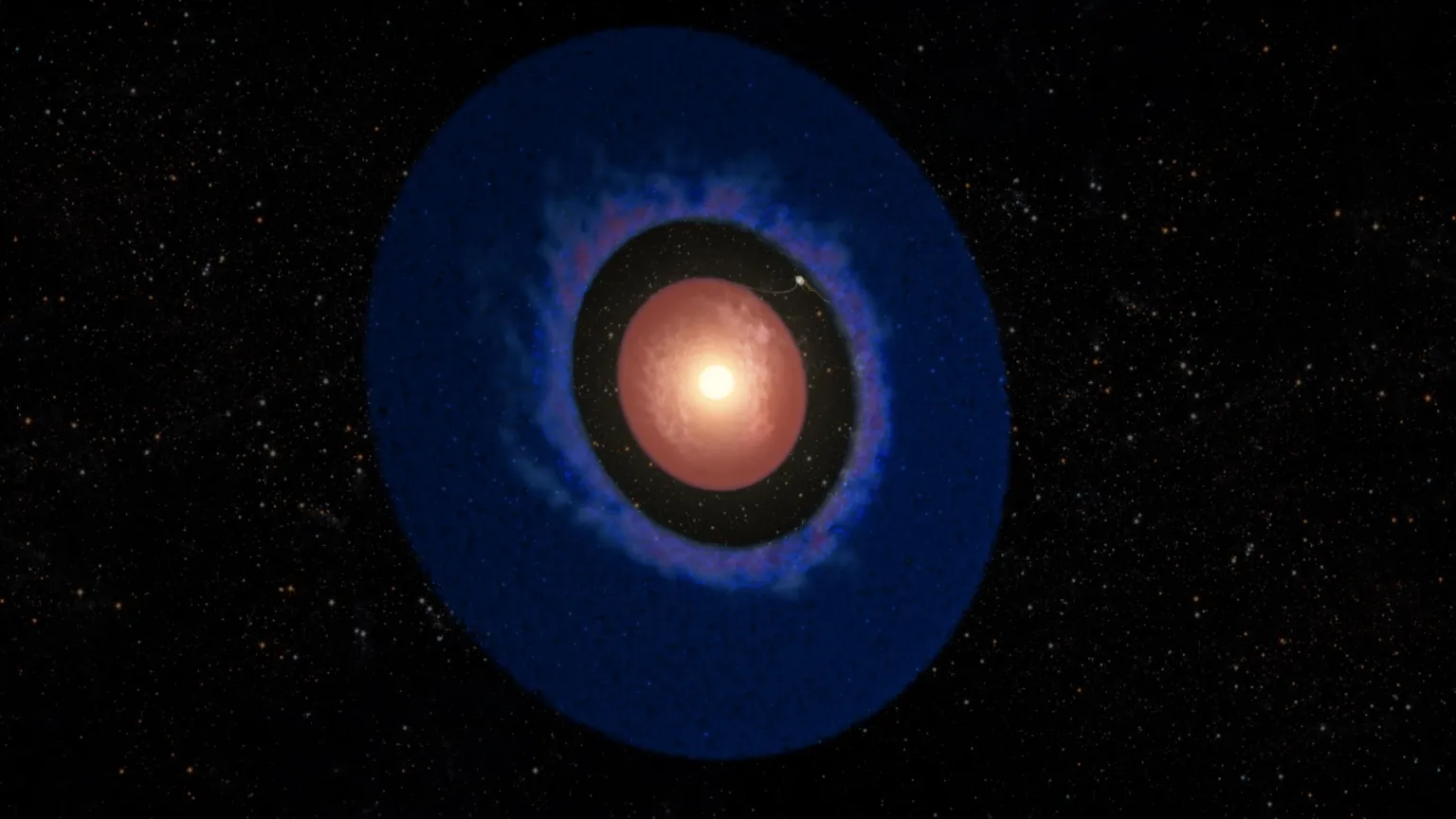
The discovery is closely connected to a large gap seen in the protoplanetary disk around Elias 2-24. Astronomers have long studied such gaps because planets can create them as they move through the material surrounding a young star.
Earlier observations using the Atacama Large Millimeter/submillimeter Array (ALMA) revealed the disk structure around Elias 2-24. Later observations from the European Southern Observatory’s Very Large Telescope (VLT) showed a faint object in the same gap.
At first, scientists could not be certain that the faint object was actually a planet. Its young age and large distance from the star created questions about whether existing planet-formation models could explain its presence.
Archive Data Helped Confirm the Discovery
A major part of the discovery came from older observations stored in the W. M. Keck Observatory Archive. Andrea Bernardi, a doctoral researcher at Universidad Diego Portales in Chile, led the research team.
The team examined Keck observations from 2018 and 2020 and compared them with observations from other facilities. By studying how the faint object moved over time, researchers found evidence that it was behaving like a planet rather than an imaging error or a distant background object.
The work combined observations from the W. M. Keck Observatory in Hawaii, ALMA in Chile and the European Southern Observatory’s VLT. This combination helped researchers confirm Elias 2-24 b.
Why the Youngest Planet Matters
The Youngest Planet discovery is important because planets this young are extremely difficult to observe. Most known exoplanets are much older and are often detected when they pass in front of their stars, causing a small drop in starlight.
That method becomes much harder to use for newborn planets because they can remain buried in thick clouds of dust and gas. Young planets can also orbit relatively far from their stars, making them difficult to detect against the bright light of the host star.
NASA says the discovery could help scientists improve models of how giant planets form. Existing models have faced difficulties explaining how a Jupiter-sized planet could develop so quickly at such a large distance from its young star. Elias 2-24 b therefore provides an important opportunity to examine these early stages directly.
Elias 2-24 b and Jupiter
Elias 2-24 b has a mass comparable to Jupiter, but the two planets are at very different stages of development. Jupiter is billions of years old and has long completed its main formation stage. Elias 2-24 b, by comparison, is still collecting material from the disk around its star.
The planet is also located about 55 times farther from its star than Earth is from the Sun. This large separation makes the system particularly useful for studying how giant planets can form in the outer regions of planetary systems.
New Telescopes Could Find More Baby Planets
The discovery comes as new space-based observatories are expanding the ability to study young planetary systems. NASA’s Nancy Grace Roman Space Telescope, which launched on August 30, 2026, carries a coronagraph designed to block the bright light of stars and help scientists study faint objects near them.
The Roman Space Telescope could make it easier to detect young planets that are difficult to see with existing instruments. Researchers hope that future observations will identify more planets in the early stages of formation and provide additional evidence about how planetary systems develop.
A Rare View of Planet Formation
The Youngest Planet Elias 2-24 b gives astronomers a rare look at a planetary system still under construction. Because our own Solar System is billions of years old, scientists cannot directly watch its formation. Young systems such as Elias 2-24 provide a way to observe similar processes much earlier in their development.
Researchers will continue studying Elias 2-24 b to learn more about its mass, atmosphere, temperature and continuing growth. The system could become an important laboratory for understanding how giant planets develop around young stars.