ZSI New Lichen Moth Species Found in Himalayas

ZSI New Lichen Moth Species discovery has brought fresh attention to India’s rich biodiversity, especially in the eastern Himalayan region. Scientists from the Zoological Survey of India have identified two new species of lichen moths, adding to the growing list of insects found in this ecologically important zone. The findings were officially published in the international journal Zootaxa on March 2, 2026.
Thank you for reading this post, don't forget to subscribe!This discovery shows how much of nature is still unexplored, even today. It also highlights the importance of protecting fragile ecosystems like the Himalayas, where many unknown species continue to exist.
ZSI New Lichen Moth Species Found in Sikkim and West Bengal
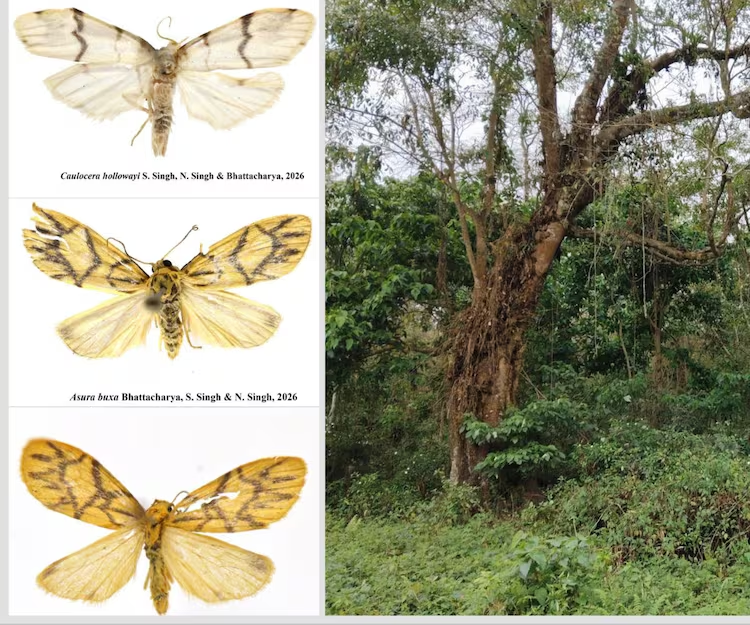
The two newly identified moth species are named Caulocera hollowayi and Asura buxa. These species were discovered in different locations across the eastern Himalayas.
- Caulocera hollowayi was found near Golitar in Sikkim
- Asura buxa was identified in Panijhora, located in West Bengal
The research team included Indian scientists such as Navneet Singh, Santosh Singh and Srishti Bhattacharya, who carefully studied the collected specimens. Their work confirmed that these moths had never been recorded before, making them new additions to science.
ZSI New Lichen Moth Species and the Role of Scientific Naming
The process of identifying and naming new species is known as taxonomy. This step is very important because it helps scientists organize and understand the natural world. Once a species is named, it becomes easier for researchers around the globe to study it and share information.
Along with the discovery of these two moths, the researchers also reported seven other lichen moth species that were recorded in India for the first time. This shows that India’s insect diversity is much richer than previously known.
Such discoveries are important in today’s world, where environmental changes are affecting many species. Proper identification helps in tracking and protecting them.
ZSI New Lichen Moth Species Identified Through Unique Features
To confirm that these moths were new species, scientists studied their physical and microscopic features in detail. They examined:
- Wing colours and patterns
- Body shape and size
- Band markings on wings
- Microscopic structures
Special attention was given to reproductive structures, which are often used to identify insect species. Researchers also studied tiny body scales and the arrangement of bristles, known as chaetotaxy. These detailed observations helped them confirm that the moths were indeed new and different from known species.
ZSI New Lichen Moth Species and the Importance of the Eastern Himalayas
The eastern Himalayan region is one of the world’s most important biodiversity hotspots. It is home to a wide range of plants, animals and insects that are not found anywhere else.
The discovery of new species in this region shows how rich and valuable this ecosystem is. However, it also reminds us that these areas need protection. Climate change, deforestation and human activities are putting pressure on such fragile environments.
By studying species like lichen moths, scientists can better understand how ecosystems function and how they are changing over time.
ZSI New Lichen Moth Species and Their Role in Nature
Lichen moths may look small and simple, but they play an important role in nature. Their caterpillars feed on lichens, which are special organisms that grow on rocks, trees and soil.
Lichens are very sensitive to pollution, especially air pollution. Because of this, lichen moths are often used as natural indicators of environmental health. If these moths are present in an area, it usually means the air is clean and the ecosystem is healthy.
On the other hand, if their numbers decrease, it can be a sign of pollution or environmental damage. This makes them important for monitoring the condition of natural habitats.
ZSI New Lichen Moth Species Highlight Need for Conservation
In recent years, there has been growing concern about the loss of biodiversity due to human activities. Discoveries like the ZSI New Lichen Moth Species remind us that many species are still unknown and could disappear before they are even studied.
Protecting regions like the eastern Himalayas is important not only for wildlife but also for people. Healthy ecosystems provide clean air, water and resources that support life.
Scientists continue to explore and document new species, but conservation efforts must keep pace with these discoveries. Awareness, research and responsible development are key to maintaining balance in nature.