



Citizen Charter: Meaning, Principles, Importance, Challenges and Reforms

Citizen Charter is an important part of good governance and public administration. It is a document that explains the services provided by a government department or public organization to the citizens. It tells people what kind of services they can expect, how much time will be taken, and how complaints can be solved if services are not delivered properly.
Thank you for reading this post, don't forget to subscribe!The main purpose of a Citizen Charter is to make government offices more responsible, transparent, and citizen-friendly. It focuses on improving the relationship between citizens and public service providers. In simple words, a Citizen Charter acts like a promise made by a government department to the people.
In today’s modern democracy, citizens expect fast, fair, and efficient public services. A Citizen Charter helps to fulfill these expectations by improving accountability and service quality. It also increases public trust in government institutions.
The concept of Citizen Charter has become very important in countries like India, where millions of people depend on government services every day. Whether it is getting a passport, ration card, electricity connection, pension, or health service, citizens want timely and proper service. Citizen Charter helps in making this process smooth and organized.
Meaning of Citizen Charter
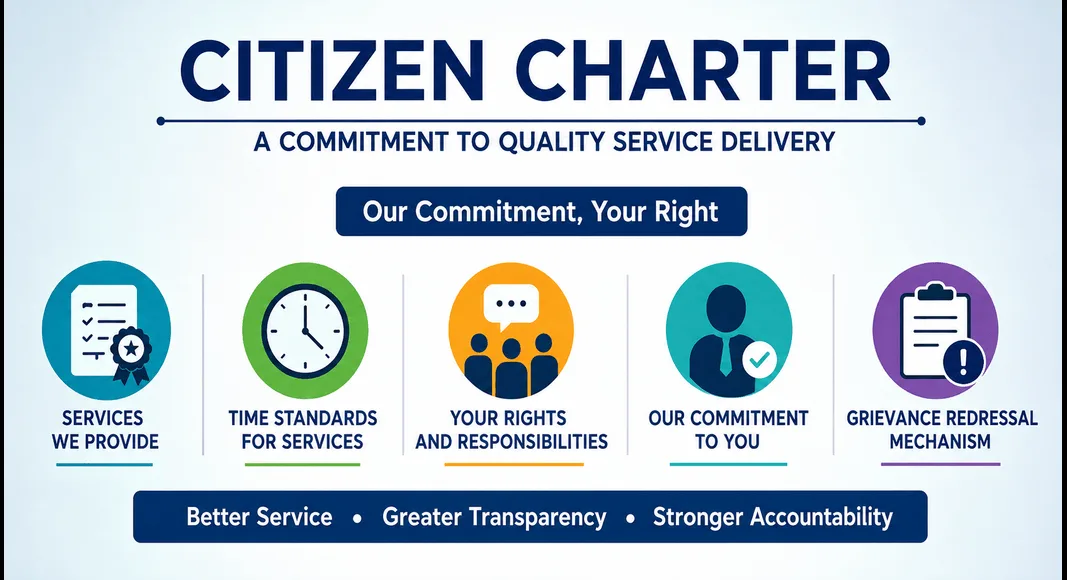
A Citizen Charter is an official document that clearly explains the services provided by an organization, the standards of service, the responsibilities of officials, and the rights of citizens. It also gives details about grievance redressal systems for solving public complaints.
The Citizen Charter includes:
- Standards of services
- Information about procedures
- Time limits for service delivery
- Complaint handling systems
- Responsibilities of citizens
- Transparency in administration
The charter treats citizens as customers and public offices as service providers. It encourages organizations to work efficiently and honestly.
A Citizen Charter is not legally enforceable. This means citizens cannot directly go to court if the charter is not followed. However, it acts as a moral and administrative commitment by the organization.
Origin of Citizen Charter
The concept of Citizen Charter started in the United Kingdom in 1991 under the government of Prime Minister John Major. The main aim was to improve the quality of public services and make government departments more responsive to people’s needs.
The British government launched it as a national program to ensure that citizens received better and faster services. The success of this idea encouraged many other countries, including India, to adopt the Citizen Charter system.
Citizen Charter in India
In India, the Department of Administrative Reforms and Public Grievances (DARPG) introduced the Citizen Charter initiative. The purpose was to create transparent, accountable, and citizen-friendly governance.
The government asked different ministries and departments to prepare their own Citizen Charters. Guidelines were provided to help organizations create effective and useful charters.
The Citizen Charter movement in India became an important administrative reform because it focused on improving public services and reducing delays, corruption, and confusion in government offices.
India also introduced the “Right of Citizens for Time Bound Delivery of Goods and Services and Redressal of their Grievances Bill, 2011.” The aim of this bill was to ensure timely delivery of public services and proper handling of complaints.
Objectives of Citizen Charter
The main objectives of Citizen Charter are:
1. Improving Public Services
The charter aims to improve the quality and efficiency of government services. It helps departments work in a more organized and responsible way.
2. Ensuring Transparency
Citizen Charter makes rules, procedures, and responsibilities clear to the public. This reduces secrecy and corruption.
3. Increasing Accountability
Government officials become more accountable because service standards and time limits are clearly mentioned.
4. Promoting Citizen Participation
The charter encourages citizens to participate in governance by giving feedback and suggestions.
5. Building Trust
When services are delivered properly and on time, people develop trust in government institutions.
6. Providing Grievance Redressal
It gives citizens a proper system to file complaints if services are delayed or denied.
Main Features of Citizen Charter
A good Citizen Charter usually contains the following features:
Vision and Mission Statement
It explains the goals and objectives of the organization.
Services Offered
The charter gives complete information about the services provided by the department.
Time Limit for Services
It clearly mentions the time within which services will be delivered.
Rights and Responsibilities
Citizens are informed about their rights as well as their responsibilities.
Grievance Redressal System
Details are provided about how complaints can be made and solved.
Contact Information
Names and contact details of responsible officers are included.
Principles of Citizen Charter
The Citizen Charter movement is based on certain important principles. These principles help organizations provide better services to citizens.
1. Quality
Government departments should continuously improve the quality of services provided to the public.
2. Choice
Citizens should be given choices wherever possible in selecting services.
3. Standards
Clear service standards and time limits should be mentioned.
4. Value for Money
Public money collected through taxes should be used properly and efficiently.
5. Accountability
Officials and organizations must be answerable for their actions and performance.
6. Transparency
Rules, procedures, and systems should be open and clear to everyone.
7. Participation
Citizens should be consulted and involved in decision-making processes.
Importance of Citizen Charter
Citizen Charter plays a major role in improving governance and administration. Its importance can be understood in the following ways:
1. Promotes Good Governance
Citizen Charter supports good governance by ensuring transparency, accountability, and efficiency.
2. Reduces Corruption
When rules and procedures are clearly mentioned, chances of corruption and misuse of power decrease.
3. Improves Service Delivery
Departments become more focused on providing timely and quality services.
4. Empowers Citizens
People become aware of their rights and service standards.
5. Encourages Responsibility
Officials become more careful and responsible in their duties.
6. Builds Public Confidence
Citizens gain confidence in government systems when services improve.
7. Increases Efficiency
Clear targets and timelines help organizations work more efficiently.
Elements of an Effective Citizen Charter
An effective Citizen Charter should include the following elements:
- Simple and clear language
- Easy accessibility to the public
- Realistic and measurable service standards
- Regular updates and improvements
- Strong grievance redressal mechanism
- Citizen participation in preparation
- Monitoring and evaluation system
These elements help make the charter practical and useful.
Shortcomings of Citizen Charter in India
Although the Citizen Charter system has many benefits, it also faces several challenges and weaknesses in India.
1. Lack of Public Awareness
Many citizens do not know about Citizen Charters or the services mentioned in them.
2. Poor Implementation
In many departments, the charter exists only on paper and is not properly followed.
3. No Legal Enforcement
Citizen Charters are not legally binding, so departments may ignore them without facing punishment.
4. Lack of Participation
Citizens, NGOs, and frontline workers are often not consulted during the preparation of charters.
5. Outdated Information
Many charters are not updated regularly and contain old information.
6. Uniform Approach
Some organizations use the same charter for all offices without considering local needs and problems.
7. Weak Grievance Redressal
Complaint handling systems are often slow and ineffective.
8. Lack of Accountability
Officials are rarely punished for failing to meet service standards.
9. Unclear Service Standards
Some charters do not clearly mention measurable service standards or time limits.
10. Lack of Monitoring
There is often no proper system to monitor whether the charter is being implemented correctly.
Reforms Needed in Citizen Charter
To make Citizen Charter more effective and useful, several reforms are necessary.
1. Decentralized Approach
Different offices should prepare charters according to local needs and conditions.
2. Public Participation
Citizens, NGOs, and civil society organizations should be involved in drafting the charter.
3. Clear Service Standards
Departments should mention measurable and realistic service standards.
4. Strong Complaint System
A proper grievance redressal mechanism should be developed.
5. Regular Updates
Citizen Charters should be revised regularly according to changing needs.
6. Awareness Campaigns
Governments should educate people about their rights and the services available.
7. Use of Technology
Online systems and digital platforms should be used for service delivery and complaint handling.
8. Accountability of Officials
Officials responsible for delays or failures should be held accountable.
9. Independent Evaluation
External agencies should periodically evaluate the performance of Citizen Charters.
10. Training of Employees
Government staff should receive proper training to implement the charter effectively.
Citizen Charter and Transparency
Transparency means openness and clarity in government functioning. Citizen Charter helps in increasing transparency by:
- Providing clear information about services
- Explaining procedures and rules
- Mentioning time limits
- Reducing hidden processes
- Informing citizens about their rights
Transparency reduces confusion and corruption in administration.
Citizen Charter and Accountability
Accountability means officials are answerable for their actions and duties. Citizen Charter improves accountability because:
- Service standards are publicly declared
- Responsibilities are clearly assigned
- Citizens can question delays and failures
- Complaint systems are available
This creates pressure on officials to perform their duties honestly and efficiently.
Citizen Charter and Good Governance
Good governance includes transparency, accountability, participation, efficiency, and responsiveness. Citizen Charter supports all these values.
A successful Citizen Charter system creates a citizen-centered administration where people are treated with respect and dignity.
It also strengthens democracy because citizens become active participants in governance instead of passive receivers of services.
Sevottam Model and Citizen Charter
The Sevottam Model is an important framework for improving public service delivery in India. The word “Sevottam” means excellence in service.
It includes three main components:
1. Citizen Charter
It focuses on proper implementation of service standards and citizen commitments.
2. Grievance Redressal
It ensures that complaints are handled effectively and fairly.
3. Service Delivery Capability
It focuses on improving the ability of organizations to deliver better services.
The Sevottam Model helps organizations become more citizen-friendly and efficient.
Role of Technology in Citizen Charter
Technology can make Citizen Charter more effective in many ways:
Online Services
Citizens can apply for services online without visiting offices repeatedly.
Digital Tracking
People can track the status of their applications and complaints.
Faster Communication
Websites, mobile apps, and SMS alerts improve communication.
Transparency
Digital systems reduce corruption and increase openness.
Data Monitoring
Government departments can monitor performance more effectively.
Digital India initiatives have helped improve service delivery in many sectors.
Examples of Citizen Charter Services
Many government departments in India use Citizen Charters, such as:
- Passport services
- Railways
- Municipal offices
- Electricity boards
- Hospitals
- Banks
- Police departments
- Educational institutions
These departments mention service standards, timelines, and complaint systems for citizens.
Challenges in Rural Areas
Citizen Charter implementation faces special challenges in rural areas:
- Lack of awareness among villagers
- Poor internet connectivity
- Low literacy levels
- Shortage of trained staff
- Weak monitoring systems
The government must focus on awareness programs and digital infrastructure in villages.
Suggestions for Better Citizen Participation
Citizens can play an important role in improving Citizen Charters by:
- Giving feedback on services
- Reporting corruption and delays
- Participating in public discussions
- Using grievance systems properly
- Staying informed about their rights
Active citizen participation can make public administration more democratic and effective.
Conclusion
Citizen Charter is an important tool for improving public administration and governance. It helps make government departments more transparent, accountable, and citizen-friendly. By clearly explaining services, responsibilities, and grievance systems, Citizen Charter strengthens the relationship between citizens and the government.
Although the Citizen Charter system in India faces many challenges such as poor implementation, lack of awareness, and weak accountability, proper reforms can make it more effective. Public participation, use of technology, regular monitoring, and strong grievance redressal systems are necessary for success.
Citizen Charter should not remain only a written document. It should become a practical system that ensures quality services for every citizen. When properly implemented, it can help create a responsive, efficient, and democratic administration focused on the needs of the people.
FAQs on Citizen Charter
1. What is a Citizen Charter?
A Citizen Charter is a document that explains the services provided by a government department and the standards of service delivery.
2. Who introduced the Citizen Charter concept?
The Citizen Charter concept was first introduced in the United Kingdom in 1991 by the government of John Major.
3. What is the main aim of a Citizen Charter?
The main aim is to improve public service delivery and make government departments more transparent and accountable.
4. Is a Citizen Charter legally enforceable?
No, a Citizen Charter is not legally enforceable and is considered non-justiciable.
5. Which department coordinates Citizen Charter in India?
The Department of Administrative Reforms and Public Grievances (DARPG) coordinates Citizen Charter initiatives in India.
6. What are the main principles of Citizen Charter?
The main principles include quality, transparency, accountability, standards, participation, and value for money.
7. Why is Citizen Charter important?
It helps improve governance, reduces corruption, increases accountability, and provides better services to citizens.
8. What is grievance redressal in Citizen Charter?
Grievance redressal is the system through which citizens can file complaints regarding poor or delayed services.
9. What are the major problems of Citizen Charter in India?
Major problems include poor implementation, lack of awareness, weak accountability, and outdated charters.
10. What is the Sevottam Model?
The Sevottam Model is a framework for improving public service delivery through Citizen Charter, grievance handling, and service excellence.