




Cooperative Federalism in India: Cooperation and Competition for Development

Cooperative Federalism in India is one of the most important features of the Indian political system. India is a large and diverse country with different languages, cultures, traditions, and economic conditions. Managing such diversity requires a governance system where powers are shared between the Central Government and State Governments.
Thank you for reading this post, don't forget to subscribe!The word “federalism” comes from the Latin word foedus, which means an agreement or treaty. In a federal system, power is divided between different levels of government. Both the national government and state governments have their own areas of authority defined by the Constitution.
India adopted a unique form of federalism after independence. Although the Constitution does not directly use the word “federal,” India functions as a federal country. Over time, the practical working of Indian federalism led to the development of two important concepts: Cooperative Federalism and Competitive Federalism.
Today, these two approaches play a major role in promoting development, improving governance, and strengthening the relationship between the Centre and the States.
Understanding Federalism in India
Federalism is a system where powers are divided between a central authority and regional governments.
In India:
- The Central Government manages national matters such as defence, foreign affairs, and currency.
- State Governments manage local matters such as police, public health, agriculture, and local administration.
- Some subjects are shared by both through the Concurrent List.
India is often described as a quasi-federal country because it combines federal and unitary features. During normal times, states enjoy autonomy, but during emergencies, the Centre gains greater powers.
This system helps maintain national unity while allowing states to address local needs.
What is Cooperative Federalism?
Cooperative Federalism refers to a system in which the Centre and States work together to achieve common national goals.
Instead of competing, they coordinate policies, share responsibilities, and support each other for the welfare of citizens.
The relationship is based on partnership, consultation, and mutual trust.
Features of Cooperative Federalism
- Centre and States work together.
- Shared responsibility for development.
- Joint decision-making.
- Coordination in policy implementation.
- Mutual respect and consultation.
The idea is that national progress is possible only when both the Union and States move forward together.
Importance of Cooperative Federalism
1. Promotes National Unity
India is home to many languages, religions, and cultures. Cooperation between governments helps maintain unity while respecting diversity.
2. Better Policy Implementation
Many government programs require support from both Centre and States. Cooperation ensures effective implementation.
3. Balanced Development
Cooperative federalism helps ensure that all regions receive development opportunities.
4. Faster Problem Solving
Issues such as natural disasters, health emergencies, and economic challenges require joint efforts.
5. Strengthens Democracy
When states participate in national decision-making, democracy becomes stronger and more inclusive.
What is Competitive Federalism?
Competitive Federalism refers to a system where states compete with each other to attract investment, improve governance, and achieve better development outcomes.
Under this model, states try to perform better than others in areas such as:
- Ease of doing business
- Infrastructure
- Education
- Healthcare
- Investment opportunities
- Employment generation
Competition encourages innovation and efficiency.
Features of Competitive Federalism
- States compete for investment.
- Better governance is rewarded.
- Innovation is encouraged.
- Economic growth becomes faster.
- Citizens receive improved public services.
Unlike cooperative federalism, which focuses on partnership, competitive federalism focuses on healthy competition.
Difference Between Cooperative and Competitive Federalism
| Cooperative Federalism | Competitive Federalism |
|---|---|
| Based on cooperation | Based on competition |
| Centre and States work together | States compete with each other |
| Focuses on collective development | Focuses on individual state performance |
| Encourages partnership | Encourages innovation |
| Promotes national unity | Promotes efficiency and growth |
Both approaches are important and often work together.
Constitutional Basis of Federalism in India
The Constitution provides the framework for federal governance.
Article 1
It states:
“India, that is Bharat, shall be a Union of States.”
This shows that India consists of states united under one nation.
Division of Powers
The Constitution divides legislative powers into three lists:
1. Union List
Only Parliament can make laws.
Examples:
- Defence
- Foreign Affairs
- Railways
- Banking
2. State List
State Legislatures can make laws.
Examples:
- Police
- Agriculture
- Public Health
- Local Government
3. Concurrent List
Both Parliament and States can make laws.
Examples:
- Education
- Forests
- Marriage
- Labour Welfare
In case of conflict, Central law generally prevails.
This arrangement creates a balance between national interests and state autonomy.
Evolution of Competitive Federalism in India
Competitive federalism gained momentum after the economic reforms of 1991.
As India’s economy opened to global markets, states began competing for:
- Foreign investment
- Industries
- Infrastructure projects
- Employment opportunities
Governments realized that better policies could attract businesses and generate growth.
States started improving:
- Road networks
- Electricity supply
- Industrial policies
- Digital services
This competition encouraged faster development.
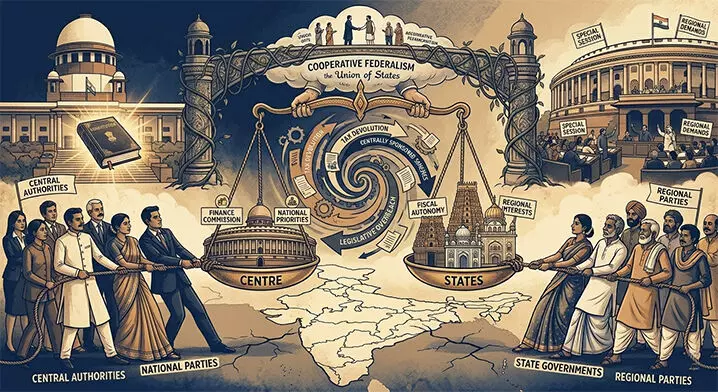
Major Steps Promoting Competitive Federalism
Acceptance of 14th Finance Commission Recommendations
The Centre increased the share of states in the divisible tax pool from 32% to 42%.
This gave states greater financial freedom.
Goods and Services Tax (GST)
GST created a common national market and strengthened fiscal cooperation.
The GST Council became an example of cooperative federalism.
It includes representatives from both the Centre and States.
NITI Aayog and Federalism
The Government replaced the Planning Commission with the NITI Aayog in 2015.
Its objective is to strengthen cooperative and competitive federalism.
Functions of NITI Aayog
- Encourages policy dialogue between Centre and States.
- Promotes best practices among states.
- Measures state performance.
- Supports innovation and reforms.
- Encourages healthy competition.
State Rankings
NITI Aayog publishes rankings on:
- Health
- Education
- Water management
- Sustainable development
- Innovation
These rankings motivate states to improve performance.
Examples of Competitive Federalism
Ease of Doing Business Rankings
States compete to provide a business-friendly environment.
This attracts investment and creates jobs.
Investor Summits
Many states organize investment summits to attract industries.
Examples include:
- Vibrant Gujarat
- Global Investors Summit
Swachh Bharat Rankings
Cities and states compete to improve cleanliness and sanitation.
Digital Governance
States are introducing online services to improve citizen convenience and transparency.
Role of Cooperative Federalism During National Challenges
Natural Disasters
Floods, cyclones, and earthquakes require joint action.
The Centre provides financial and logistical support while states manage local operations.
Public Health Emergencies
Disease outbreaks require coordinated efforts.
The Centre and States work together on:
- Vaccination programs
- Medical supplies
- Healthcare infrastructure
Economic Development
Large projects often require cooperation between multiple states and the Centre.
Challenges to Cooperative and Competitive Federalism
Despite progress, several challenges remain.
1. Trust Deficit
Some states feel that the Centre does not consult them sufficiently before making important decisions.
2. Financial Concerns
States often argue that they need greater financial support for development.
3. Unequal Development
Not all states start from the same level.
Developed states have:
- Better infrastructure
- Skilled workforce
- Greater investment
Less-developed states struggle to compete.
4. Political Differences
Different political parties govern different states.
Political disagreements can sometimes affect cooperation.
5. Regional Imbalances
States such as Bihar, Odisha, Assam, and others often require special support because of developmental challenges.
6. Resource Disputes
Conflicts may arise regarding:
- River water sharing
- Power distribution
- Natural resources
These disputes can weaken cooperative efforts.
Why Some States Need Additional Support
Competitive federalism assumes that all states can compete equally.
However, reality is different.
Some states have:
- Better connectivity
- More industries
- Stronger infrastructure
Others face challenges such as:
- Poverty
- Lack of industries
- Difficult geography
Therefore, the Centre must provide assistance to weaker states so that competition remains fair.
Suggestions for Strengthening Federalism
Strengthen the Inter-State Council
The Inter-State Council under Article 263 should be used more actively for dialogue and coordination.
Greater Consultation
States should be involved in national decision-making processes.
Transparent Funding
Allocation of funds should be transparent and based on objective criteria.
Sharing Best Practices
Successful policies from one state should be shared with others.
Improve Ease of Doing Business
States should continue improving governance and administrative efficiency.
Strengthen Infrastructure
Special support should be provided to less-developed regions.
Encourage Innovation
States should be rewarded for innovative governance initiatives.
Why India Needs Both Cooperation and Competition
Neither cooperation nor competition alone can ensure development.
Benefits of Cooperation
- National unity
- Shared goals
- Better coordination
- Balanced development
Benefits of Competition
- Faster reforms
- Better governance
- Innovation
- Efficient use of resources
When both work together, development becomes more effective.
For example, states can compete in attracting investment while cooperating on national issues like health, environment, and security.

GST: A Model of Cooperative Federalism
The Goods and Services Tax (GST) is often cited as one of the best examples of cooperative federalism.
The GST Council includes:
- Union Finance Minister
- State Finance Ministers
Important decisions are taken through discussion and consensus.
This system allows both Centre and States to participate equally in tax-related decisions.
GST has helped create the idea of “One Nation, One Tax.”
Conclusion
Cooperative Federalism in India is essential for maintaining national unity, promoting balanced development, and strengthening democracy. At the same time, competitive federalism encourages states to improve governance, attract investment, and deliver better services to citizens.
The future of India lies in a balanced combination of both approaches. Cooperation ensures that no state is left behind, while competition motivates states to perform better. Together, they create a strong foundation for economic growth, social development, and good governance.
As India continues its journey toward becoming a developed nation, the spirit of “Team India” where the Centre and States work together while striving for excellence will remain the key to achieving inclusive and sustainable progress.
FAQs
1. What is Cooperative Federalism?
Cooperative Federalism is a system where the Central and State Governments work together to achieve common national goals.
2. What is Competitive Federalism?
Competitive Federalism is a system where states compete with each other to attract investment, improve governance, and promote development.
3. Why is federalism important in India?
Federalism helps manage India’s diversity by sharing powers between the Centre and the States.
4. Is India a federal country?
India has a quasi-federal system with both federal and unitary features.
5. What are the three lists in the Indian Constitution?
The Union List, State List, and Concurrent List divide legislative powers between the Centre and States.
6. What is the role of NITI Aayog in federalism?
NITI Aayog promotes cooperative and competitive federalism by encouraging collaboration and healthy competition among states.
7. How does GST support cooperative federalism?
GST brings the Centre and States together through the GST Council to make tax-related decisions jointly.
8. What are the benefits of Competitive Federalism?
It improves governance, attracts investment, creates jobs, and encourages innovation.
9. What challenges does Cooperative Federalism face?
Major challenges include trust deficits, financial disputes, regional inequalities, and political differences.
10. Why does India need both cooperative and competitive federalism?
Cooperation ensures balanced development, while competition encourages efficiency and growth.