


Inter-State River Water Sharing Disputes in India

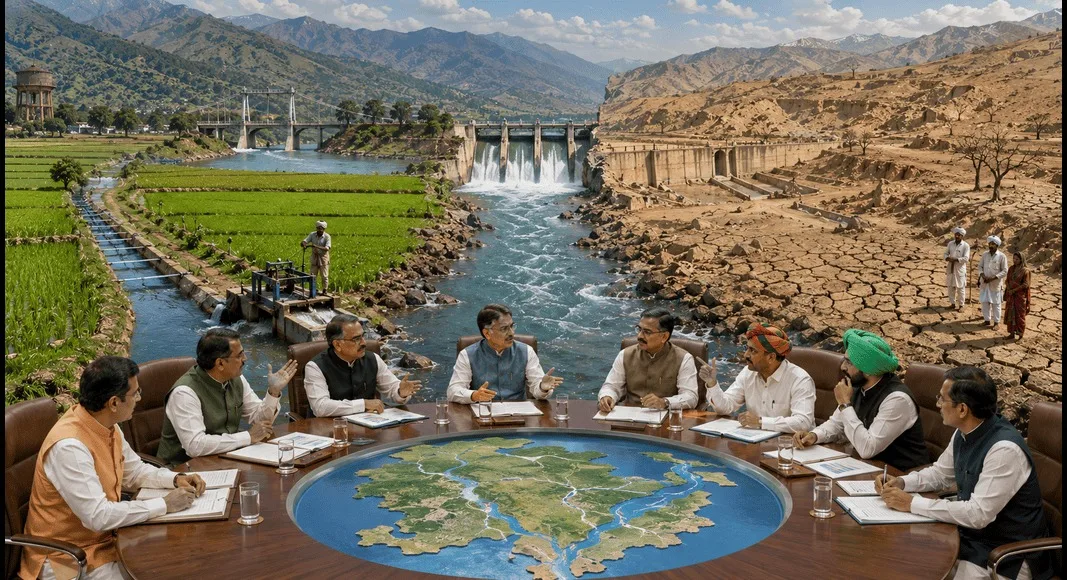
Inter-State River Water Sharing Disputes are among the most important and challenging issues in India’s federal system. Rivers often flow through more than one state, and disagreements arise when states demand a larger share of water for drinking, agriculture, industries, and power generation. As India’s population grows and water resources become more stressed, these disputes have become more frequent and politically sensitive.
Thank you for reading this post, don't forget to subscribe!Examples such as the Cauvery River dispute, Krishna River dispute, Mahanadi dispute, and Satluj-Yamuna Link (SYL) Canal issue show how water-sharing disagreements can affect relations between states. To resolve these disputes peacefully, India has developed constitutional provisions, laws, and tribunals. However, many challenges still remain.
Water is one of the most valuable natural resources. It is essential for agriculture, industries, electricity production, and daily life. India has many major rivers, but most of them flow across multiple states. Since different states depend on the same rivers, conflicts often arise regarding how much water each state should receive.
Inter-State River Water Sharing Disputes occur when two or more states disagree over the use, distribution, or control of water from a river that flows across state boundaries. These disputes test the strength of India’s cooperative federal system and require careful management to ensure fairness and national unity.
Why Do River Water Disputes Occur?
Several factors contribute to river water disputes in India:
1. Uneven Distribution of Water
Different regions receive different amounts of rainfall. Some states are water-rich while others face frequent droughts. States with less water often seek a larger share from common rivers.
2. Growing Population
India’s population continues to increase, leading to higher demand for drinking water, food production, and industrial activities.
3. Agricultural Dependence
Agriculture consumes nearly 80% of India’s freshwater resources. States that depend heavily on farming demand greater access to river water.
4. Climate Change
Irregular rainfall, changing monsoon patterns, and frequent droughts make water availability uncertain, increasing tensions among states.
5. Political Interests
Water disputes are often linked to regional politics. Political parties sometimes use these issues to gain public support, making compromise difficult.
6. Construction of Dams and Projects
When one state builds dams, reservoirs, or canals, downstream states may fear reduced water flow, leading to conflicts.
Constitutional Provisions Related to Water Disputes
The Indian Constitution provides a framework for managing water resources and resolving disputes.
Entry 17 of the State List
Under Entry 17 of the State List, states have authority over:
- Water supply
- Irrigation
- Canals
- Drainage
- Embankments
- Water storage
- Water power
This means states have significant control over water resources within their territories.
Entry 56 of the Union List
Entry 56 empowers the Central Government to regulate and develop inter-state rivers and river valleys when it is considered necessary in the public interest.
Article 262
Article 262 specifically deals with water disputes.
It provides that:
- Parliament may make laws for resolving disputes related to inter-state rivers.
- Parliament may also restrict the jurisdiction of courts, including the Supreme Court, in such matters.
This article forms the constitutional basis for water dispute resolution mechanisms in India.
Major Inter-State River Water Disputes in India
1. Cauvery Water Dispute
The Cauvery River dispute involves:
It is one of India’s longest-running water disputes. The disagreement centers on how much water Karnataka should release to Tamil Nadu during different seasons.
2. Krishna River Dispute
The Krishna River dispute involves:
These states compete for water used in irrigation, drinking purposes, and hydroelectric projects.
3. Ravi-Beas Dispute
This dispute involves:
The issue mainly concerns the distribution of water from the Ravi and Beas rivers and the construction of the Satluj-Yamuna Link Canal.
4. Mahanadi Dispute
The dispute is between:
Odisha has raised concerns about dams and barrages being constructed upstream in Chhattisgarh.
5. Mahadayi Dispute
This dispute involves:
- Goa
- Karnataka
- Maharashtra
The conflict revolves around the diversion of Mahadayi River water for drinking and irrigation purposes.
6. Vamsadhara Dispute
This dispute exists between:
The disagreement relates to irrigation projects and water-sharing arrangements.
7. Periyar River Dispute
This dispute involves:
The issue is linked to the Mullaperiyar Dam and concerns over water storage and dam safety.
8. Narmada Water Dispute
States involved are:
The dispute mainly concerns allocation of water and benefits from dam projects.
9. Godavari River Dispute
The Godavari River passes through several states, including:
- Maharashtra
- Telangana
- Andhra Pradesh
- Karnataka
- Odisha
Sharing water among multiple states has led to disagreements over the years.
Mechanism for Resolving Water Disputes
Inter-State River Water Disputes Act, 1956
To address river disputes, Parliament enacted the Inter-State River Water Disputes Act, 1956.
According to this law:
- A state can request the Central Government to intervene.
- The Central Government first attempts negotiation.
- If negotiations fail, a Water Disputes Tribunal is established.
- The tribunal examines evidence and gives its decision.
Amendment of 2002
The Act was amended in 2002 based on recommendations of the Sarkaria Commission.
Key changes included:
- Tribunal must be established within one year.
- Tribunal should give its decision within three years.
- Additional time may be granted under special circumstances.
Active Water Dispute Tribunals in India
Krishna Water Disputes Tribunal-II
States involved:
- Karnataka
- Telangana
- Andhra Pradesh
- Maharashtra
Mahanadi Water Disputes Tribunal
States involved:
- Odisha
- Chhattisgarh
Mahadayi Water Disputes Tribunal
States involved:
- Goa
- Karnataka
- Maharashtra
Ravi and Beas Tribunal
States involved:
Vamsadhara Water Disputes Tribunal
States involved:
- Andhra Pradesh
- Odisha
These tribunals play a crucial role in resolving conflicts peacefully.
Problems with Existing Tribunals
Although tribunals were created to settle disputes, several challenges have reduced their effectiveness.
1. Long Delays
Many disputes take decades to resolve.
For example:
- Godavari dispute began in 1962.
- Tribunal was formed in 1968.
- Award was given in 1979.
Similarly, the Cauvery Tribunal was formed in 1990 but delivered its final award only in 2007.
2. Lack of Transparency
The procedures followed by tribunals are often complicated and difficult for the public to understand.
3. Continued Litigation
Even after tribunal decisions, states frequently approach the Supreme Court through special legal provisions, leading to further delays.
4. Limited Expertise
Tribunals are mainly composed of judicial members. However, water disputes also require experts in:
- Hydrology
- Agriculture
- Environmental science
- Economics
- Climate studies
5. Inadequate Data
Reliable and universally accepted river water data is often unavailable.
Different states may present different figures, making fair decisions difficult.
6. Politicisation
Water disputes often become political issues.
Political leaders may take rigid positions to satisfy local voters, reducing opportunities for compromise.
7. Compliance Issues
Some states hesitate to fully implement tribunal awards, creating additional conflicts.
8. Complex Federal Structure
India’s federal system involves multiple stakeholders, making decision-making slow and complicated.
Inter-State River Water Disputes (Amendment) Bill, 2017
To improve the dispute resolution process, the government introduced the Inter-State River Water Disputes (Amendment) Bill, 2017.
Key Features of the Bill
Permanent Tribunal
Instead of creating a separate tribunal for every dispute, the Bill proposes a single permanent tribunal.
This would save time and resources.
Dispute Resolution Committee (DRC)
A Dispute Resolution Committee would be established before referring a matter to the tribunal.
The committee would attempt to resolve disputes through negotiations.
Time-Bound Resolution
The committee would be expected to resolve disputes within one year and six months.
Specialized Benches
If the dispute remains unresolved, it would be referred to a tribunal bench for adjudication.
Binding Decisions
The tribunal’s decision would be final and binding on all parties.
National Data System
The Bill proposes a transparent data collection system and a central database for river water information.
This would help ensure accuracy and reduce disagreements over data.
Importance of Cooperative Federalism
River water disputes cannot be solved only through legal mechanisms. Cooperation among states is equally important.
Benefits of Cooperative Federalism
- Encourages dialogue and negotiation.
- Reduces litigation.
- Promotes efficient water management.
- Builds trust among states.
- Supports national unity.
States must recognize that rivers are shared resources and should be managed collectively for the benefit of all.
Suggestions for Better Water Management
Improve Data Collection
A national river data system should provide accurate and transparent information.
Encourage Negotiation
States should prioritize discussions and mediation before approaching tribunals.
Use Modern Technology
Advanced monitoring systems can improve water measurement and forecasting.
Include Experts
Tribunals should include scientists, engineers, environmentalists, and economists.
Promote Water Conservation
States should adopt efficient irrigation methods such as drip irrigation and rainwater harvesting.
Reduce Political Interference
Water disputes should be treated as development issues rather than political issues.
Strengthen River Basin Management
Integrated river basin planning can help states share resources more effectively.
Conclusion
Inter-State River Water Sharing Disputes remain a major challenge for India’s federal structure. Rivers such as the Cauvery, Krishna, Mahanadi, Ravi-Beas, and Mahadayi have shown how difficult it can be to balance the interests of different states. While constitutional provisions, tribunals, and laws provide mechanisms for dispute resolution, delays, political interference, lack of data, and implementation issues continue to create obstacles.
The proposed reforms under the Inter-State River Water Disputes (Amendment) Bill, 2017 can help improve the system by introducing a permanent tribunal, better data management, and faster dispute resolution. However, legal reforms alone are not enough. Lasting solutions require cooperation, trust, transparency, and a spirit of cooperative federalism.
As water becomes an increasingly scarce resource, India must focus on dialogue, scientific planning, and sustainable water management to ensure that river waters are shared fairly among all states while protecting the nation’s unity and development.
FAQs on Inter-State River Disputes
1. What are Inter-State River Disputes?
Inter-State River Disputes are conflicts between two or more states over the sharing, use, or control of river water.
2. Why do river water disputes occur in India?
They occur due to unequal water availability, increasing demand, irrigation needs, and political disagreements.
3. Which constitutional provision deals with river water disputes?
Article 262 of the Indian Constitution deals with disputes related to inter-state river waters.
4. What is the Inter-State River Water Disputes Act, 1956?
It is a law that provides a mechanism for resolving river water disputes through tribunals.
5. What is the Cauvery Water Dispute?
It is a long-standing dispute over the sharing of the Cauvery River among Karnataka, Tamil Nadu, Kerala, and Puducherry.
6. What is a Water Disputes Tribunal?
A tribunal is a special body set up by the Central Government to resolve inter-state water disputes.
7. Which are the major river water disputes in India?
Major disputes include Cauvery, Krishna, Mahanadi, Ravi-Beas, Mahadayi, Narmada, and Vamsadhara.
8. What are the problems with existing tribunals?
Major issues include delays, lack of transparency, political interference, and disputes over water data.
9. What is the Inter-State River Water Disputes (Amendment) Bill, 2017?
It proposes a permanent tribunal, a dispute resolution committee, and a national water data system.
10. How can river water disputes be solved effectively?
Through cooperation, scientific water management, transparent data sharing, and timely dispute resolution.