


Preamble of India: Meaning, Features and Importance

The Preamble of the Indian Constitution is often called the introduction or the soul of the Constitution. It explains the basic philosophy, objectives, and values on which the Constitution is based. It tells us what kind of country India is and what the Constitution aims to achieve for its citizens.
Although the Preamble is short, it reflects the dreams and vision of the makers of the Constitution. It highlights important principles such as justice, liberty, equality, and fraternity, which guide the functioning of the Indian democracy.

What is the Preamble of the Indian Constitution?
The Preamble is the opening statement of the Constitution. It introduces the Constitution and explains its purpose and ideals.
It tells us:
- Who made the Constitution.
- What type of country India is.
- What rights and values the Constitution guarantees.
- When the Constitution was adopted.
Because it summarizes the entire Constitution, many constitutional experts call it the identity card of the Constitution.
History of the Preamble
The Preamble is based on the Objectives Resolution, which was introduced by Jawaharlal Nehru on 13 December 1946.
The Constituent Assembly adopted this resolution on 22 January 1947. Later, many of its ideas were included in the Preamble.
The Constitution was adopted on 26 November 1949, while it came into force on 26 January 1950, celebrated every year as Republic Day.
The Text of the Preamble
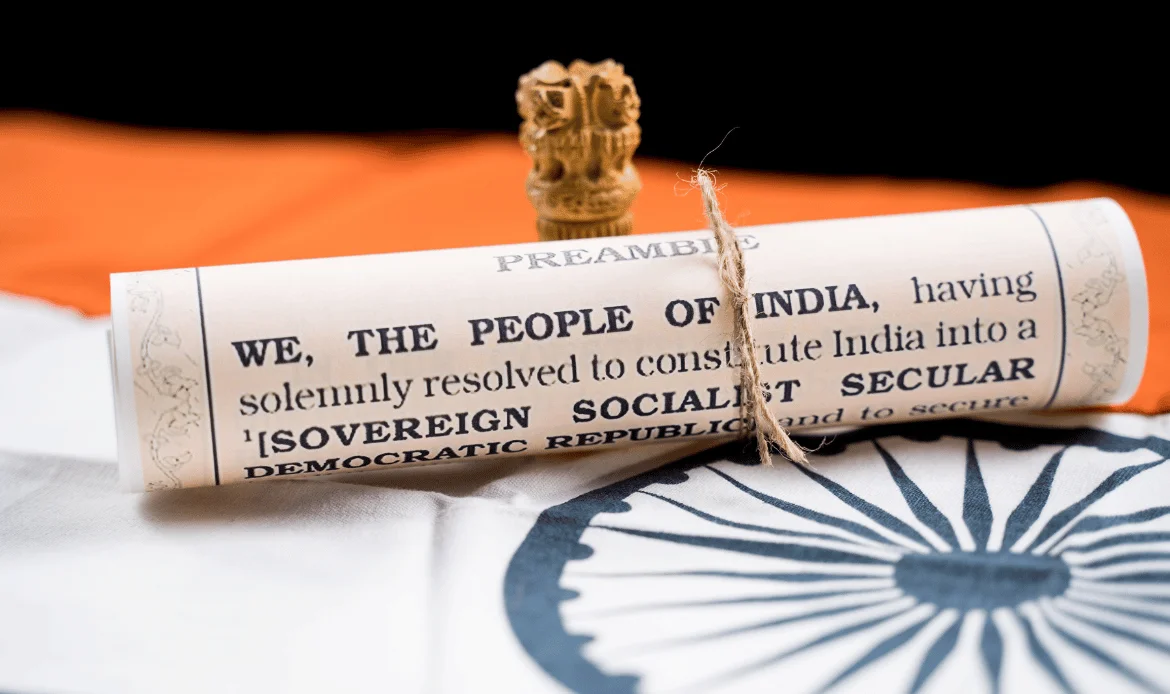
The Preamble begins with the famous words:
“We, the People of India…”
These words clearly show that the Constitution derives its authority from the people of India and not from any king, ruler, or foreign government.
Main Components of the Preamble
The Preamble contains four important parts.
1. Source of Authority
The words “We, the People of India” indicate that the Constitution has been created by the people themselves through their elected representatives.
2. Nature of the Indian State
The Preamble declares India to be:
- Sovereign
- Socialist
- Secular
- Democratic
- Republic
These words define the character of the Indian nation.
3. Objectives of the Constitution
The Constitution promises:
- Justice
- Liberty
- Equality
- Fraternity
These are the core values that every citizen should enjoy.
4. Date of Adoption
The Constitution was adopted on:
26 November 1949
Meaning of Important Words in the Preamble
We, the People of India
These words show that the ultimate power belongs to the people.
The government works according to the will of the citizens through democratic elections.
Sovereign
A sovereign country is completely independent.
India can make its own laws and policies without interference from any foreign country.
India is free to decide its foreign policy, economy, defence, and internal administration.
Socialist
The word “Socialist” was added by the 42nd Constitutional Amendment in 1976.
It means India aims to reduce economic inequality and ensure social welfare.
India follows a mixed economy, where both government-owned and private businesses operate together.
The government works for:
- Equal opportunities
- Poverty reduction
- Welfare schemes
- Social justice
Secular
The word “Secular” was also added by the 42nd Amendment.
It means the government does not have any official religion.
Every citizen has the freedom to:
- Practice any religion.
- Change religion.
- Not follow any religion.
All religions receive equal protection under the Constitution.
Democratic
India is a democracy because the people elect their representatives through free and fair elections.
Every adult citizen has the right to vote regardless of religion, caste, gender, or wealth.
Democracy ensures that governments remain accountable to the people.
Republic
A republic means the head of the country is elected and not a hereditary king or queen.
In India, the President is the elected Head of State.
Objectives of the Indian Constitution
The Preamble sets four major goals.
Justice
Justice means fairness for everyone.
The Constitution promises three types of justice.
Social Justice
It aims to remove discrimination based on:
- Caste
- Religion
- Gender
- Race
- Place of birth
Every citizen deserves equal respect.
Economic Justice
Economic justice ensures that everyone gets equal opportunities to earn a livelihood.
It also supports fair wages and protection against exploitation.
Political Justice
Political justice guarantees equal participation in democracy.
Every eligible citizen has the right to:
- Vote
- Contest elections
- Join political parties
- Express political opinions
Liberty
Liberty means freedom.
The Constitution provides freedom of:
- Speech and expression
- Thought
- Belief
- Faith
- Worship
However, these freedoms are subject to reasonable restrictions to maintain public order and national security.
Equality
Equality means every citizen is equal before the law.
No person receives special treatment because of caste, religion, wealth, or gender.
The Constitution provides equal opportunities in education, employment, and public life.
Fraternity
Fraternity means brotherhood among all citizens.
It encourages:
- National unity
- Mutual respect
- Social harmony
- Human dignity
Fraternity helps keep India united despite its diversity.
Why are Justice, Liberty, Equality and Fraternity Connected?
Dr. B. R. Ambedkar believed these four values cannot exist separately.
For example:
- Liberty without equality may allow powerful people to dominate others.
- Equality without liberty may suppress individual freedom.
- Without fraternity, society may become divided.
Together, these values create a balanced and democratic society.

Importance of the Preamble
The Preamble plays an important role in understanding the Constitution.
Its importance includes:
Explains the philosophy of the Constitution
It reflects the vision of the Constitution’s makers.
Guides lawmakers
While making new laws, Parliament keeps the ideals of the Preamble in mind.
Helps courts interpret laws
If any constitutional provision is unclear, courts use the Preamble to understand its true meaning.
Promotes national unity
The Preamble encourages people to respect diversity while maintaining unity.
Protects democratic values
It reminds governments that all decisions should follow constitutional principles.
Is the Preamble Legally Enforceable?
The Preamble itself cannot be enforced directly in a court.
This means a citizen cannot file a case only because a value mentioned in the Preamble has been violated.
However, the Preamble is an important guide for interpreting constitutional provisions and laws.
Important Supreme Court Judgments
Berubari Union Case (1960)
The Supreme Court initially held that:
- The Preamble is not a part of the Constitution.
- It helps explain the Constitution but cannot give legal powers.
This was the first major judgment on the status of the Preamble.
Kesavananda Bharati Case (1973)
This landmark judgment completely changed the earlier view.
The Supreme Court held that:
- The Preamble is a part of the Constitution.
- It helps explain constitutional provisions.
- Parliament can amend the Preamble under Article 368.
- However, the basic structure of the Constitution cannot be changed.
This became one of the most important constitutional judgments in India.
Union Government vs LIC of India (1995)
The Supreme Court again confirmed that:
- The Preamble forms an integral part of the Constitution.
- It serves as an important guide for constitutional interpretation.
- It is not directly enforceable in courts.
Amendment of the Preamble
The Preamble has been amended only once.
42nd Constitutional Amendment Act, 1976
Three important changes were made.
The words:
- Socialist
- Secular
were added between Sovereign and Democratic.
The phrase:
“Unity of the Nation”
was changed to:
“Unity and Integrity of the Nation.”
This amendment strengthened India’s commitment to equality, religious freedom, and national unity.
Article 368 and Amendment of the Preamble
Since the Kesavananda Bharati judgment, it has been accepted that the Preamble can be amended under Article 368.
However, Parliament cannot change the basic structure of the Constitution.
For example, democracy, secularism, rule of law, and judicial independence cannot be removed.
Interesting Facts about the Preamble
- The Constitution was adopted on 26 November 1949.
- It came into force on 26 January 1950.
- Article 394 brought certain Articles into force immediately after adoption.
- The ideals of Liberty, Equality, and Fraternity were inspired by the French Revolution.
- The Preamble has been amended only once.
- It is often described as the “Soul of the Constitution.”
- Dr. B. R. Ambedkar played a major role in drafting the Constitution.
- The Preamble reflects the aspirations of the people of India.
Relevance of the Preamble Today
Even after more than seventy years, the Preamble continues to guide India.

Its values remain important in dealing with challenges such as:
- Social inequality
- Religious harmony
- Economic development
- Women’s rights
- Education
- Freedom of speech
- Environmental protection
- Good governance
The Preamble reminds every citizen that India belongs equally to all
Conclusion
The Preamble of the Indian Constitution is much more than just an introduction. It expresses the hopes, dreams, and values of independent India. It declares India to be a sovereign, socialist, secular, democratic republic and promises justice, liberty, equality, and fraternity to every citizen.
Although it cannot be directly enforced in a court, it plays a vital role in interpreting the Constitution and guiding lawmakers, judges, and citizens. Landmark judgments such as the Kesavananda Bharati case have confirmed that the Preamble is an important part of the Constitution and forms the foundation of India’s democratic system.
Understanding the Preamble helps us understand not only the Constitution but also the ideals that unite the people of India. Every citizen should know its meaning because it represents the vision of a just, equal, and democratic nation for present and future generations.
FAQs
1. What is the Preamble of the Indian Constitution?
The Preamble is the introductory part of the Indian Constitution that explains its philosophy, objectives, and guiding principles.
2. Who is the source of authority for the Indian Constitution?
The people of India are the source of authority, as shown by the words “We, the People of India.”
3. When was the Indian Constitution adopted?
The Constitution was adopted on 26 November 1949 and came into force on 26 January 1950.
4. Is the Preamble a part of the Constitution?
Yes. The Supreme Court confirmed in the Kesavananda Bharati Case (1973) that the Preamble is a part of the Constitution.
5. Can the Preamble be amended?
Yes. It can be amended under Article 368, but its basic structure cannot be changed.
6. Which words were added to the Preamble by the 42nd Amendment?
The words Socialist, Secular, and Integrity were added through the 42nd Constitutional Amendment Act, 1976.
7. What are the main objectives mentioned in the Preamble?
The Preamble aims to secure Justice, Liberty, Equality, and Fraternity for all citizens.
8. What does ‘Republic’ mean in the Preamble?
It means that the Head of the State is elected by the people and not a hereditary monarch.
9. Why is the Preamble important?
It reflects the vision of the Constitution, guides lawmakers and courts, and explains the core values of Indian democracy.
10. Is the Preamble enforceable in a court of law?
No. The Preamble itself is not directly enforceable, but it helps courts interpret constitutional provisions.