



Labour Reforms and Employment Growth in India

Labour and Employment is one of the most important sectors for the growth of India’s economy. A strong labour system ensures that workers receive fair wages, safe working conditions, social security, and equal opportunities. At the same time, it helps businesses grow by creating a skilled and protected workforce. The Ministry of Labour and Employment worked on several important reforms and welfare schemes during 2019 to improve the lives of workers and simplify labour laws in the country.
Thank you for reading this post, don't forget to subscribe!The Ministry focused on major areas such as labour law reforms, digital governance, social security, employment generation, pension schemes, and better services through technology. These initiatives aimed to make labour laws easier to understand, improve transparency, and provide greater financial security to workers in both the organized and unorganized sectors.
Role of the Ministry of Labour and Employment
The Ministry of Labour and Employment is responsible for protecting workers’ rights, promoting employment, improving working conditions, and implementing labour welfare schemes across India. It also works to simplify labour regulations, encourage job creation, and strengthen social security systems.
In 2019, the Ministry introduced important reforms through the use of technology and by combining several old labour laws into four simplified labour codes.
Labour Law Reforms
India previously had many separate labour laws, making compliance difficult for both employers and employees. To make the legal system simpler and more effective, the Ministry decided to combine and rationalize the existing Central labour laws into four Labour Codes.
The main objectives of these Labour Codes are:
- Simplify labour laws.
- Ensure fair wages.
- Improve workplace safety.
- Expand social security.
- Strengthen grievance redressal.
- Promote ease of doing business.
The four Labour Codes cover wages, industrial relations, social security, and occupational safety.
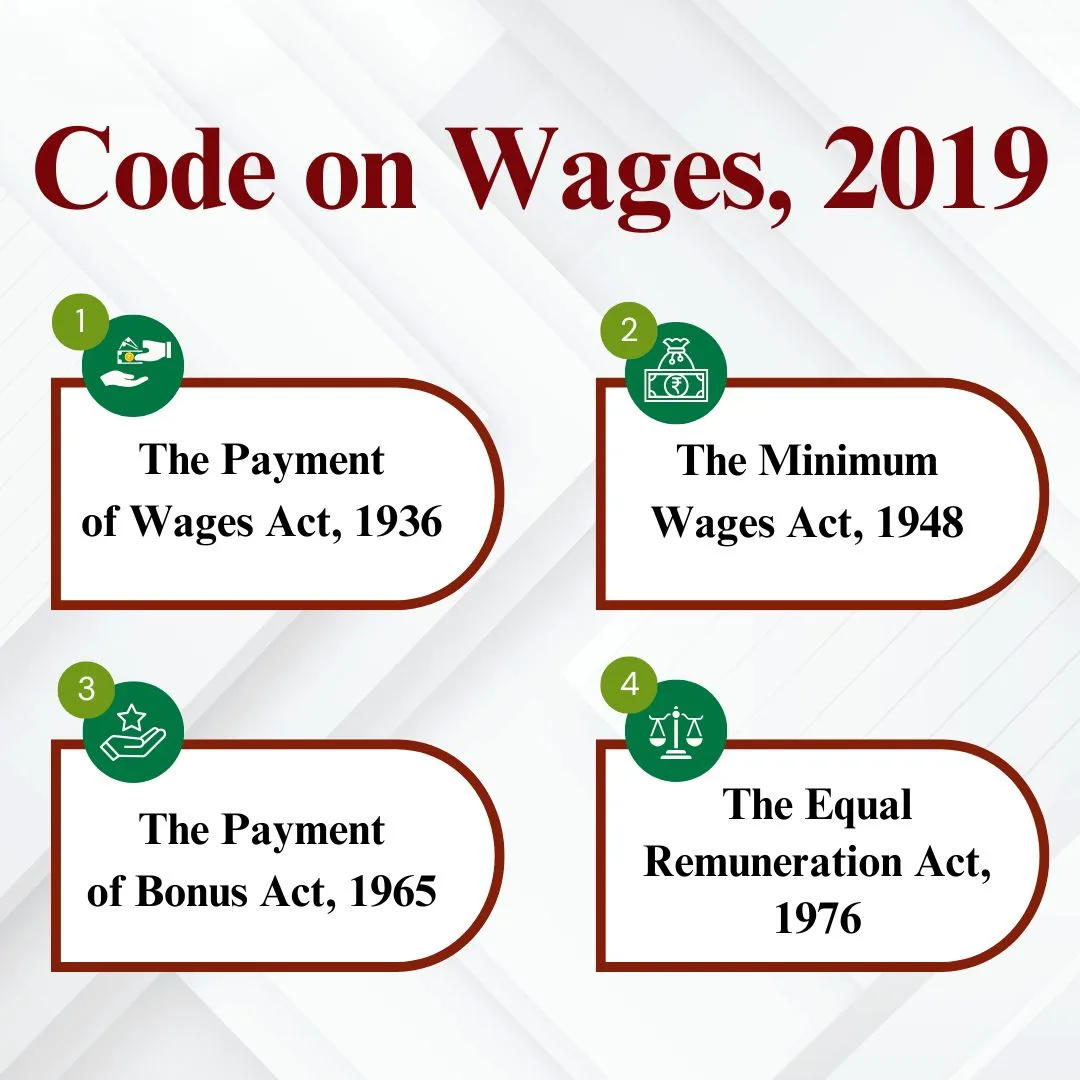
Code on Wages, 2019
The Code on Wages, 2019 was passed by Parliament to bring together several important wage-related laws under one legislation.
It replaced the following four Acts:
- Minimum Wages Act, 1948
- Payment of Wages Act, 1936
- Payment of Bonus Act, 1965
- Equal Remuneration Act, 1976
Main objectives
- Ensure timely payment of wages.
- Provide minimum wage protection.
- Promote equal pay for equal work.
- Simplify wage-related regulations.
This code creates a uniform wage framework that benefits both employers and workers.
Code on Industrial Relations
The Industrial Relations Code combines important laws related to employer-employee relationships.
It replaces:
- Trade Unions Act, 1926
- Industrial Employment (Standing Orders) Act, 1946
- Industrial Disputes Act, 1947
Objectives
- Improve industrial harmony.
- Reduce labour disputes.
- Protect workers’ rights.
- Simplify dispute resolution.
- Encourage better communication between employers and employees.
This code helps industries function more smoothly while protecting employee interests.
Code on Social Security
The Social Security Code combines nine labour laws related to worker welfare and social protection.
Some important Acts included are:
- Employees’ Compensation Act, 1923
- Maternity Benefit Act, 1961
- Payment of Gratuity Act, 1972
- Unorganized Workers’ Social Security Act, 2008
Main objectives
- Expand social security coverage.
- Improve employee welfare.
- Protect workers during sickness, maternity, disability, and retirement.
- Extend benefits to more categories of workers.
This code aims to create a stronger social protection system for India’s workforce.
Code on Occupational Safety, Health and Working Conditions
This Labour Code combines thirteen existing labour laws related to workplace safety.
Some important Acts included are:
- Factories Act, 1948
- Plantation Labour Act, 1951
- Mines Act, 1952
- Building and Other Construction Workers Act, 1996
Objectives
- Improve workplace safety.
- Protect workers’ health.
- Ensure better working conditions.
- Reduce workplace accidents.
- Standardize safety regulations across industries.
A safer workplace increases productivity and improves workers’ quality of life.
Governance Reforms Through Technology
The Ministry introduced several digital initiatives to improve transparency and make labour services more efficient.
Shram Suvidha Portal
The Shram Suvidha Portal is an online platform developed to simplify compliance with labour laws.
Its main features include:
- Online registration of establishments.
- Labour Identification Number (LIN) for every registered unit.
- Single online return instead of multiple returns.
- Computerized inspection reports within 72 hours.
- Faster grievance redressal.
- Greater transparency in inspections.
The portal reduces paperwork and improves efficiency for both businesses and government agencies.
Integration of States with Shram Suvidha Portal
The Ministry also started integrating State Governments with the Shram Suvidha Portal.
This initiative helps:
- Share labour-related data.
- Provide Labour Identification Numbers to establishments.
- Improve coordination between the Centre and States.
- Create a unified labour database.
Support for Start-ups
Under the Start-up India initiative, eligible start-ups can receive exemptions from labour inspections under six Central Labour Acts.
These businesses submit self-certified declarations through the Shram Suvidha Portal.
This reform encourages entrepreneurship by reducing unnecessary regulatory burden while maintaining compliance.
Social Security Schemes
One of the Ministry’s major achievements in 2019 was strengthening pension coverage for workers in the unorganized sector.
Pradhan Mantri Shram Yogi Maandhan (PM-SYM)
The Pradhan Mantri Shram Yogi Maandhan (PM-SYM) is a voluntary and contributory pension scheme.
Eligibility
Workers must:
- Belong to the unorganized sector.
- Earn ₹15,000 or less per month.
- Have an Aadhaar number.
- Possess a savings bank or Jan Dhan account.
- Be between 18 and 40 years of age.
Benefits
- Minimum monthly pension of ₹3,000 after the age of 60.
- Equal contribution by the Government based on the subscriber’s contribution.
- Financial security during old age.
This scheme helps millions of unorganized workers secure a stable income after retirement.
National Pension Scheme for Traders, Shopkeepers and Self-Employed Persons
The Government also launched a pension scheme specifically for traders and self-employed individuals.
Eligibility
Applicants should:
- Be between 18 and 40 years old.
- Have an annual turnover up to ₹1.5 crore.
- Not be members of EPFO, ESIC, NPS, or PM-SYM.
- Not be income tax payers.
Benefits
- Equal contribution by the Central Government.
- Minimum assured monthly pension of ₹3,000 after the age of 60.
Enrollment is carried out through Common Service Centres (CSCs).
Pension Week
To increase awareness, the Ministry celebrated Pension Week from 30 November to 6 December 2019 across all States and Union Territories.
The campaign encouraged more workers to enroll in:
- PM-SYM
- National Pension Scheme for Traders
The awareness drive helped increase participation in both pension schemes.
Major Digital Initiatives by EPFO
The Employees’ Provident Fund Organisation (EPFO) introduced several technology-based services.
Online UAN Generation
Workers can now generate their Universal Account Number (UAN) online without lengthy paperwork.
This makes access to EPF services easier and faster.
Pension Payment Order (PPO) on DigiLocker
EPFO made Employees’ Pension Scheme (EPS) Pension Payment Orders available on DigiLocker.

This allows pensioners to securely access their documents anytime using digital devices.
e-Inspections
EPFO introduced digital inspections for employers.
The benefits include:
- Greater transparency.
- Faster inspections.
- Reduced paperwork.
- Better compliance monitoring.
Major Steps Taken by ESIC
The Employees’ State Insurance Corporation (ESIC) also introduced important reforms.
Reduction in ESI Contribution Rates
The Government reduced ESI contribution rates to provide financial relief.
This benefits:
- Employees through higher take-home salary.
- Employers through lower compliance costs.
Lower contribution rates encourage businesses to hire more workers.
ESIC “Chinta Se Mukti” App
ESIC launched the Chinta Se Mukti mobile application on the UMANG platform.
The app allows users to:
- Check contribution details.
- Verify benefit eligibility.
- Track claim status.
- Access services digitally.
This makes ESIC services more convenient and accessible.
National Career Service (NCS)
The National Career Service (NCS) Project is implemented by the Directorate General of Employment under the Ministry of Labour and Employment.
It serves as a one-stop employment platform.
The portal offers:
- Job matching.
- Career guidance.
- Skill training information.
- Career counseling.
- Employment services.
It connects:
- Job seekers
- Employers
- Training providers
- Career counselors
The Ministry also operates National Career Service Centres for:
- Persons with disabilities.
- Scheduled Castes (SCs).
- Scheduled Tribes (STs).
These centres promote inclusive employment opportunities.
Pradhan Mantri Rojgar Protsahan Yojana (PMRPY)
The Pradhan Mantri Rojgar Protsahan Yojana (PMRPY) encourages employers to create new jobs.
Under this scheme:
- The Government pays the employer’s contribution of 12% towards EPF and EPS for eligible new employees.
- The support is provided for three years.
Benefits
For employers:
- Reduced employment costs.
- Encouragement to hire more workers.
For employees:
- Formal employment.
- Social security benefits.
- Provident fund coverage.
- Pension benefits.
This scheme supports employment generation in the organized sector.
Employment Linked Incentive (ELI) Scheme
One of the major employment announcements after 2019 was the Employment Linked Incentive (ELI) Scheme, announced as part of the 2024-25 Union Budget.
The scheme aims to:
- Create millions of new jobs.
- Encourage formal employment.
- Support first-time employees.
- Incentivize employers for hiring additional workers.
The ELI Scheme focuses especially on the manufacturing sector and young job seekers entering the workforce.
It is expected to strengthen employment generation in the coming years.
Focus on Gig and Platform Workers
The nature of employment has changed rapidly with the growth of digital platforms.
Workers such as:
- Food delivery partners
- Cab drivers
- Online service providers
- Freelancers
are known as gig and platform workers.
The Code on Social Security, 2020 recognized these workers for the first time under labour laws.
Between 2020 and 2025, the government worked on developing social security frameworks to extend benefits such as insurance and welfare support to these workers.
Digital Governance and Ease of Compliance

The Ministry has continued promoting digital governance by:
- Expanding online labour services.
- Improving data integration.
- Simplifying compliance procedures.
- Reducing paperwork.
- Increasing transparency.
- Encouraging online inspections.
These reforms help both employers and workers while improving administrative efficiency.
Importance of Labour Reforms
The reforms introduced in 2019 have several long-term benefits for India’s economy.
Some major advantages include:
- Simpler labour laws.
- Better protection for workers.
- Improved workplace safety.
- Expanded pension coverage.
- Greater transparency through digital services.
- Faster grievance redressal.
- Better employment opportunities.
- Increased ease of doing business.
- Promotion of entrepreneurship.
- Stronger social security for workers.
These initiatives create a balanced system that benefits workers, employers, and the overall economy.
Conclusion
The Ministry of Labour and Employment has introduced several important reforms between 2019 and 2025 to improve India’s labour ecosystem. In 2019, the Ministry focused on simplifying labour laws through the four Labour Codes, strengthening pension schemes, promoting digital governance, and improving services offered by EPFO and ESIC.
After 2019, the Ministry continued its reform journey by launching the e-Shram Portal, expanding social security coverage, improving digital services, strengthening the National Career Service, modernizing EPFO operations, expanding ESIC healthcare facilities, and introducing new employment initiatives such as the Employment Linked Incentive (ELI) Scheme. It also recognized gig and platform workers under the Social Security Code, reflecting the changing nature of employment in India.
Although the nationwide implementation of the Labour Codes is still awaited, these reforms have laid a strong foundation for a more transparent, efficient, and worker-friendly labour system. With continued focus on technology, social security, employment generation, and labour welfare, the Ministry aims to build a modern workforce that supports India’s long-term economic growth and inclusive development.
FAQs
1. What are Labour Reforms?
Labour Reforms are changes made to labour laws to simplify regulations, protect workers’ rights, improve working conditions, and promote employment.
2. What are the four Labour Codes introduced by the Government?
The four Labour Codes are:
- Code on Wages
- Code on Industrial Relations
- Code on Social Security
- Code on Occupational Safety, Health and Working Conditions
3. What is the Code on Wages, 2019?
The Code on Wages, 2019 combines four existing wage-related laws into one and ensures fair wages, equal remuneration, and timely payment of wages.
4. What is the purpose of the Shram Suvidha Portal?
The Shram Suvidha Portal is an online platform that simplifies labour law compliance through online registration, inspections, grievance redressal, and a single return filing system.
5. What is Pradhan Mantri Shram Yogi Maandhan (PM-SYM)?
PM-SYM is a voluntary pension scheme for unorganized workers that provides a minimum monthly pension of ₹3,000 after the age of 60.
6. Who can join the National Pension Scheme for Traders?
Traders, shopkeepers, and self-employed persons aged 18–40 years with an annual turnover up to ₹1.5 crore and meeting the eligibility criteria can join the scheme.
7. What is the National Career Service (NCS)?
The National Career Service is a government employment portal that connects job seekers, employers, career counselors, and training providers on one platform.
8. What is the objective of Pradhan Mantri Rojgar Protsahan Yojana (PMRPY)?
PMRPY encourages employers to create new jobs by allowing the Government to pay the employer’s EPF and EPS contribution for eligible new employees for three years.
9. What are the major digital initiatives introduced by EPFO?
EPFO introduced online UAN generation, DigiLocker access for Pension Payment Orders (PPO), and e-Inspections to improve digital services and transparency.
10. How do Labour Reforms benefit workers and employers?
Labour Reforms simplify labour laws, improve workplace safety, strengthen social security, increase transparency, encourage job creation, and make compliance easier for businesses.