


Attitude: Content, Structure and Function

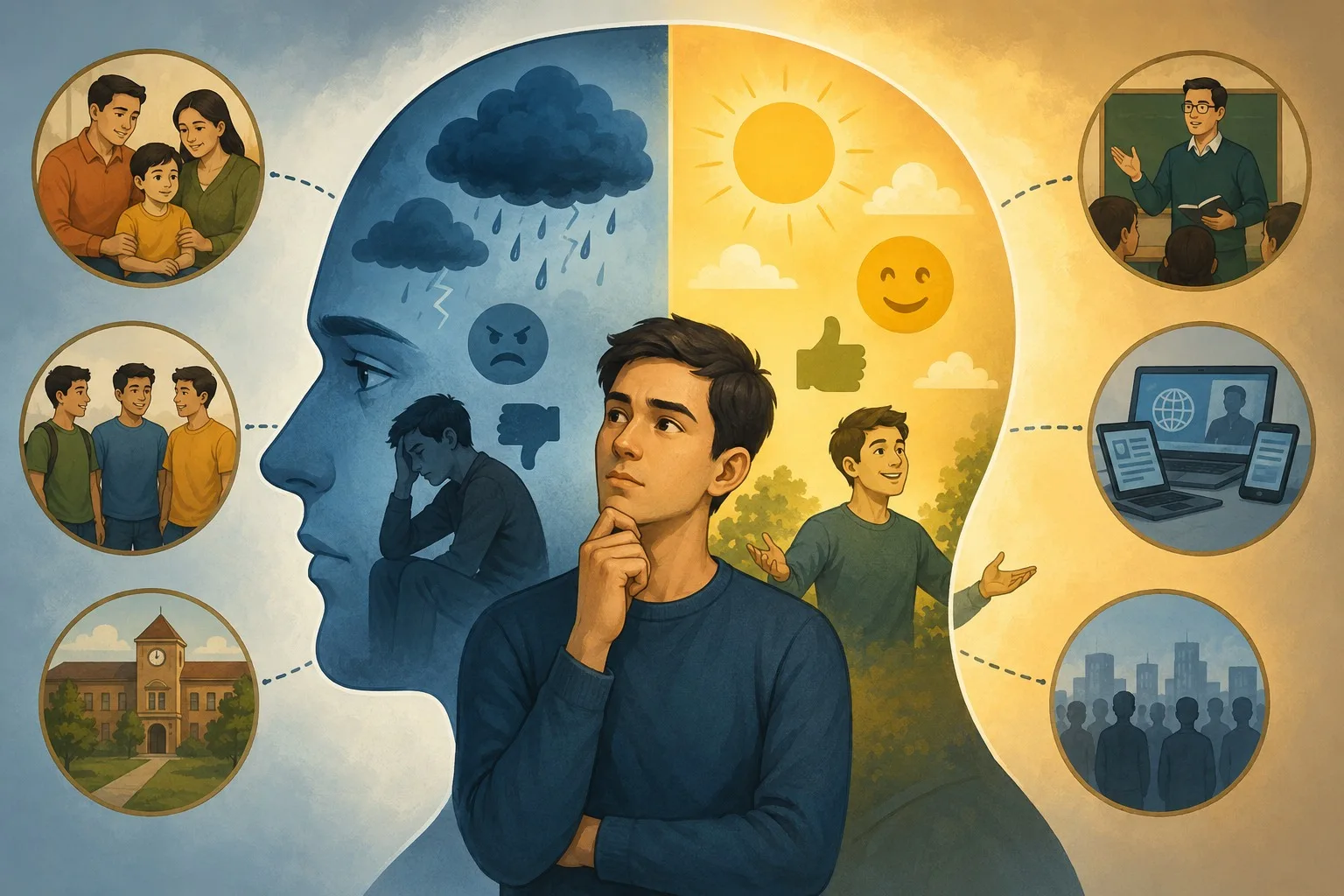
Attitude plays an important role in human life. It affects how we think, feel, and behave in different situations. Whether at home, school, workplace, or society, our attitude shapes our decisions and relationships. A positive attitude can help a person succeed and maintain healthy relationships, while a negative attitude can create problems and reduce productivity.
Thank you for reading this post, don't forget to subscribe!In simple words, attitude is the way a person thinks or feels about a person, object, issue, or situation. It reflects whether someone likes or dislikes something. Attitudes can be strong or weak, positive or negative, and they may change over time based on experiences.
What is Attitude?
Attitude is a psychological tendency in which a person evaluates something with favor or disfavor. This means a person may develop positive feelings, negative feelings, or mixed feelings about something.
For example, a student may love mathematics because they enjoy solving problems. Another student may dislike it because they find it difficult. These different feelings are examples of attitudes.
Attitudes are not always fixed. They can change due to learning, life experiences, social interaction, or new information.
Types of Attitude
Attitude can mainly be divided into two types:
1. Explicit Attitude
Explicit attitudes are attitudes that a person is aware of. These attitudes are formed consciously and directly influence behavior.
For example, if someone says, “I support environmental protection,” they clearly know their attitude.
Characteristics:
- Conscious and intentional
- Easy to express
- Directly affects decisions and actions
2. Implicit Attitude
Implicit attitudes are hidden attitudes that a person may not consciously recognize. These attitudes exist in the subconscious mind but still affect behavior.
For example, a person may unknowingly treat some people differently because of subconscious bias.
Characteristics:
- Subconscious
- Hard to identify
- Influences behavior indirectly
Components of Attitude
Attitude has three major components:
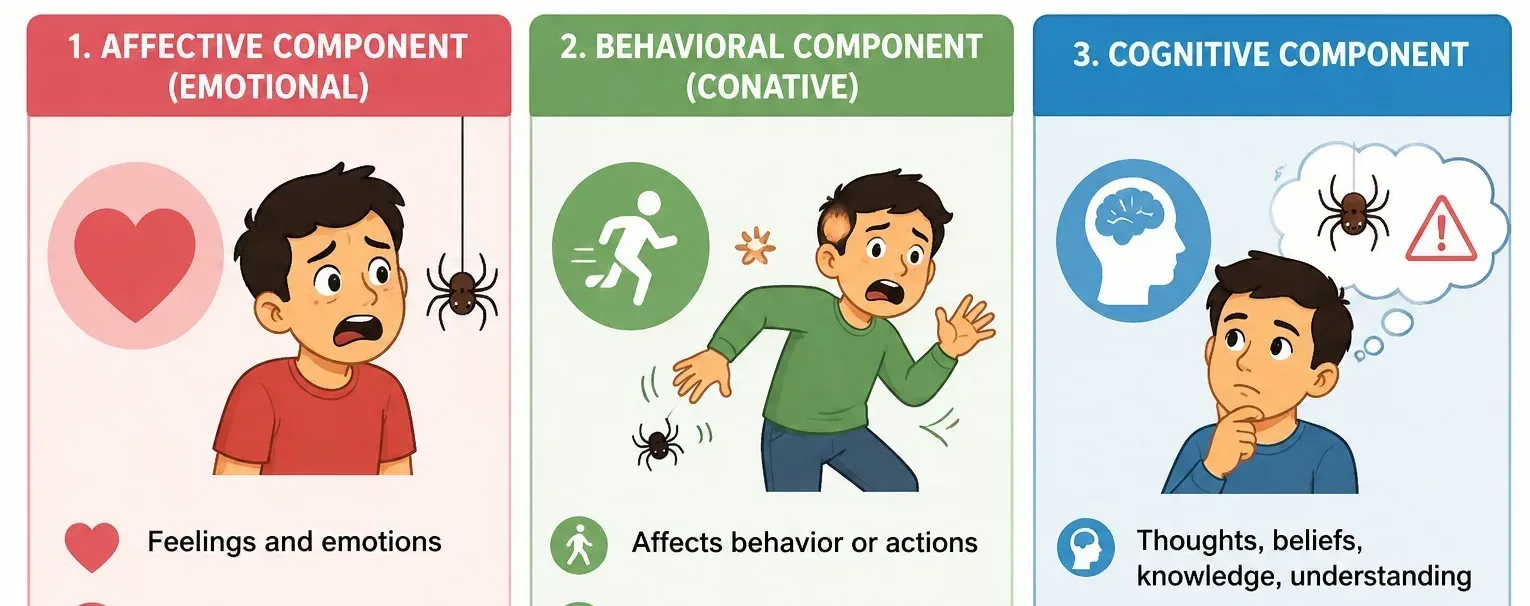
1. Affective Component (Emotional)
This component relates to feelings and emotions toward something.
Example: “I am scared of spiders.”
This shows emotional response such as fear, happiness, anger, or love.
2. Behavioral Component (Conative)
This component relates to how attitude affects behavior or actions.
Example: “I avoid spiders and scream when I see one.”
The person’s behavior is shaped by their attitude.
3. Cognitive Component
This component includes thoughts, beliefs, knowledge, and understanding.
Example: “I believe spiders are dangerous.”
This belief forms the cognitive part of attitude.
Components of Attitude Table
| Component | Meaning | Example |
|---|---|---|
| Affective | Feelings or emotions | Fear of spiders |
| Behavioral | Action or reaction | Avoiding spiders |
| Cognitive | Beliefs or thoughts | Thinking spiders are dangerous |
Factors Responsible for Formation of Attitude
Many factors influence attitude formation.
Culture
Culture has a strong impact on attitude. Culture includes traditions, customs, religion, rewards, and social rules.
Different cultures create different attitudes.
Example: Some foods may be acceptable in one country but not in another.
Culture teaches people what is right or wrong in society.
Family
Family is one of the strongest influences in attitude formation.
Parents, grandparents, and siblings shape the beliefs and values of children.
Example: A child raised in a respectful family usually develops respectful behavior.
Social Groups
Friends, classmates, colleagues, and neighbors influence attitudes.
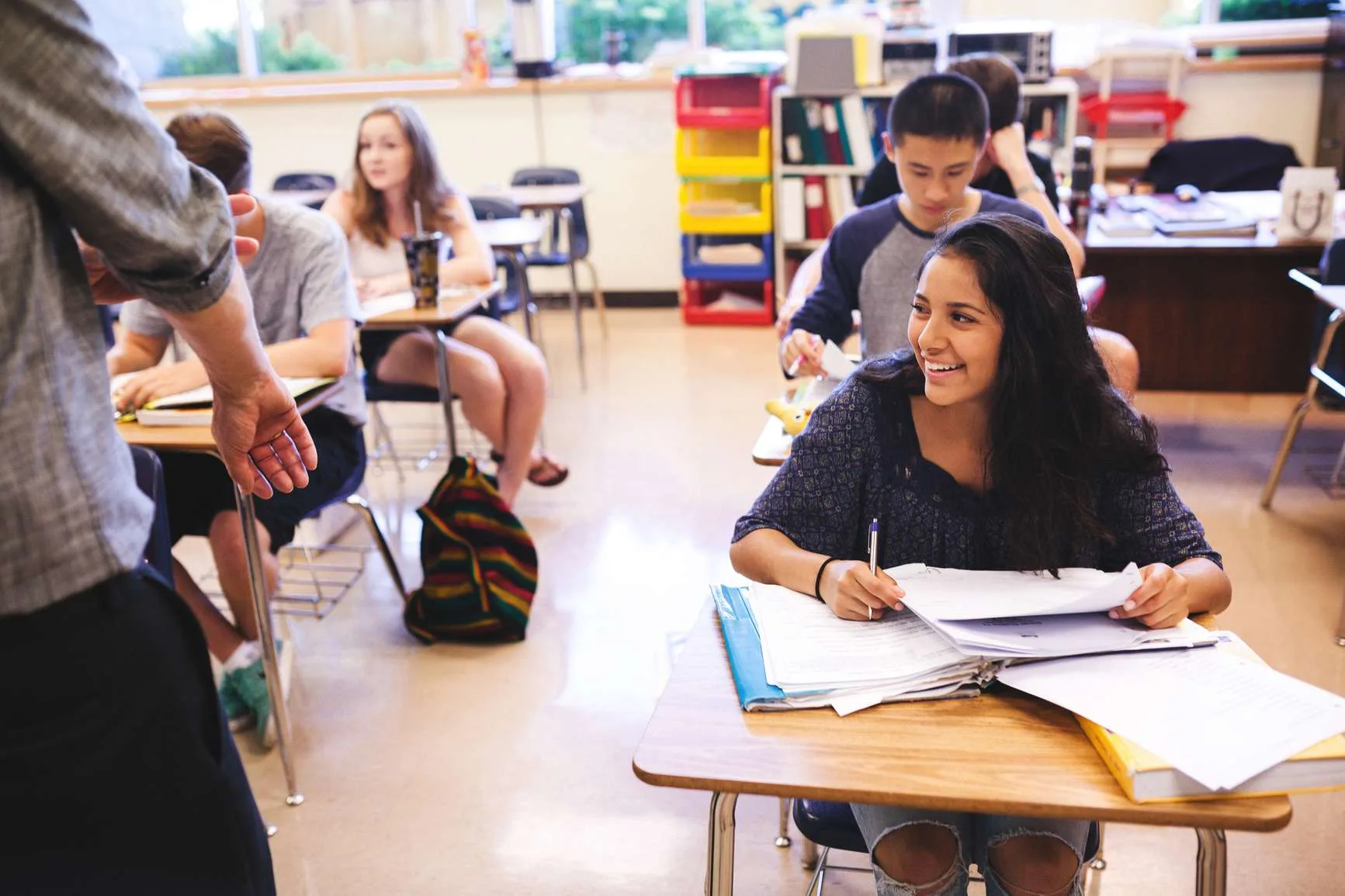
People often adopt the opinions of those around them.
Example: Voting choices are often influenced by family and friends.
Institutions
Institutions like schools, colleges, offices, and religious organizations shape attitudes.
Schools teach discipline, values, and responsibility.
Example: A school promoting cleanliness can create positive attitudes toward hygiene.
Familiarity
People often feel comfortable with things they know well.
The unknown usually creates fear.
Repeated exposure creates comfort and positive feelings.
Example: A student may fear public speaking initially but feel confident after repeated practice.
Techniques to Change Attitude
Attitudes can change through different methods.
Classical Conditioning
This method links a neutral thing with a positive experience repeatedly.
After repeated association, the neutral thing creates positive feelings.
Example: Educational ads using happy music can create positive attitudes toward learning.
Instrumental Conditioning
Reward encourages repeated behavior, while punishment discourages unwanted behavior.
Example:
- Praising a child for good marks encourages studying
- Punishing bad behavior discourages mistakes
Social Observation
People learn by observing others.
Family, teachers, media, and society influence attitudes through examples.
Example: A child watching helpful parents may develop kindness.
Functions of Attitude
Attitudes serve many important functions.
Knowledge Function
Attitudes help people understand the world around them.
They simplify information and help in decision-making.
Example: Trusting doctors helps people accept medical advice quickly.
Utilitarian Function
Attitudes help maximize benefits and reduce losses.
People adopt attitudes that support their interests.
Example: Positive attitude toward savings helps financial stability.
Social Role Function
Attitudes help people fit into society and express identity.
They show which groups or values a person supports.
Example: Supporting social equality reflects personal values.
Self-Esteem Function
Attitudes protect self-respect and confidence.
They help people deal with stress and internal conflicts.
Example: Associating with supportive friends improves self-esteem.
Attitude and Value System
A value system refers to the importance a person gives to ethical and moral values.
Values guide attitudes.
Two people may believe in honesty but may prioritize it differently.
Example:
- One may value honesty above everything
- Another may value loyalty more in certain situations
Thus, values influence attitude formation.
Difference Between Attitude and Behavior
Although attitude and behavior are related, they are different.
| Attitude | Behavior |
|---|---|
| Internal thought or feeling | External action |
| Based on beliefs and experience | Based on situation and response |
| Mental tendency | Observable conduct |
| Shows perception | Shows action |
Example:
A person may believe in punctuality (attitude), but reaching office on time is behavior.
How Attitude Influences Behavior
Attitude strongly affects behavior.
Positive Attitude
Positive attitudes improve productivity and relationships.
Example: A cheerful employee motivates others.
Benefits:
- Better teamwork
- Higher productivity
- Improved confidence
Negative Attitude
Negative attitudes reduce efficiency and create conflicts.
Example: Constant complaining lowers team morale.
Effects:
- Poor performance
- Stress
- Conflict
Selfish Attitude
Selfish attitudes lead to self-centered decisions.
Example: Choosing only personal benefit in group work.
Logical or Rational Attitude
Rational attitudes encourage logical thinking.
Example: A rational person seeks evidence before believing rumors.
Egoistic Attitude
An ego-based attitude often creates conflicts.
Example: An elder forcing younger siblings to obey even when wrong.
Value-Based Attitude
These attitudes come from moral beliefs.
Example: In India, touching elders’ feet reflects respect.
Moral and Political Attitudes
Moral Attitude
Moral attitude relates to right and wrong.
It supports ethical behavior and good values.
Examples of moral attitudes:
- Goodness
- Respect
- Compassion
- Empathy
- Selflessness
A morally strong person acts responsibly and ethically.
Political Attitude
Political attitude refers to how a person views political systems, policies, and governance.
It affects opinions about government and public issues.
Examples:
- Voting decisions
- Opinions about economic policies
- Support for social welfare programs
Political attitudes influence democracy and governance.
Social Influence and Persuasion
Social Influence
Social influence changes a person’s thoughts, feelings, or behavior due to interaction with others.
Sources include:
- Family
- Friends
- Media
- Society
Example: Social campaigns can promote cleanliness.
Persuasion
Persuasion means changing or strengthening attitudes through communication.
It may be intentional or unintentional.
Example: Government campaigns encouraging school enrollment.
Persuasion is widely used in:
- Advertising
- Education
- Administration
- Public awareness campaigns
Theory of Persuasion
The theory of persuasion explains how people change attitudes and beliefs.
It focuses on effective communication.
Governments, companies, and institutions use persuasion to influence public behavior.
Example: Campaigns promoting vaccination or education.

Factors Affecting Persuasion Success
Audience Characteristics
The audience plays a major role.
Factors include:
- Intelligence
- Self-esteem
- Mood
- Openness to new ideas
People with balanced self-esteem are often easier to persuade.
Source Characteristics
The person delivering the message matters.
Important qualities:
- Expertise
- Trustworthiness
- Attractiveness
- Credibility
People trust messages from reliable sources.
Example: Health advice from doctors is more persuasive.
Cognitive Routes
Persuasion works through two routes.
Central Route
In this method, people carefully analyze facts and logic before changing attitude.
Example: Scientific evidence convincing people to stop smoking.
Peripheral Route
In this method, people focus on external factors rather than facts.
Example: Celebrities promoting products in advertisements.
A famous athlete advertising sports shoes influences buyers even without detailed product knowledge.
Importance of Attitude in Daily Life
Attitude affects almost every area of life.
It influences:
- Academic success
- Career growth
- Relationships
- Leadership
- Decision-making
People with healthy attitudes usually:
- Solve problems better
- Stay motivated
- Handle stress effectively
- Inspire others
Developing a positive attitude improves overall quality of life.
Famous Quotes on Attitude
Thomas Jefferson said:
“Nothing can stop the man with the right mental attitude from achieving his goal.”
A. P. J. Abdul Kalam said:
“Problems are common, but attitude makes the difference.”
Albert Einstein said:
“Weakness of attitude becomes weakness of character.”
Helen Keller said:
“Optimism is the faith that leads to achievement.”
Attitude is one of the most powerful forces in human life. It shapes how we see the world, how we react to challenges, and how we connect with others. A positive and balanced attitude helps build success, confidence, and meaningful relationships. By understanding attitude, its structure, and its functions, we can improve ourselves and contribute positively to society.
FAQs
Q1. What is attitude in simple words?
Attitude is the way a person thinks, feels, or reacts toward a person, object, situation, or idea. It can be positive, negative, or neutral.
Q2. What are the three components of attitude?
The three components of attitude are:
- Affective (feelings and emotions)
- Behavioral (actions and reactions)
- Cognitive (thoughts and beliefs)
Q3. What is the difference between explicit and implicit attitude?
Explicit attitude is a conscious attitude that a person is aware of, while implicit attitude is subconscious and influences behavior without awareness.
Q4. How is attitude formed?
Attitude is formed through culture, family, social groups, institutions, and personal experiences.
Q5. Can attitude be changed?
Yes, attitude can change through learning, experience, observation, persuasion, and conditioning.
Q6. How does attitude affect behavior?
Attitude influences how a person acts in different situations. Positive attitudes usually lead to productive behavior, while negative attitudes may create conflict.
Q7. What is persuasion in attitude change?
Persuasion is the process of changing or strengthening a person’s attitude, belief, or behavior through communication.
Q8. Why is attitude important in daily life?
Attitude is important because it affects decision-making, relationships, work performance, and overall success in life.