


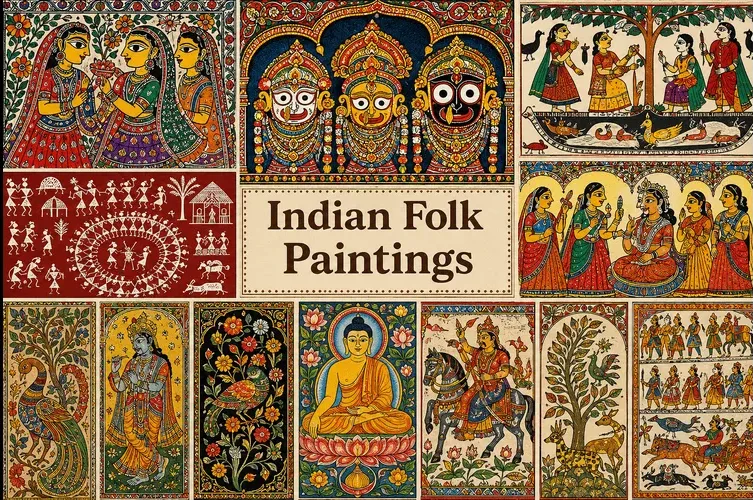
Indian Folk Paintings of India: Traditional Art Forms and Cultural Heritage (Part-II)

Indian Folk Paintings of India represent the rich cultural heritage, traditions, and artistic creativity of the country. These paintings are deeply connected with the daily life, customs, religious beliefs, and festivals of different regions of India. Passed down from one generation to another, folk paintings continue to preserve the history and identity of local communities.
India is known for its diversity, and this diversity can be clearly seen in its folk art traditions. Every region has its own unique style, colors, themes, and methods of painting. Most folk paintings are inspired by nature, mythology, rituals, village life, and spiritual beliefs. These paintings are not only beautiful forms of art but also important records of Indian culture and traditions.

Traditionally, folk paintings were made on walls, cloth, palm leaves, paper, or floors using natural colors prepared from plants, minerals, rice paste, mud, and flowers. Over time, modern materials such as canvas and synthetic colors have also started being used. However, the traditional essence of these paintings still remains strong.
Today, Indian folk paintings are admired not only in India but also across the world. Many of these art forms have received recognition through Geographical Indication (GI) tags, which help protect their originality and regional identity.
What are Folk Paintings?
Folk paintings are traditional art forms created by local artists and communities using simple methods and materials. These paintings mainly reflect the culture, beliefs, stories, rituals, and daily lifestyle of the people.
Unlike modern paintings that are often created for decoration or personal expression, folk paintings were originally made for religious ceremonies, festivals, marriages, and social occasions. They were closely linked with the traditions and customs of society.
Some important features of Indian folk paintings are:
- Use of bright and natural colors
- Themes based on religion and mythology
- Simple and symbolic figures
- Connection with nature and village life
- Traditional methods passed through generations
- Handmade designs and patterns
Indian folk paintings are valuable because they help preserve the traditions and stories of local communities.
Major Types of Indian Folk Paintings
Madhubani Painting
Madhubani Painting is one of the most famous folk art forms of India. It originated in the Mithila region of Bihar, especially around Madhubani district. This painting style is also known as Mithila painting.
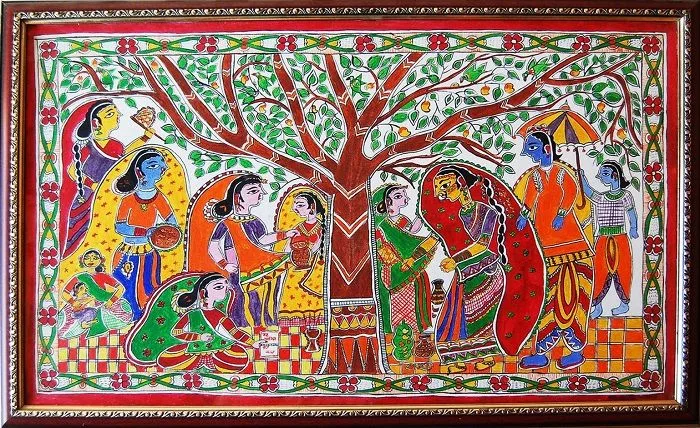
Traditionally, women of the village used to paint on the walls of their homes during marriages, festivals, and religious ceremonies. The themes are mostly related to Hindu gods and goddesses such as Krishna, Rama, Shiva, Durga, and Lakshmi.
Madhubani paintings are known for their bright colors, detailed patterns, and symbolic figures. Fish, peacocks, flowers, trees, and the sun are commonly used symbols. Fish usually represent prosperity and fertility.
Earlier, natural colors made from flowers, leaves, turmeric, rice paste, and soot were used. The paintings were created on mud walls coated with cow dung. Today, they are also painted on paper, cloth, and canvas.
Important features of Madhubani painting include:
- Double-line borders
- Bright and bold colors
- No empty spaces
- Floral and geometric patterns
- Two-dimensional figures without shading
This art form has received GI status because of its unique cultural identity.
Pattachitra Painting
Pattachitra is a traditional painting style of Odisha. The word “Patta” means cloth or canvas, and “Chitra” means picture.
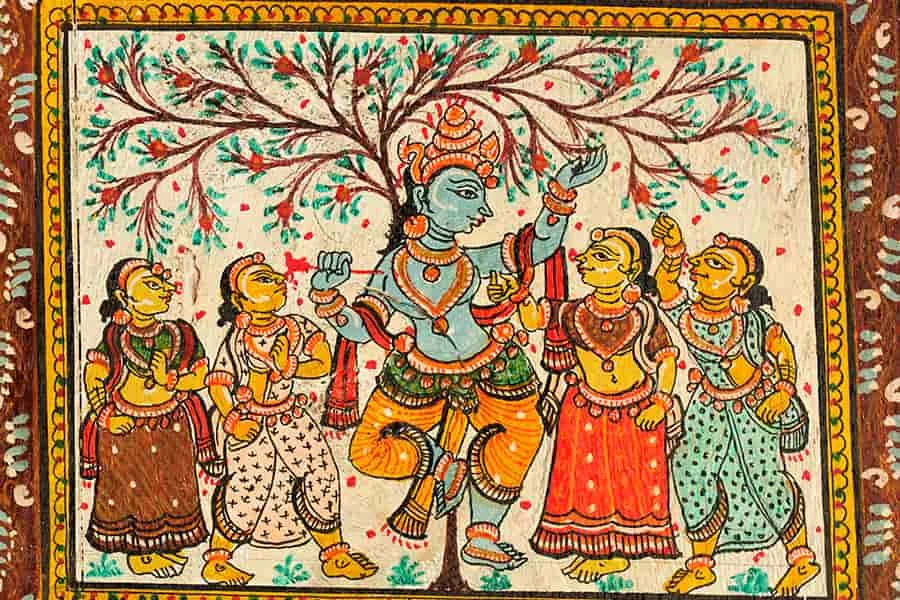
These paintings are mainly based on stories related to Lord Jagannath, Lord Krishna, Vishnu, and other Hindu deities. The paintings combine both folk and classical styles.
Artists prepare the canvas by coating cloth with chalk and gum. Natural colors are made from minerals, stones, and plant materials. Brushes made from animal hair are used for painting.
One important feature of Pattachitra is that artists do not use pencil sketches. The entire painting is created directly using brushes.
Types of Pattachitra include:
- Cloth-based paintings
- Palm leaf paintings known as Talapattachitra
- Wall hangings and decorative artworks
These paintings are famous for their detailed borders, decorative patterns, and mythological themes.
Patua Art
Patua Art belongs to the cultural tradition of Bengal. It is believed to be nearly a thousand years old.
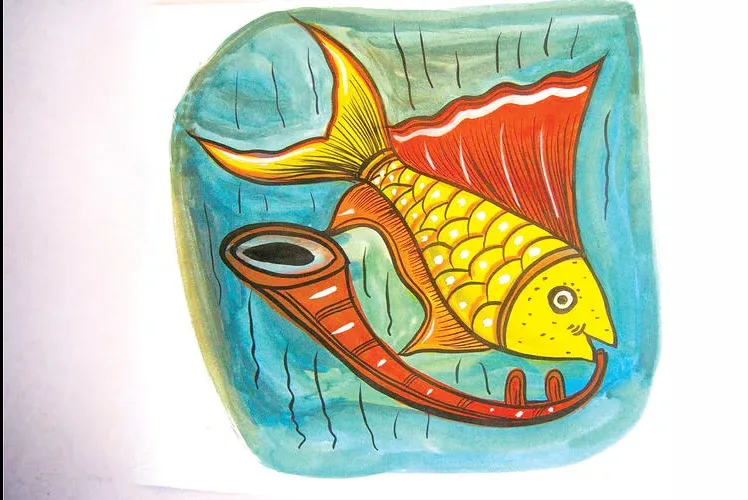
Patua artists paint long scrolls called “pats” and travel from village to village singing stories related to the paintings. These stories are usually based on gods, goddesses, social events, and moral lessons.
Originally, Patua paintings focused mainly on religious themes. However, modern Patua artists also create paintings about political events, social awareness, health, and environmental issues.
Features of Patua Art include:
- Scroll-based storytelling
- Bright poster colors
- Combination of painting and music
- Social and religious themes
This art form reflects the close relationship between art and oral storytelling in Indian culture.
Kalighat Painting
Kalighat Painting developed in Kolkata during the 19th century around the Kalighat temple.
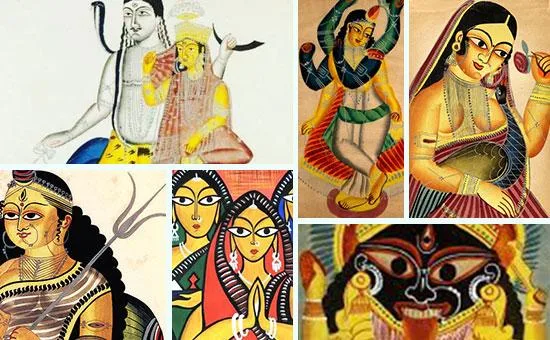
Rural artists who moved to the city began creating paintings for temple visitors. These paintings were made using watercolors on paper.
Initially, Kalighat paintings mainly showed Hindu gods and goddesses. Later, artists started painting scenes from everyday life, social problems, and changing urban society.
Important characteristics include:
- Bold outlines
- Simple background
- Smooth shading
- Expressive human figures
Kalighat paintings are considered one of the earliest examples of modern Indian urban folk art.
Paitkar Painting
Paitkar Painting is a traditional tribal painting style practiced in Jharkhand.
These paintings are closely linked with tribal customs, rituals, and religious beliefs. Stories related to life after death and Goddess Ma Mansa are common themes.
Paitkar paintings are usually created on scrolls using natural colors. The art form is slowly disappearing because fewer artists are continuing the tradition.
Despite its declining condition, Paitkar painting remains an important symbol of tribal culture and storytelling.
Kalamkari Painting
Kalamkari is a famous hand-painted textile art of Andhra Pradesh.
The word “Kalamkari” comes from two Persian words:
- Kalam = pen
- Kari = craftsmanship
Artists use bamboo pens to draw designs on cotton cloth. Natural vegetable dyes are used for coloring.
There are two major styles of Kalamkari:
- Srikalahasti Style – Free-hand drawings based on Hindu mythology.
- Machilipatnam Style – Decorative patterns using blocks and floral designs.
Common themes include:
- Ramayana and Mahabharata stories
- Lotus flowers
- Animals and birds
- Decorative floral patterns
Kalamkari paintings are highly respected for their detailed craftsmanship and eco-friendly colors.
Warli Painting
Warli Painting is an ancient tribal art form practiced by the Warli tribe of Maharashtra and Gujarat.
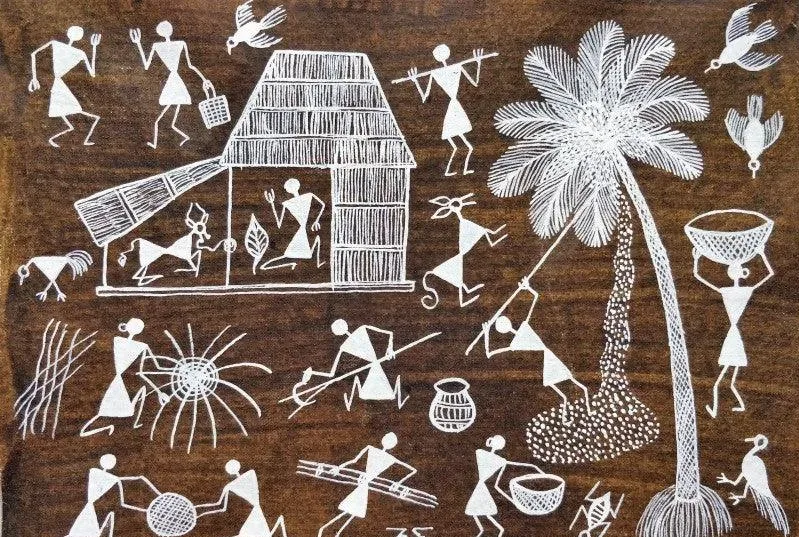
This painting style is believed to be thousands of years old and resembles prehistoric cave paintings.
Warli paintings are simple yet meaningful. They are mostly painted in white on mud walls using rice paste.
The paintings use basic geometric shapes:
- Circle for sun and moon
- Triangle for mountains and trees
- Square for sacred spaces
Human and animal figures are created by joining triangles together.
Themes include:
- Farming
- Hunting
- Dancing
- Festivals
- Nature
Warli paintings beautifully show the close relationship between humans and nature.
Thangka Painting
Thangka Painting is a traditional Buddhist painting found in regions such as Ladakh, Sikkim, Himachal Pradesh, and Arunachal Pradesh.
These paintings are usually made on cotton canvas using natural vegetable and mineral colors.
Thangka paintings are highly spiritual and are used for meditation, teaching, and worship.
Different colors have symbolic meanings:
- White represents peace
- Red represents passion
- Yellow represents compassion
- Green represents wisdom
- Black represents anger
Major themes include:
- Life of Buddha
- Buddhist deities
- Wheel of Life
- Spiritual teachings
Thangka paintings are important parts of Buddhist culture and religious practice.
Manjusha Painting
Manjusha Painting belongs to the Bhagalpur region of Bihar and is also called Angika art.
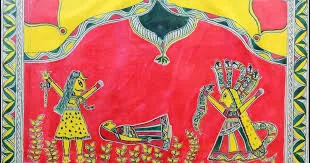
This art form is closely connected with snake worship and stories related to Goddess Bishahari.
Snake motifs are commonly used in these paintings. Artists traditionally paint on boxes made from jute and paper.
The paintings use bright colors and decorative borders, making them visually attractive.
Phad Painting
Phad Painting is a religious scroll painting tradition of Rajasthan.
These paintings are created on long cloth scrolls known as “Phad.” They mainly depict stories of local heroes and deities such as Pabuji and Devnarayan.
Features include:
- Large eyes and round faces
- Bright vegetable colors
- Narrative storytelling scenes
- Processions and celebrations
Phad paintings are often accompanied by songs and storytelling performances.
Cheriyal Scroll Painting
Cheriyal Scroll Painting is a traditional art form of Telangana.
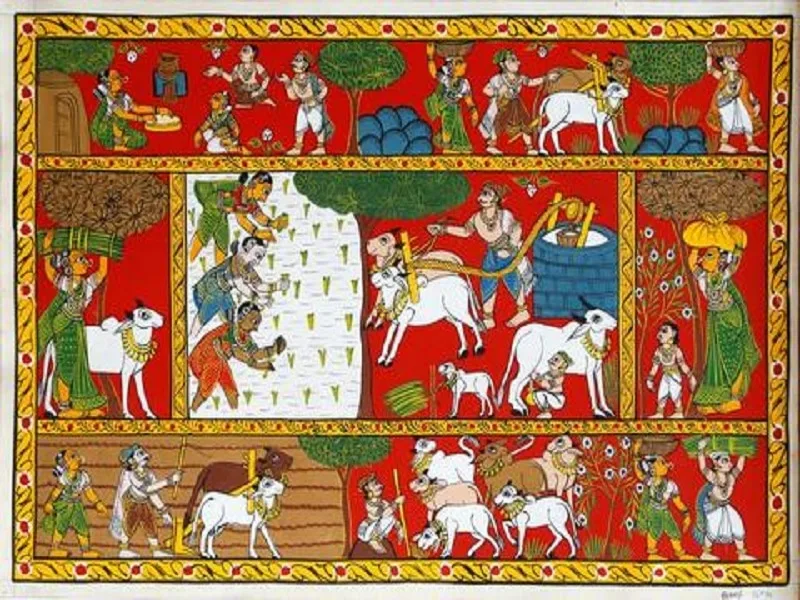
These scroll paintings are created in a comic-like style and are used by storytellers to narrate mythological stories.
The paintings are often very long and colorful. Themes mainly include:
- Ramayana
- Mahabharata
- Puranic stories
- Local folklore
Cheriyal paintings received GI status in 2007.
Pithora Painting
Pithora Painting is practiced by tribal communities in Gujarat and Madhya Pradesh.
These paintings are created on house walls during special family occasions and religious ceremonies.
Animals, especially horses, are common subjects in the paintings. Pithora art is believed to bring peace, happiness, and prosperity.
The paintings have deep spiritual and ritual importance for tribal communities.
Saura Painting
Saura Painting is a ritual wall painting tradition of the Saura tribe of Odisha.
This art form is similar to Warli painting because it uses simple stick-like human figures and geometric shapes.
The paintings are dedicated to Idital, the main deity worshipped by the Saura tribe.
Features include:
- White paintings on red or yellow backgrounds
- Natural mineral and plant colors
- Ritual and spiritual themes
- Geometric human figures
Saura paintings reflect the spiritual life and traditions of tribal communities.
Importance of Indian Folk Paintings
Indian folk paintings are important for many reasons:
Preservation of Culture
These paintings help preserve ancient customs, beliefs, traditions, and stories.
Religious and Spiritual Value
Many folk paintings are connected with rituals, worship, and festivals.
Source of Employment
Folk art provides income and employment to thousands of traditional artists and craftsmen.
Promotion of Tourism
Tourists from around the world visit India to experience its rich artistic heritage.
Educational Value
These paintings teach people about Indian history, mythology, and village life.
Challenges Faced by Folk Paintings
Despite their cultural importance, many folk art traditions face serious challenges.
Decline of Traditional Artists
Young generations are often moving toward modern professions, reducing the number of traditional artists.
Lack of Financial Support
Many artists struggle financially because handmade paintings require time and effort.
Competition from Machine-Made Products
Cheap printed copies reduce the demand for original handmade paintings.
Loss of Traditional Knowledge
As older artists pass away, many traditional techniques and stories are being forgotten.
Steps Needed for Conservation
To protect Indian folk paintings, several steps are necessary:
- Government support and funding for artists
- Promotion through exhibitions and tourism
- Art education in schools and colleges
- Online marketing opportunities for artists
- Preservation of traditional techniques
- Public awareness about cultural heritage
GI tags and cultural programs also play an important role in protecting these art forms.
Conclusion
Indian Folk Paintings of India are a living expression of the country’s rich cultural heritage and artistic traditions. From Madhubani and Warli to Pattachitra and Kalamkari, each painting style reflects the unique identity, beliefs, and creativity of different regions and communities.
These paintings are not only beautiful artworks but also important cultural treasures that connect modern society with ancient traditions. They preserve stories of mythology, daily life, festivals, spirituality, and social values.
Although many folk painting traditions face challenges in the modern world, proper conservation efforts, public awareness, and support for traditional artists can help protect these valuable art forms for future generations.
Indian folk paintings continue to inspire people across the world with their simplicity, beauty, colors, and deep cultural meaning.
FAQs
1. What are Indian folk paintings?
Indian folk paintings are traditional art forms created by local communities that reflect culture, religion, and daily life.
2. Which is the most famous folk painting in India?
Madhubani Painting is one of the most famous folk paintings in India.
3. What materials are used in folk paintings?
Traditional folk paintings use natural colors made from plants, minerals, rice paste, flowers, and mud.
4. What is the main theme of Warli painting?
Warli Painting mainly shows nature, farming, hunting, festivals, and village life.
5. Which state is famous for Pattachitra painting?
Pattachitra belongs to Odisha.
6. What is Kalamkari art?
Kalamkari is a traditional hand-painted textile art made using natural dyes and bamboo pens.
7. Why are folk paintings important?
Folk paintings help preserve India’s cultural heritage, traditions, mythology, and regional identity.
8. Which folk painting is related to Buddhism?
Thangka Painting is related to Buddhist culture and spiritual teachings.