


Delimitation in India: Meaning, Process and Importance

Delimitation in India is an important process in the country’s democratic system. It helps ensure that every citizen’s vote carries equal value and that electoral constituencies are fairly divided according to population changes. Delimitation becomes especially important when there are major demographic changes or administrative reorganizations, such as the reorganization of Jammu and Kashmir into two Union Territories.
Thank you for reading this post, don't forget to subscribe!In recent years, delimitation gained national attention after the bifurcation of the former state of Jammu and Kashmir into the Union Territories of Jammu & Kashmir and Ladakh. This administrative change made it necessary to redraw electoral constituency boundaries to ensure fair political representation.
What is Delimitation?
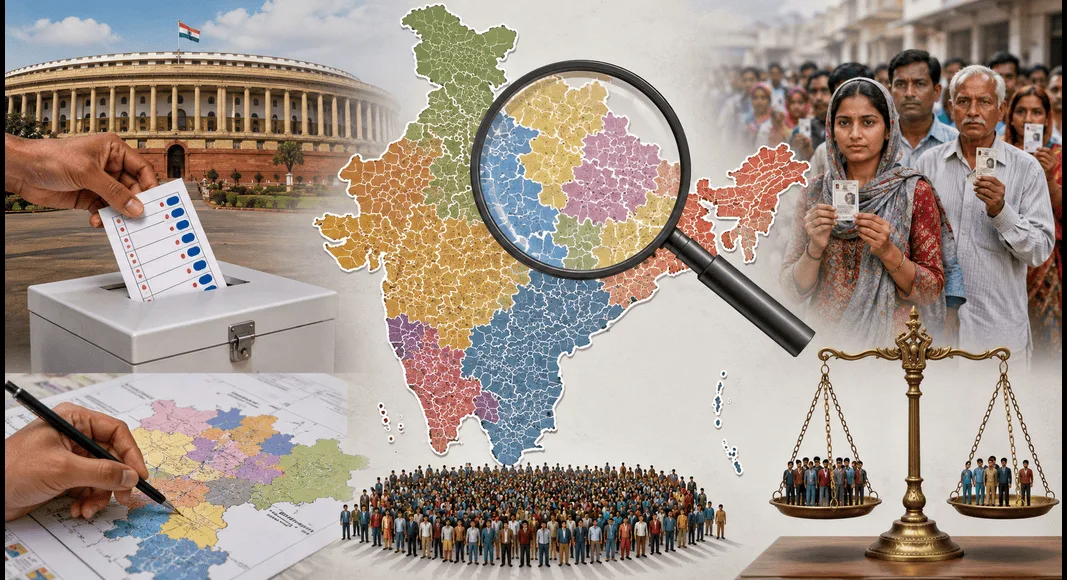
Delimitation refers to the process of fixing or redrawing the boundaries of electoral constituencies based on changes in population.
As populations increase, decrease, or shift from one area to another, constituency boundaries may no longer represent equal numbers of people. Delimitation helps correct this imbalance.
In simple words, delimitation ensures that:
- Every constituency represents a nearly equal population.
- Citizens receive fair political representation.
- Elections remain democratic and balanced.
- No region gains an unfair advantage over another.
The process is carried out periodically after a Census so that electoral boundaries reflect the latest population figures.
Why is Delimitation Necessary?
A democracy functions effectively only when citizens are represented fairly. Population growth is not uniform across all regions. Some areas experience rapid population growth, while others grow slowly.
Without delimitation, constituencies with small populations and those with large populations may elect the same number of representatives. This creates inequality in representation.
Main Objectives of Delimitation
1. Equal Representation
The primary objective is to ensure that each elected representative serves approximately the same number of people.
2. One Vote, One Value
Every citizen’s vote should have equal importance. Delimitation helps maintain this democratic principle.
3. Fair Electoral Competition
Constituencies should be drawn fairly so that no political party gains an unfair electoral advantage.
4. Better Governance
Balanced constituencies allow elected representatives to effectively address the needs of their voters.
5. Representation of Marginalized Communities
Delimitation helps identify constituencies that should be reserved for Scheduled Castes (SCs) and Scheduled Tribes (STs) based on population distribution.
Constitutional Basis of Delimitation
The Indian Constitution provides the legal framework for delimitation.
Article 82
Article 82 states that after every Census, Parliament can enact a Delimitation Act.
This law allows the government to redraw constituency boundaries according to updated population data.
Article 170
Article 170 deals with the division of states into territorial constituencies for legislative assembly elections.
After each Census, states can be reorganized into constituencies according to population changes.
Together, Articles 82 and 170 ensure that parliamentary and assembly constituencies remain representative of the people.
History of Delimitation in India
India has conducted several delimitation exercises since independence.
First Delimitation (1950-51)
The first delimitation exercise was conducted by the President of India with assistance from the Election Commission.
This exercise was necessary because India was preparing for its first general elections.
Delimitation Commission Act, 1952
To create a formal mechanism, Parliament passed the Delimitation Commission Act in 1952.
Since then, separate Delimitation Commissions have been established periodically.
Delimitation Commissions in India
India has established Delimitation Commissions in:
- 1952
- 1963
- 1973
- 2002
Each commission worked on redrawing constituency boundaries based on Census data.
Why Was Delimitation Not Conducted After Every Census?
Although the Constitution provides for delimitation after every Census, it was not conducted after the 1981 and 1991 Censuses.
The reason was linked to population control efforts.
Many southern states successfully implemented family planning programs and achieved lower population growth rates. There were concerns that these states might lose parliamentary seats if delimitation was based strictly on population figures.
To avoid penalizing states that controlled population growth, the number of seats was frozen.
What is the Delimitation Commission?
The Delimitation Commission is an independent and powerful body responsible for carrying out the delimitation process.
It is appointed by the President of India and works closely with the Election Commission.
The commission functions independently and its decisions carry legal authority.
Composition of the Delimitation Commission
The commission generally consists of:
Retired Supreme Court Judge
A retired judge serves as the Chairperson and ensures legal fairness.
Chief Election Commissioner
The Chief Election Commissioner participates to ensure electoral integrity.
State Election Commissioners
Election Commissioners from the concerned states assist in the process.
This combination ensures that legal, administrative, and electoral considerations are properly balanced.
Functions of the Delimitation Commission
The commission performs several important tasks.
Redrawing Constituency Boundaries
The commission redraws parliamentary and assembly constituencies based on population data.
Equal Population Distribution
It attempts to ensure that constituencies have nearly equal populations.
Reservation of Seats
The commission identifies constituencies where SC and ST populations are concentrated and reserves seats accordingly.
Resolving Boundary Issues
It examines geographical, administrative, and social factors while determining constituency boundaries.
Final Decision Making
If commission members disagree, the majority opinion becomes the final decision.
Powers of the Delimitation Commission
The Delimitation Commission is considered a high-powered body.
Its decisions have the force of law.
Important features include:
- Its orders cannot easily be challenged in court.
- Decisions become effective immediately after publication.
- Governments are required to implement its recommendations.
These powers ensure that delimitation remains free from political interference.
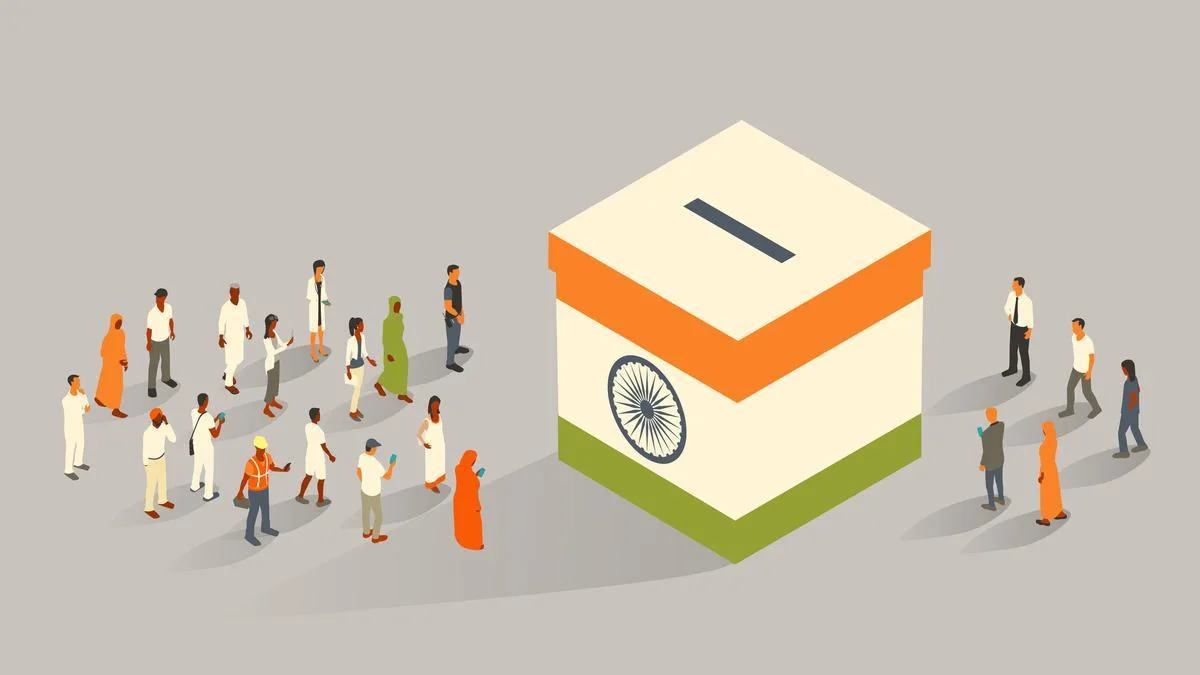
Current Position of Delimitation in India
The most recent major delimitation exercise was conducted under the Delimitation Commission established in 2002.
The process was based on the 2001 Census.
As a result, many constituencies across India were redrawn before the 2009 General Elections.
Out of 543 Lok Sabha constituencies, 499 were affected by delimitation.
However, some states and regions were excluded from this exercise, including:
- Jammu and Kashmir (at that time)
- Assam
- Arunachal Pradesh
- Nagaland
- Manipur
- Jharkhand
Later developments have revived discussions on delimitation, particularly after the reorganization of Jammu and Kashmir.
Delimitation in Jammu and Kashmir
The Jammu and Kashmir Reorganisation Act, 2019 divided the former state into two Union Territories:
- Jammu and Kashmir
- Ladakh
This administrative change required fresh delimitation of constituencies.
The Election Commission and related authorities initiated discussions regarding:
- Redrawing assembly constituencies.
- Adjusting representation.
- Ensuring balanced political participation.
The exercise became important because constituency boundaries needed to reflect the new administrative structure.
Major Challenges of Delimitation
Although delimitation is necessary, it is not free from challenges.
Population Growth Differences
One major issue is uneven population growth among states.
States that controlled population growth may lose political influence if seats are allocated purely on population numbers.
Meanwhile, states with higher population growth could gain more seats.
This creates concerns regarding fairness.
Frozen Number of Seats
The total number of seats in Parliament has remained largely unchanged for decades.
As India’s population has grown significantly, many MPs now represent much larger populations than before.
This reduces the quality of representation.
Regional Imbalance
Some states fear losing political power if future delimitation reallocates seats based solely on population.
This concern is especially strong among southern states.
Political Sensitivity
Delimitation can influence election outcomes.
As a result, political parties often view the process with caution.
Administrative Complexity
Redrawing hundreds of constituencies requires:
- Accurate population data
- Geographic analysis
- Public consultations
- Legal scrutiny
The process is time-consuming and complex.
Delimitation and the Principle of Democracy
A core democratic principle is that every citizen should have equal political influence.
If one constituency contains 10 lakh people and another contains only 5 lakh people, voters in the smaller constituency effectively have greater representation.
Delimitation helps correct such imbalances.
This supports the democratic ideal of:
“One Person, One Vote, One Value.”
By ensuring fair representation, delimitation strengthens public confidence in elections.
Freeze on Delimitation
The Constitution was amended to freeze the allocation of seats based on population.
This freeze was intended to encourage states to continue family planning efforts without fear of losing representation.
The freeze was extended several times and currently remains in place until 2026.
After 2026, India may undertake a major delimitation exercise based on updated Census figures.
This future exercise is expected to have significant political and constitutional implications.
Suggested Reforms
Experts have proposed several reforms to improve the delimitation process.
Build National Consensus
Political parties and state governments should discuss future delimitation openly to avoid conflicts.
Balance Population and Development
Seat allocation should consider both population and development achievements.
Strengthen Data Collection
Reliable Census and demographic data are essential for fair delimitation.
Improve Public Participation
Citizens should be consulted before constituency boundaries are finalized.
Increase Parliamentary Representation
India may eventually need more Lok Sabha seats because of its large and growing population.
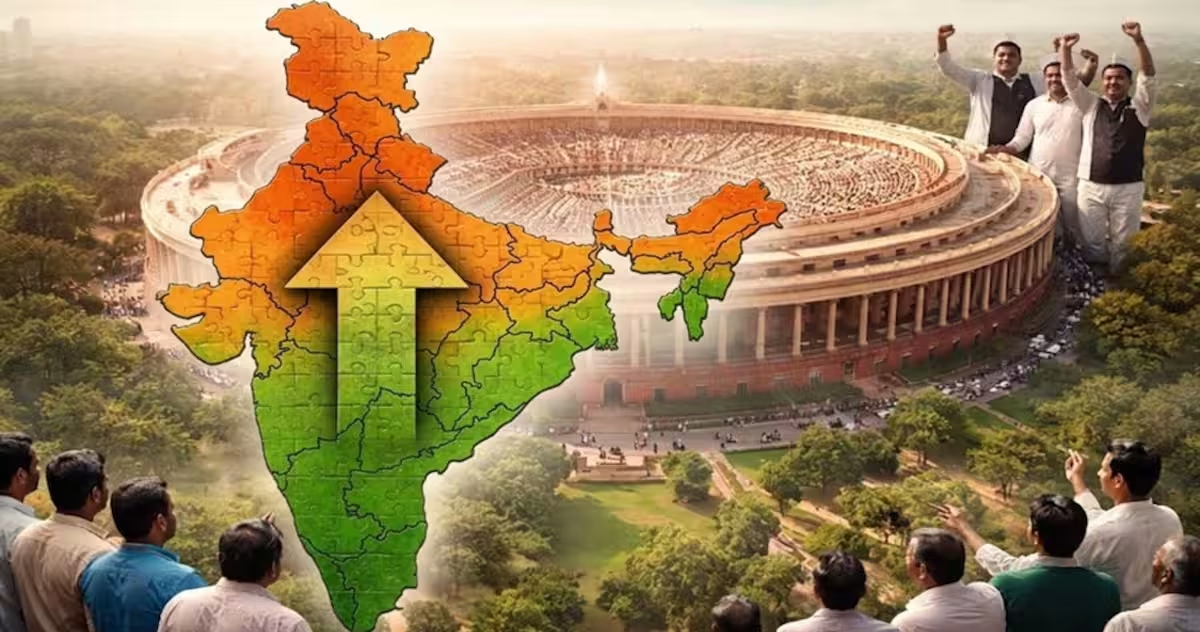
Future of Delimitation in India
The year 2026 is likely to be a turning point in India’s electoral history.
Once the freeze ends, policymakers will face important questions:
- Should parliamentary seats be increased?
- How should seats be distributed among states?
- How can fairness be maintained for states with successful population control programs?
These decisions will shape India’s democratic structure for decades.
A carefully planned delimitation process can strengthen representation, improve governance, and ensure that democracy remains fair and inclusive.
Conclusion
Delimitation in India is a crucial democratic exercise that ensures fair representation of citizens in Parliament and State Assemblies. It involves redrawing constituency boundaries according to population changes so that every vote has equal value.
The Delimitation Commission plays a central role in maintaining electoral fairness by balancing population distribution, reserving seats for marginalized communities, and preventing unequal representation.
While the process faces challenges such as regional imbalances, population differences, and political sensitivities, it remains essential for a healthy democracy. As India approaches 2026, discussions about future delimitation will become increasingly important.
A transparent, balanced, and consensus-based approach will help strengthen democratic institutions and ensure that all citizens continue to enjoy fair political representation in the world’s largest democracy.
FAQs Delimitation in India
1. What is delimitation?
Delimitation is the process of fixing or redrawing the boundaries of electoral constituencies based on population changes.
2. Why is delimitation important?
It ensures fair representation and follows the principle of “One Vote, One Value.”
3. Which constitutional articles deal with delimitation?
Articles 82 and 170 of the Indian Constitution.
4. Who conducts delimitation in India?
The Delimitation Commission conducts the process.
5. Who appoints the Delimitation Commission?
The President of India appoints the Delimitation Commission.
6. How many times has the Delimitation Commission been constituted?
Four times: 1952, 1963, 1973, and 2002.
7. What are the main functions of the Delimitation Commission?
It redraws constituency boundaries and identifies reserved seats for SCs and STs.
8. Can courts challenge the decisions of the Delimitation Commission?
No, its decisions have the force of law and cannot generally be challenged in court.
9. Why was delimitation in Jammu and Kashmir discussed after 2019?
The reorganization of Jammu and Kashmir into two Union Territories made constituency redrawing necessary.
10. When is the next major delimitation exercise expected?
A major delimitation exercise is expected after 2026 when the current freeze on seat allocation ends.