
Statehood Demand: Challenges and Future of New States in India

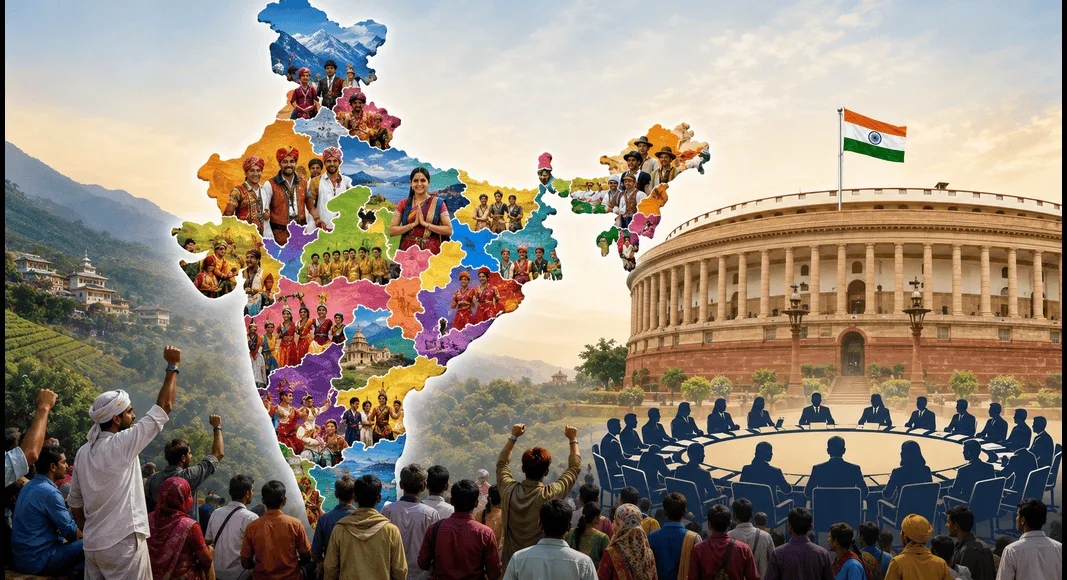
Statehood Demand is an important political and administrative issue in India. Since independence, different regions of the country have demanded separate states for various reasons. In the early years, these demands were mainly based on language, culture, ethnicity, and identity. Over time, the reasons changed, and people began demanding new states for better governance, faster development, administrative convenience, and greater participation in decision-making.
Thank you for reading this post, don't forget to subscribe!India is a vast and diverse country with different languages, cultures, traditions, and geographical conditions. Because of this diversity, managing every region from a single state government can sometimes become difficult. Many regions feel neglected and believe that separate statehood can help solve their problems.
The creation of states like Chhattisgarh, Jharkhand, Uttarakhand, and Telangana shows that statehood demands continue to shape India’s federal structure. As democracy grows stronger, people become more aware of their rights and demand better governance and development.
What is Statehood Demand?
Statehood Demand refers to the demand made by a particular region or group of people for the creation of a separate state within India.
People generally demand a new state when they feel that:
- Their region is neglected.
- Development is uneven.
- Administrative services are poor.
- Their language, culture, or identity is not receiving proper recognition.
- Local resources are not being used for regional development.
Such demands are common in large and diverse countries where different regions have unique needs and aspirations.
Historical Background of State Reorganization in India
Demand for Linguistic States
Soon after independence, people demanded that states should be organized according to language.
One of the most significant movements was led by Potti Sreeramulu, who demanded a separate state for Telugu-speaking people. He went on a hunger strike, and after his death in 1952, widespread protests erupted across the region.
As a result, the Government of India created Andhra State in 1953, making it the first state formed on a linguistic basis.
States Reorganisation Commission (SRC)
To address similar demands across the country, the government established the States Reorganisation Commission in 1953.
Based on its recommendations, the States Reorganisation Act, 1956 was passed.
Under this Act:
- 14 states were created.
- 6 Union Territories were formed.
This marked the beginning of systematic state reorganization in India.
Timeline of Major State Reorganizations
1960 – Maharashtra and Gujarat
The bilingual Bombay State was divided into:
- Maharashtra (Marathi-speaking)
- Gujarat (Gujarati-speaking)
1963 – Nagaland
Nagaland was separated from Assam and became a new state.
1966 – Haryana and Himachal Pradesh
Punjab was reorganized, resulting in the formation of:
1972 – Meghalaya, Manipur, and Tripura
These regions received full statehood.
1975 – Sikkim
Sikkim became a part of India and later gained statehood.
1987 – Goa and Arunachal Pradesh
Both became full-fledged states.
2000 – Three New States
Three important states were created:
- Chhattisgarh from Madhya Pradesh
- Uttarakhand from Uttar Pradesh
- Jharkhand from Bihar
2014 – Telangana
Telangana was carved out of Andhra Pradesh and became India’s 29th state.
Major Statehood Demands in India
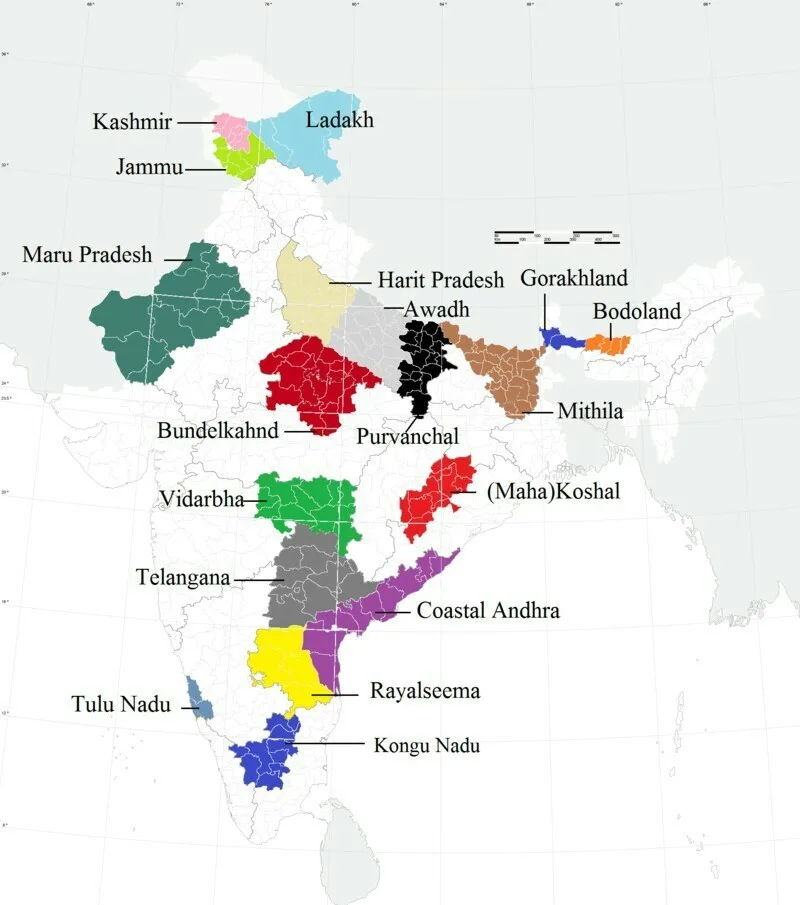
Even today, several regions continue to demand separate statehood.
Vidarbha
Vidarbha is located in eastern Maharashtra and includes Nagpur and Amravati divisions.
Reasons for Demand
- Agricultural distress
- Farmer suicides
- Perceived neglect by Maharashtra government
- Uneven development
Supporters argue that a separate state would improve governance and development.
Gorkhaland
Gorkhaland is proposed in the Darjeeling and Dooars regions of West Bengal.
Reasons for Demand
- Distinct ethnic identity
- Nepali-speaking population
- Cultural recognition
- Better administration
The demand has led to several movements and protests over the years.
Bodoland
The Bodo community in Assam has long demanded a separate state.
Developments
The movement led to the creation of the Bodoland Territorial Council (BTC) under the Sixth Schedule of the Constitution.
However, some groups still demand full statehood.
Harit Pradesh
Harit Pradesh is proposed in western Uttar Pradesh.
Reasons
- Agricultural dominance
- Better governance
- Regional development
- Administrative efficiency
Purvanchal
Purvanchal covers eastern Uttar Pradesh.
Reasons
- Poverty
- Poor infrastructure
- Lack of industrial development
- High population
Supporters believe a separate state can focus on local development.
Bundelkhand
Spread across Uttar Pradesh and Madhya Pradesh, Bundelkhand faces:
- Water scarcity
- Poverty
- Unemployment
Many people believe statehood could help address these issues.
Saurashtra
Saurashtra is a region in Gujarat.
Reasons for Demand
- Water shortages
- Limited industrial growth
- Regional imbalance
- Youth migration
Full Statehood for Delhi
Delhi currently enjoys special status under Article 239AA.
However, important subjects such as:
- Police
- Public Order
- Land
remain under the Central Government.
Supporters of full statehood argue that the elected government should have complete control over these areas.
Constitutional Provisions for Creating New States
The Indian Constitution provides a clear mechanism for state reorganization.
Article 3
Article 3 empowers Parliament to:
- Create new states.
- Alter state boundaries.
- Change state names.
- Merge states.
- Divide states.
Procedure
Step 1: Presidential Reference
The proposal is sent to the concerned State Legislature by the President.
Step 2: Opinion of State Legislature
The State Legislature discusses the proposal and gives its views.
It is important to note that Parliament is not bound by the state’s opinion.
Step 3: Introduction of Bill
A Bill is introduced in Parliament.
Step 4: Parliamentary Approval
If Parliament passes the Bill by a simple majority, the new state can be created.
This process demonstrates the strong role of Parliament in India’s federal structure.
Reasons Behind Statehood Demands
1. Regional Backwardness
Many regions feel neglected compared to other parts of the state.
People believe a separate government would focus more on local needs.
2. Administrative Convenience
Large states often face administrative difficulties.
Smaller states can:
- Improve governance
- Increase efficiency
- Deliver public services faster
3. Economic Development
Regions rich in natural resources often feel they do not receive a fair share of development benefits.
Separate statehood is seen as a solution.
4. Cultural Identity
People seek recognition and protection of their:
- Language
- Traditions
- Customs
- Heritage
5. Political Representation
Smaller states may allow local communities to participate more effectively in governance.
6. Employment Opportunities
People believe a separate state can create more local jobs and industries.
7. Resource Allocation
Many regions complain that taxes and resources generated locally are used elsewhere.
This creates resentment and fuels statehood movements.
8. Sons of the Soil Sentiment
Local populations often demand priority in jobs, education, and development opportunities.
This feeling sometimes strengthens demands for separate states.
Advantages of Creating New States
Better Governance
Smaller states are often easier to manage.
Government officials can focus more closely on local problems.
Faster Development
A separate state government can prioritize regional needs.
Improved Administration
Administrative services become more accessible to citizens.
Greater Public Participation
People feel more connected to their government.
Recognition of Identity
Separate states can help preserve local culture and traditions.
Challenges of Creating New States
Although statehood may bring benefits, it also creates several challenges.
Rise of Regionalism
New states may encourage further regional demands.
Resource Disputes
Disagreements can arise regarding:
- Water sharing
- Electricity
- Minerals
- Revenue
Boundary Conflicts
New borders may lead to territorial disputes.
Financial Burden
Creating a new state requires:
- New capital city
- Government buildings
- Administrative infrastructure
This involves huge expenses.
Political Instability
Smaller states may face unstable coalition governments.
Dominance of Local Elites
Power may shift from one capital city to another without benefiting ordinary people.
Intra-Regional Conflicts
Different communities within the new state may begin competing for resources and political influence.
Important Examples
Telangana
The creation of Telangana in 2014 is one of the most successful examples of a statehood movement.
Supporters argued that:
- Development was uneven.
- Telangana’s resources were not adequately utilized.
- Local aspirations were ignored.
The movement eventually resulted in the formation of India’s newest state.
Jharkhand
Jharkhand was created in 2000 due to:
- Tribal identity
- Resource-rich economy
- Development concerns
The state continues to work on improving socio-economic indicators.
Uttarakhand
Mountain regions demanded separate statehood because administrative decisions taken from distant capitals did not suit local needs.
Statehood improved focus on hill development.
Statehood and Federalism
India follows a federal system where powers are shared between the Centre and States.
State reorganization demonstrates the flexibility of Indian federalism.
Instead of suppressing regional aspirations, the Constitution provides democratic ways to address them.
This has helped maintain national unity while respecting regional diversity.
Way Forward
Statehood demands should be handled carefully and objectively.
Focus on Development
Economic and social development should be the primary consideration rather than political interests.
Clear Guidelines
The government should establish clear criteria for creating new states.
Strengthen Local Governance
Empowering:
- Panchayats
- Municipalities
- District administrations
can solve many problems without creating new states.
Fair Resource Distribution
Balanced development can reduce feelings of neglect.
Promote Cooperative Federalism
The Centre and States should work together to address regional concerns.
Avoid Identity-Based Divisions
Development, governance, and administrative efficiency should be the main basis for statehood rather than religion, caste, or language alone.
Conclusion
Statehood Demand remains an important feature of Indian democracy. From Andhra Pradesh to Telangana, state reorganization has played a major role in shaping modern India. While separate states can improve governance, development, and representation, they can also create new administrative and political challenges.
Therefore, demands for new states should be examined carefully on the basis of economic viability, administrative efficiency, and public welfare. India must continue balancing regional aspirations with national unity. A thoughtful and democratic approach to statehood demands will help strengthen both federalism and inclusive development in the country.
FAQs on Statehood Demand
1. What is a statehood demand?
A statehood demand is a request by a region or group of people for the creation of a separate state within India.
2. Why do people demand separate states?
People demand separate states for better governance, development, cultural recognition, and administrative convenience.
3. Which was the first state created on a linguistic basis in India?
Andhra Pradesh was the first state created on a linguistic basis in 1953.
4. Which Article of the Constitution deals with the creation of new states?
Article 3 of the Indian Constitution deals with the creation and reorganization of states.
5. What is the role of Parliament in creating a new state?
Parliament has the authority to pass a law for creating, merging, or altering state boundaries.
6. What are some major statehood demands in India?
Vidarbha, Gorkhaland, Bodoland, Purvanchal, Bundelkhand, Harit Pradesh, and full statehood for Delhi are major demands.
7. Why was Telangana created?
Telangana was created in 2014 due to demands for better development, governance, and regional representation.
8. What are the benefits of creating smaller states?
Smaller states can improve administration, development, public services, and local participation in governance.
9. What challenges arise from creating new states?
Challenges include resource disputes, financial costs, political instability, and boundary issues.
10. Does creating a new state guarantee development?
No, development depends on good governance, effective policies, and proper use of resources.